
 |
The Quest for the Perfect Game - Reviews to Extract the Essence of Games by Nicholas Hjelmberg | |






















|
Tigris & Euphrates - The Perfect Game? (Published 24 August 2014)This review has also been published at Boardgamegeek. Is it possible to fall in love with a game before even playing it? It all started when I casually browsed around the Boardgamegeek top list one day. I had no intentions to find a new game - I already had more games than time. Besides, reading the negative critics (which is a best way to judge a game, second only to actually play it), they all seemed to be too much of something. Agricola was too solitaire, Through the Ages was too long, Terra Mystica was too much of a counting exercise, Puerto Rico had too little interaction, Eclipse was too random and so on. But then I found a game that seemed to balance everything. Here was an element of go, where you woud place tile to create kingdoms and score points from them. Here was an element from chess, where you would maneuver your pieces for attack and/or defense. Here was an element of the classical civilization building, where you would improve your kingdom through monuments and buildings. However, this was not a peaceful game without player interaction. Conflicts came in two interesting shapes. In internal conflicts you would plant your dynasty members in your opponents' kingdoms with the objective of overthrowing them and reap the benefits for yourself. In external conflicts the clashes of expanding borders might form one stronger kingdom for a winner or leave the two kingdoms weaker after the fierce strife. But it did not end there. There was no such thing as "your" kingdom, they were only there to serve your dynasty's interests (i.e. generate victory points) and might (should!) be abandoned when they no longer served any purpose. Finally, in this chaos of rising and falling civilizations you would need to find a balanced growth because it was not your strongest area that awarded you the victory, it was your weakest area. The game seemed to be so simple and yet the depth of the gameplay so immense. I am of course talking about Tigris & Euphrates. But let us start with an overview of the rules. You are a leader of a dynasty in the Ancient Fertile Crescent. At your disposal, you have a king (black), a priest (red), a trader (green) and a farmer (blue). The land is represented by a checkered map and the kingdoms by adjacent tiles in the same colors as your leaders. The objective of the game is to score victory points, again in the same colors as your leaders. You start with six tiles (which are replenished at the end of each turn) and may carry out two of the following actions:
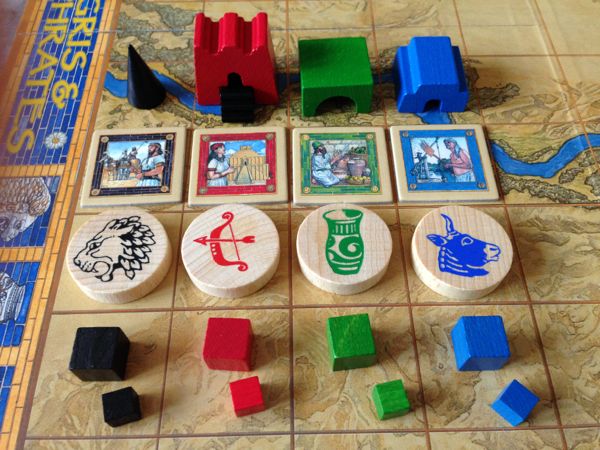
This is the peaceful part of the game where you build kingdoms. The aggressive part is when leaders of the same color end up in the same kingdom. Leaders of different colors can co-exist in a kingdom, even if belonging to different players, but leaders of the same color results in a conflict. Internal conflicts take place when leaders are placed and are fought with red tiles. The leaders gain strength from adjacent red tiles and may add tiles from their hand. External conflicts take place when tiles are placed so that kingdoms merge. The leaders gain strength from tiles of their color in their "half" of the kingdom and may add tiles from their hand. The loser is removed (and, in the external conflict, all supporting tiles), and the winner gets victory points for each removed leader and tile. Each of the four colors have special abilities:
Victory points may also be earned from monuments (and, in the advanced rules, from buildings and the ziggurat). Those can be built when tiles of the same colors are grouped in certain ways (in a square of four to build monuments etc.) and earn points to the leader or leaders of that color. At the end of the game, the player with the most victory points in his or her worst color (i.e. the player with the most balanced score) wins! Let us now continue to see how those rules make Tigris & Euphrates so special. (The list is based on the criteria for a fun game listed by Wolfgang Kramer, designer of El Grande among others.)
Some reviewers warn that Tigris & Euphrates require some sessions to reveal its secrets but either my first session proves the opposite or there is much more to discover. The session started quietly with the Lion settling in the Northeast corner and the Archer in the Northwest while the Potter and the Bull got into an early fight for the South. The Lion took advantage of the fight and built a serpent-like kingdom in the East, claiming two treasures and building the first temple. So far, it was a standard civilization game with a first- mover advantage. But then came a series of conflicts, culminating in devastating external conflicts that stretched from the Northeast to the Southwest, swept away three leaders and left the Lion kingdom scattered and the monument abandoned in a desolated land. Never before in my gaming experience have I seen such a turn of events. Survivors fled to the prospering Arrow kingdom in the Northwest and dynasties replaced each other but in the end, the Arrow dynasty emerged as the winner.
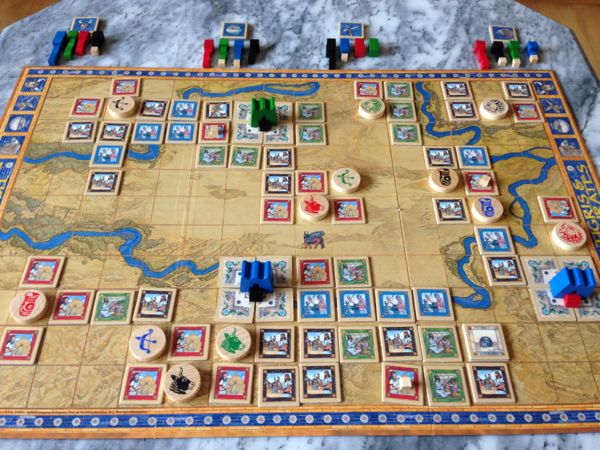
Note that the end position contains a newbie error - can you spot it? To sum up, Tigris & Euphrates satisfies all criteria for a fun game. Each session is unique as tiles are placed and removed on the game board. Leaders will come and go and kingdoms will carefully expand until the time is ripe for a confrontation. Players will be veering between hope and despair as the kingdoms rise and fall in the Ancient Fertile Crescent. There are few games that give such a complete gaming experience like Tigris & Euphrates and in my opinion it is truly the perfect game. |
|