 |
The Quest for the Perfect Game - Reviews to Extract the Essence of Games by Nicholas Hjelmberg | |

















|
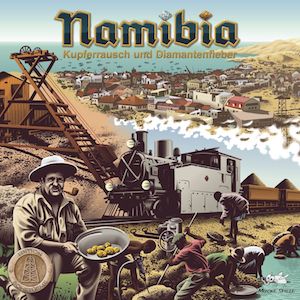
Namibia - An Unpolished Gem Hidden in the Desert (Published 27 September 2021)This review has also been published at Boardgamegeek. IntroductionNamibia caught my interest when I was looking for game components at Spielmaterial. The game is part of the so called Edition Bohrtürme, a game designer contest where the games had to use the components of Giganten. The winner in the category "more complex games" was Namibia. In Namibia, the players take on the roles of mining corporations, competing to prospect, extract, and transport the four resources of copper, silver, gold, and diamonds (and uranium in the expansion) during the colonial era. What makes this game different from many similarly themed games is the way one player's actions may set up opportunities for the next player. Resources, rails, and ports are placed by individual players but may be used by all players. Or, to be more specific, the first player to take the opportunity. Let's take a closer look at the game's structure. 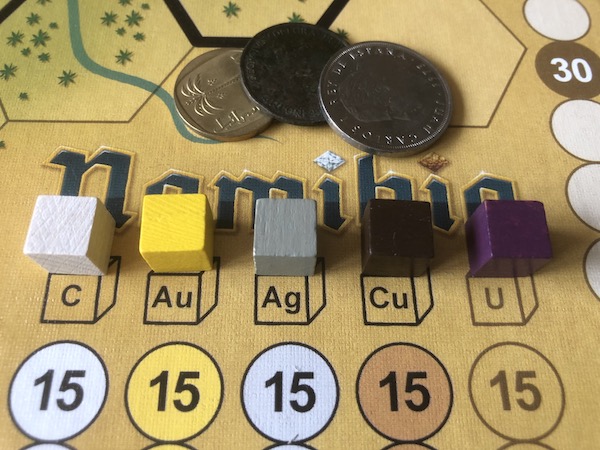
Diamonds, gold, silver, copper, and uranium waiting to be prospected, extracted and transported. The Rounds and Phases of NamibiaNamibia is played over six rounds, each of which is divided into four phases. Similar to games like Tinners' Trail, money may be exchanged for victory points at the end of some rounds at a diminishing rate. Thus, the players have to balance their economy to maximize their victory points while keeping enough money for future expenses. Besides victory points, money is used only for one decision but that's an agonizing one: the dollar auction. Phase 1: The Dollar AuctionEach round starts with a dollar auction for turn order. This means that all bids are lost, whether you win the auction or not. The dollar auction has been criticized by some but works well in Namibia since each place in the turn order has its pros and cons. 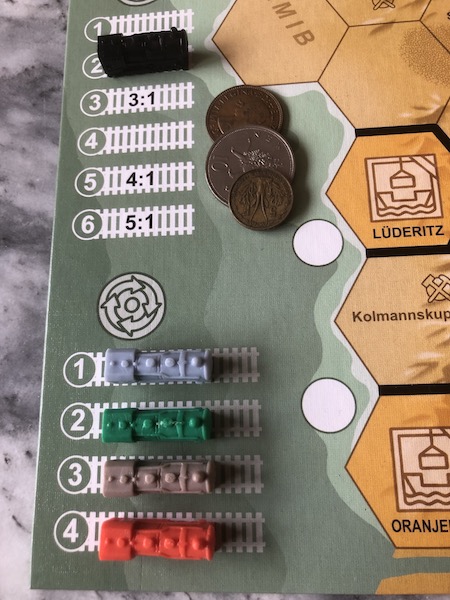
Thematically, the dollar auction is a bribe to the colonial administration, which gives you short-term benefits but damages your long-term reputation. Gamewise, it provides plenty of opportunities for negotiations, freeriding, and backstabbing. Should I bid high to connect my mines or can I rely on a competitor to do it for me? Should I bid high and aim for a port and resource that only benefit me or can I go later in turn order and freeride on another player's selection? Or perhaps I should bid low to set up better market and mining opportunities for the next round? There is no worst place in the auction as long as you can match it to your strategy. Let's look closer at what you can do with your turn order. Phase 2: The Infrastructure (mine, prospect, rails, truck)Mining in Namibia is a three-step process. First you prospect, which means that you place one resource cubes in an empty area or two resource cubes if there are similar resources next to it (i.e. you extend a seam). Then you place a mine laid down in an area (i.e. you start a mine). Finally you place your laid down mines in an upright position (i.e. the resources have been excavated and are ready to transport). Unfortunately the process isn't as simple as it sounds since you have to take the actions in opposite order. Prospected resources round 1 can't be mined until round 2 and can't be transported until round 3. This means that you can't be sure that your prospected resources will be mined by yourself, nor can you be sure that those valuable resources you mined will be as valuable by the time you get to transport them. To be successful in the Namibian copper rush and diamond fever, you need planning and negotiation skills - or simply a good gut feeling. There is also another important limitation in Namibia. Each player has a unique resource which they may not prospect or mine. This reduces the competition a bit but also the negotiation space, since not all of the game's "currencies" are of interest to everybody. Beware, this resource is only indicated on a player summary that's not included in the game but has to be printed out separately so the rule is easily missed. 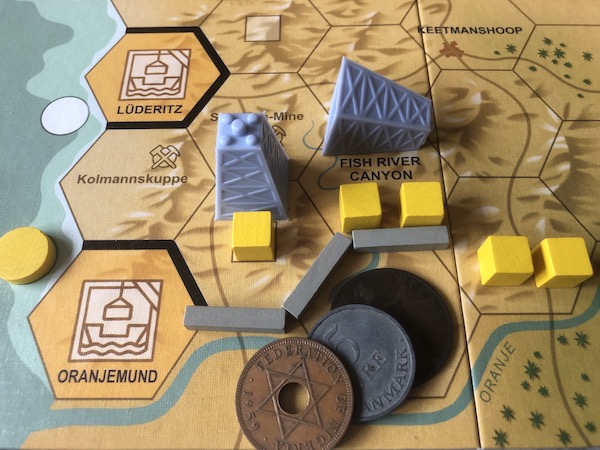
Blue has mined gold outside Oranjemund, started a gold mine in Fish River Canyon, and prospected more gold further out along the Oranje River. The mines are connected through rail to Oranjemund, from where gold will be transported this round. But getting the resources out of the ground is only the first step on the way to the money (and victory points). Let's now move on to the transport. Phase 3: The TransportResources are converted into money in the transport phase. However, besides excavated resources there are several requirements that have to be fulfilled. First, the player in turn must choose one of the four resources to be transported and one of the four ports to receive the resource (and each port and resource can be chosen only once). Second, there must be a mean of transport between the mine and the port. This may be either a truck (placed in the infrastructure phase and with a resource capacity of one) or a rail connection (along the rails placed in the infrastructure phase and with an unlimited resource capacity). While the trucks are personal, the rail network may be used by all players. The latter part differs from many other pick-up and deliver games such as Age of Steam, where rails are owned and where the owner either has exclusive right to it or gets a benefit if it's used by another player. In Namibia, it's the selection of port and resource that provides this benefit. For each other player's truck or mine that transports to "your" port, you get two victory points. Thus, the question you have to ask yourself is whether it's better to be nice and get this benefit or to be mean and leave your opponents' resources unsold in the Namibian dust. But selling resources isn't always a good thing. There is also a resource market with fluctuating prices to take into account. Phase 4: The MarketMost game resource markets have one token for supply, demand, and price, whereby each resource bought or sold affects the price. Namibia has three separate tokens for this, something I haven't seen in other games. As long as the supply is less than or equal to the demand, you get a fixed price per resource. However, as soon as the supply exceeds the demand, the price is halved while the demand increases by two. If, on the other hand, the supply remains less than the demand when the transport phase is completed, it is the demand that is halved and the price that increases by two. In the case where supply and demand balance each other, both price and demand increases by one, and in the case where a resource is not selected for transportation at all (remember that the last player in turn order may not choose a resource), both price and demand increases by three. Thus, we have market with plenty of opportunities for manipulation. Perhaps it's best for the players to cooperate to keep the market in balance to slowly but steadily push price and demand upwards? But what if one player breaks the agreement and dumps her resources? Should you then try to push the prices upwards again before transporting or increase your production to take advantage of the higher demand? On the other hand, the number of mines per player is limited so perhaps you have to sell at the lower price to free your mines for future prospects?
The diamond price is halved and the demand increased by two, the gold price is increased by two and the demand is halved, the silver price and demand increase by one, and the copper price and demand increase by three. The good Challenges of NamibiaTo summarize so far, there are many challenges of Namibia.
The less good challenges of NamibiaSo what's not too like about Namibia? One thing which has been criticized by some is the dollar auction, since you may end up paying for something you don't want. This may be true in real life dollar auctions but not in Namibia. Not only do all players get something for their bids but there is also an interesting tension when some players want to go first while others are happy to go last. Should you start a bidding war, and let the "passers" get relatively more money left, or should you pass, and let the "bidders" get their turn order positions too cheaply? More critical is the perceived lack of control. Although there is no randomness in the game, the fact that you do things "in the wrong order" puts much of your fate in the hands of your opponents. If you want to enter the gold market next turn, you must either trust your opponents not to "steal" your prospected gold or to prospect more gold so that there's enough for you too. With this view, Namibia turns into a tactical game of opportunities. My counterargument is that you can't play your own tactical game and focus on one resource at the time. Instead, you have to think strategically of all resources and ensure that prices and infrastructure work against the other players' interests. I don't say it's easy but if you fail, you can't blame bad luck. Unfortunately there is one challenge that is less easy to defend. I usually don't care much about the components but the ones in Namibia do not make the game justice. They don't fit the theme (oil rigs for mines and so on), they are too large for the map (which is a pity since the game comes in a commendably compact box), and the rather terrible coins don't even have values. I do hope Namibia gets a better reprint but while waiting, don't let the game's looks deceive you. 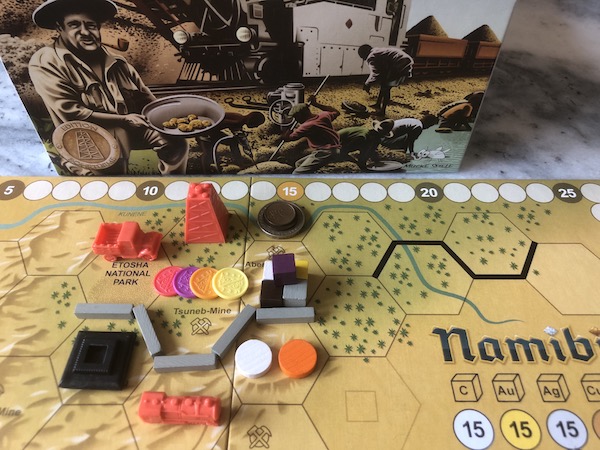
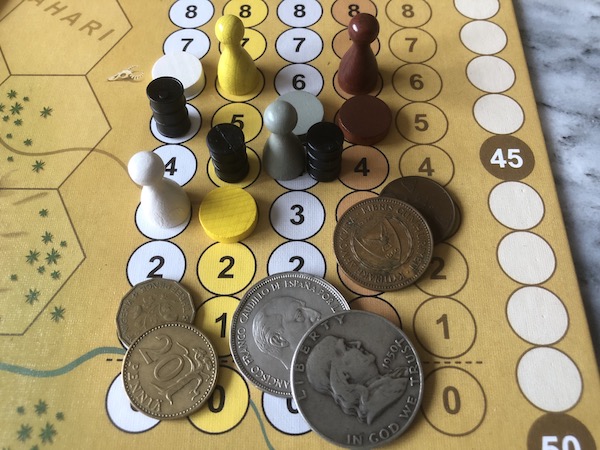
Sturdy but oversized and unthematic equipment, lousy coins, and some strange color choices (an orange disc for the red player). ConclusionNamibia is something of a hidden and unpolished gem, waiting to be discovered in the desert. It's a highly interactive and competitive economic game which features not only shared infrastructure and incentives but also a unique market mechanic where three parameters can be manipulated - supply, demand, and price. The phased turns of Namibia may give the impression of a less streamlined game than most comparable cube rail games but many phases only consist of upkeep so the downtime between turns is acceptable. The many decisions concerning bidding, resources, infrastructure, and markets are all agonizing, something that may not appeal to everybody. However, if you're into cutthroat economic games where your actions impact all players, Namibia may find a unique space in your collection. 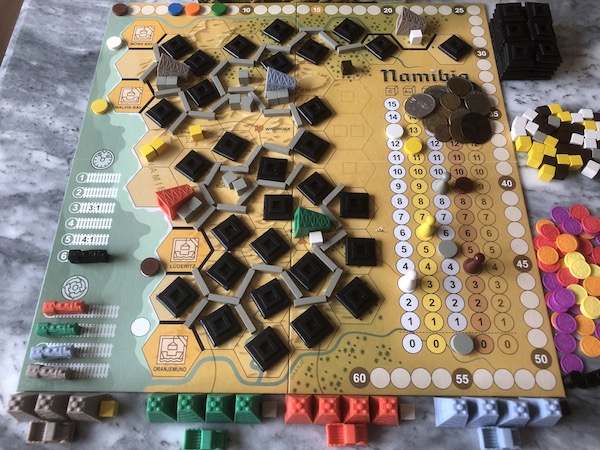
A crowded end game of Namibia, where most of the resources have been excavated and where the three top players ended up very close to each other. |
|