
 |
The Quest for the Perfect Game - Reviews to Extract the Essence of Games by Nicholas Hjelmberg | |








































|
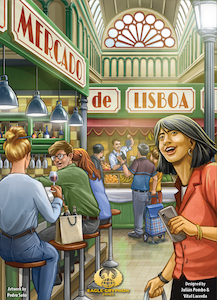
Mercado de Lisboa - A Tribute to Lisboa (Published 31 August 2020)This review has also been published at Boardgamegeek. Disclaimer: Mercado de Lisboa has not been published yet but thanks to a Tabletopia implementation I've been able to play it virtually. The Origins of Mercado de LisboaBig games are sometimes described as several more or less interlocking small games. In the worst case scenario, those small games are isolated or simply not interesting. In the typical Lacerda game on the other hand, they are so intertwined that a butterfly flapping in one game results in hurricanes in other games and it usually takes some games to understand how to master this apparent chaos. So what does all this have to do with a filler game like Mercado de Lisboa? The answer is that the game is built upon the Lisboa city-building system, one of several mini games in this big game so to speak. At the risk of oversimplification, the cost of placing a player building in Lisboa is dependent on other placed buildings and the benefit is dependent on public buildings at the ends of the row and column. This creates an elegant and interactive challenge where the players have to be on their toes all the time to predict the real estate market fluctuations and manage their resource portfolios to take advantage of them. 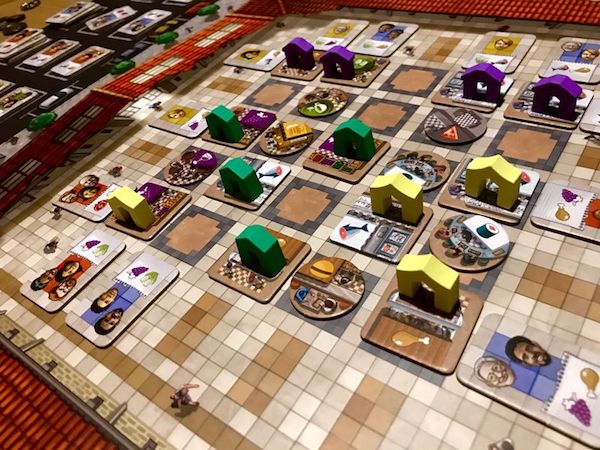
The 5x5 square grid representing Mercado de Lisboa. (Courtesy of BGG user beaverproject.) The Game of Mercado de LisboaIn Mercado de Lisboa, this mini game has been converted into four simple actions:
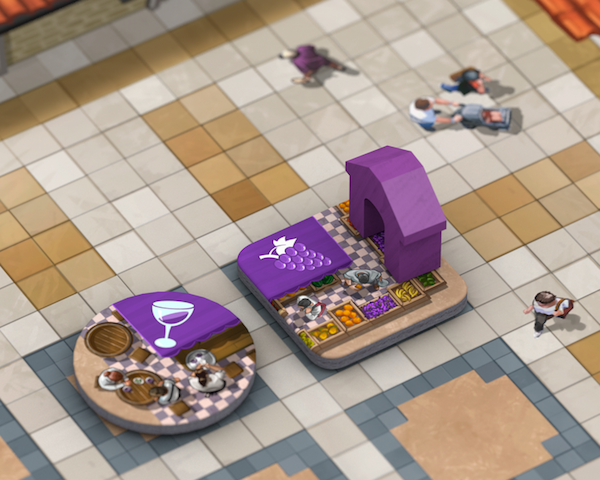
A winery with an adjacent matching fruit stand. (Courtesy of BGG user newrev.) The costs and revenues of those actions are equally simple and mathematically elegant:
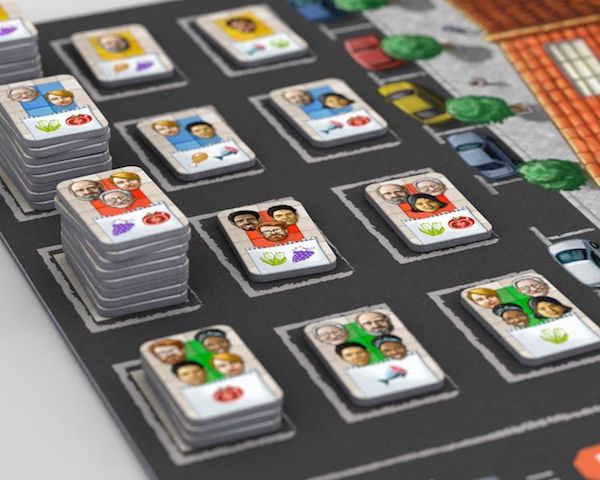
Eager mercado customers in groups of up to four people. (Courtesy of BGG user newrev.) To take an example, three customers looking for tomatoes may be placed on rows or columns with AT LEAST three stands and will generate two times three equals six coins for EVERY tomato stand adjacent to one pizza restaurant. Note that it does not matter whether the stand tile or the customer tile is placed first - the stand will earn money in both cases. The game end is triggered when there are only four spaces left for stands or customers, after which the remaining players play one more turn. The player with the most money wins. The Challenges of Mercado de LisboaSo how does those simple mechanics translate into an interesting gameplay? First of all, Mercado de Lisboa offers the classical euro switch between money and victory points. Although there are no victory points in this game, there is still a decision between investing for future gains and cashing in the returns of your investments before the game ends. It's very tempting to place a fourth stand in a row to enable the placement of four customer tiles but is it worth the cost of four coins? There is also the challenge of scarce resources, at least initially, where you have to take weaker actions now to afford stronger actions in the future. Each stand can only attract customers four times (two from the row ends and two from the column ends). Placing only one or two customers in such a valuable space feels like a waste but may be necessary to get money. Even the "emergency solution" of taking one coin may make sense if you need money but don't want to give the other players opportunities. This leads us to the most important challenge of Mercado de Lisboa: every single space of the board is important and once used, it cannot be used again. Placing many stands in a row may sound like a good strategy but what if another player in the same row takes advantage of you by placing a big customer tile with customers demanding another good? Placing restaurants can dramatically increase the value of your adjacent stands but will naturally attract opponent stands leeching off your efforts. Placing customers will earn you money but may earn opponents money as well. 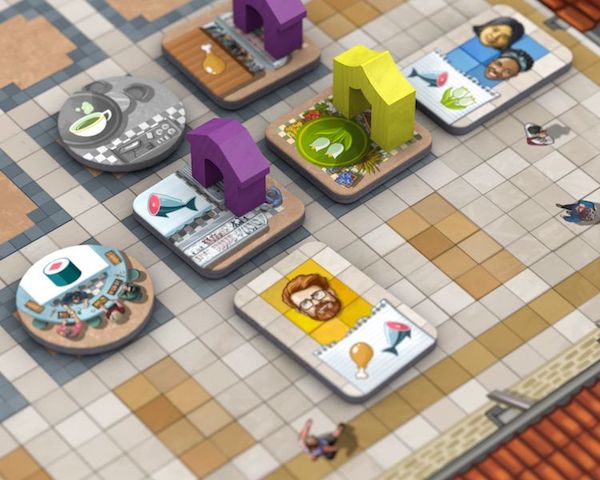
A customer looking for fish earns the purple fish stand 2 coins but blocks other customers from using the same entrance. (Courtesy of BGG user newrev.) That said, the game does not only come from the competition - it is possible to play Mercado de Lisboa solo as well. The solo game consists of a number of challenges where the absence of opponents restricting your decision space has been filled with component restrictions. One example is that you may only earn money from one type of stand. Another is the use of only a subset of the customer tiles. Although not comparable with "real opponents", those hurdles do provide similar challenges and should appeal to solo players as well. But is Less really More?We have discussed the many meaningful decisions and agonizing challenges but surely there are some flaws? One possible flaw is that the initial delightfully scarce economy gets inflated towards the end, when the challenge is not to raise the money you need but rather to find the actions that earn you the most money (and your opponents the least money) every turn. On the other hand, this means that there is an arc in the gameplay that prevents Mercado de Lisboa from getting repetitive. In addition, the increased numbers of stands and customers pave the way for "big moves" in the end that may suddenly turn the table and catch up with runaway leaders. Let's take a simple example. With well placed stands and restaurants, a single customer tile could earn you up to 32 coins(!) in a turn. However, Mercado de Lisboa is all but a multiplayer solitaire and in the fierce and sometimes chaotic environment, earning more than a single digit amount in a turn may be difficult enough. 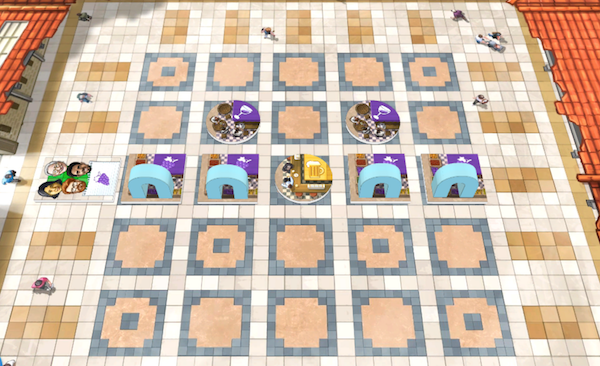
One of several examples of a 32 coin score: the two central stands earns 3x4 coins each and the two outer stands earn 1x4 coins each. This leads us to the other possible flaw, nameley that Mercado de Lisboa may feel too chaotic. It's true that you don't have complete control of your game but this chaos comes not from randomness but from the players' own rational decisions. Each player has a hand of three open stands. The reserve contains three open stands and three open customer tiles of each value. The random replenishment of the reserve adds a healthy randomness to the game that prevents it from being calculable while still providing enough information to base your decisions on. If anything, this "chaos" is but a taste of a full Lacerda game. So why not just play Lisboa?Let's return to our initial discussion about Mercado de Lisboa being a subgame of Lisboa. It's a tribute to the "mother game" that a part of it can stand on its own. But Mercado de Lisboa is more than that. It's a well designed and developed game that deserves to be judged by its own merits. This is a game where you must carefully manage your limited resources, know when to prepare for a big move and when to execute the same, and carefully navigate through the labyrinth of the Mercado that is gradually built by the players themselves. My only reservation is that this is not a filler - there's enough meat here (literally, since meat is one of the goods of the game) to make Mercado de Lisboa comparable to medium weight games. If you have considered trying a complex game of Lacerda's weight, Mercado de Lisboa may be a good gateway game. If you like it, you can expect to find similar challenges in games like Lisboa. If you think you're missing steps, such as producing the goods offered to the customers, you can certainly find it in the interlocking mechanics that have become Lacerda's trademark. I must admit that I doubted whether Vital Lacerda would be able to deliver depth in a simple and elegant game. I don't know how much of the simplicity and elegance that should be to the credit of Vital Lacerda and how much that should be to the credit of Julián Pombo but Mercado de Lisboa did prove me wrong and now I only wait for the next Lisboa descendant. "To Court Jose I" perhaps? 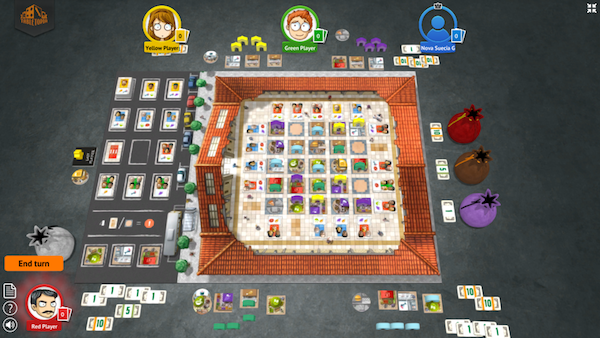
The end of a virtual 4 player visit to Mercado de Lisboa. |
|