
 |
The Quest for the Perfect Game - Reviews to Extract the Essence of Games by Nicholas Hjelmberg | |











|
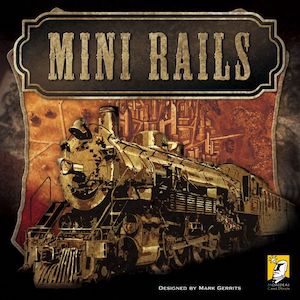
Mini Rails - The Porsche of Train Games (small and fast)? (Published 1 March 2021)This review has also been published at Boardgamegeek. IntroductionThere is something mesmerizing about train games. Typically the players start on an empty map with empty hands. But through the players' actions, companies start up and tracks are laid on the map, generating more wealth to the companies and more tracks on the map. In a true euro fashion, the players end the game with something greater than they started with, yet none of them own more than their shares (and in the worst case not even that). Unfortunately, this also means that train games usually require an investment in time and effort and few players are willing to make that. In that respect, train games are similar to civilization games: players yearn for the epic experience promised and seek for the Holy Grail, a simpler and shorter game that will provide a shortcut to a similar experience. But is it really possible to distill stock-buying and track-laying into a compact game without sacrificing experience? Let's see how well Mini Rails manages this. 
An untouched landscape, waiting to be exploited. The GameplayMini Rails lasts only six rounds, each of which lets a player take one stock-buying action and one track-laying action - no more, no less. Both stocks and tracks are represented by discs in the company's color and the action is taken by simply taking a disc and placing it in your portfolio or on the map. That's it. This action phase is preceded by a draw phase (setup for the next round) and followed by a taxation phase (cleanup after the round) without any player decisions. The player whose six shares have the highest total value wins. This may sound like a very limited decision space but every single decision has a huge impact. Let's go through the phases and actions one by one and see how they cascade in the game. 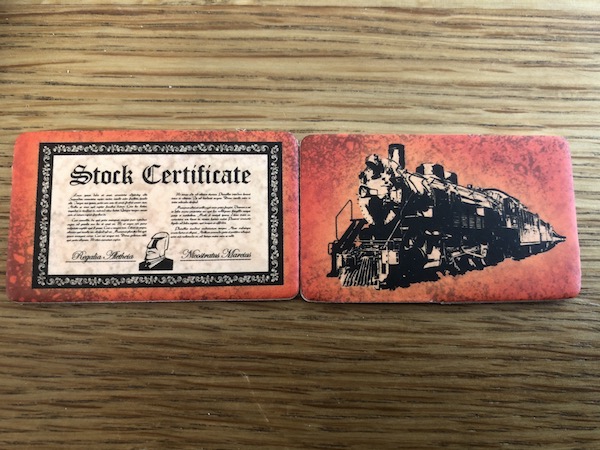
Stock or track? And which to choose first? Draw Phase - Actions and turn orderIn the Draw Phase, two company discs per player plus one additional disc are drawn from a bag. Those discs provide not only the action decisions this round but also the turn order decision for the next round. This is because the discs are arranged from left to right and if you take the leftmost disc you'll go first next round, if you take the second leftmost disc you'll go second next round and so on. So what's more important? Getting the disc of a certain company? Going early or late in the next round? Or perhaps getting two turns in a row (by taking to adjacent discs)? Let's move on to the Action Phase to understand why color and order matter so much. 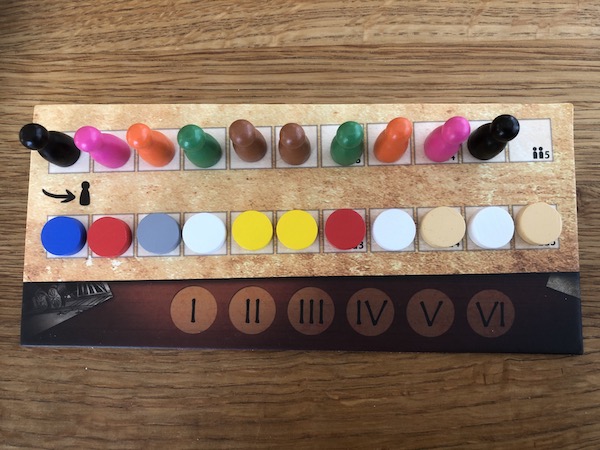
Black goes first and may take a blue disc to go first the next round as well. Action Phase - Shares first or tracks first?The actual actions of the Action Phase are deceptively simple. If you take a disc as a share, you place it on your Profit Board on the "0" space. If you take a disc as a track, you place it on the map (adjacent to the company's previous discs) in a space with a value ranging from -3 to +5 (for the central city tile) AND move all stocks accordingly. It's this stock movement that determines your stock value and eventually the winner. This has several important implications.
As if this wasn't enough, there is one more important implication revealed in the final Taxation Phase. 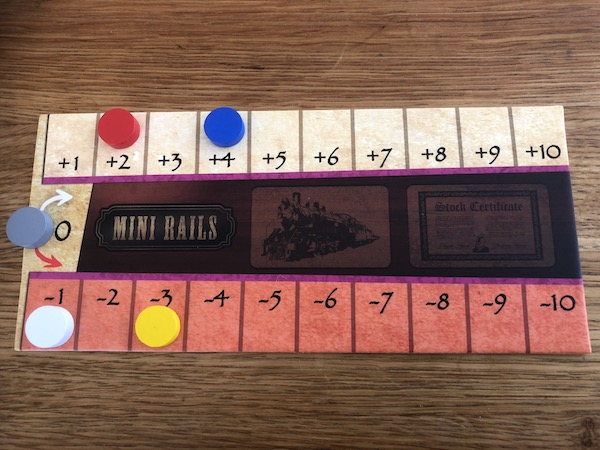
Blue has increased 4 steps since the purchase while yellow has decreased 3 steps. Taxation Phase - All or NothingDo you remember that one additional disc is drawn in every Disc phase? Then you might wonder what happens with this disc when all players have taken two each? The answer is that it goes to a certain tax track beneath the turn order track with a decisive impact on the end scoring. Shares in companies with at least one disc here are "safe" and cannot have a value lower than 0. Share in companies with no discs here on the other hand are punished and cannot have a value higher than 0. This means that it's crucial to get one of "your" discs here, even if it means less shares and tracks for you, or all your investments will be futile. But will the other players let "your" disc end up here? Or, if it does end up here, won't the other players take "your" shares or trash "your" company? Mini Rails is everything but a solitaire game.
There can only be one on the taxation track per round. Abstract or Thematic?Given all those elegant mechanics, where every component and decision have multiple functions, does Mini Rail still feel like a train game? Granted, you may not get the feeling of a robber baron, buying and selling shares in investment rounds based on how well (or badly) companies are expected to do in the operating rounds. Nevertheless, every single mechanic is thematic. Shares are indirectly bid for through the turn order selection, where you often have to give up something to get the share you want. The share values are based on "true values", where difficult (costly) tracks decrease the value and connected cities (profitable) increase the value. The decision to buy a share is based not on past performance but on expected future performance, where even a bad company may be good for you if the value increases after you bought a share. ConclusionWhat all this boils down to is a decision where groupthink is extremely important. I've seen some games where players cooperate to push certain companies ahead and other games where no company breaks even. To some players, Mini Rails may seem too chaotic. It's not possible to calculate which company will be the most profitable as even companies with promising conditions (good tiles adjacent to its tracks) are at the mercy of the other players. Some players may think of this as "lack of control". I prefer calling it "interactive". It's not the player who's best at planning ahead who wins, it's the player who's best at predicting the group's plans. 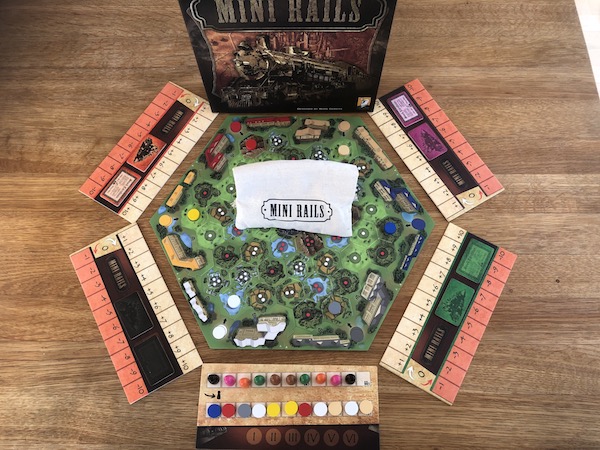
|
|