
 |
The Quest for the Perfect Game - Reviews to Extract the Essence of Games by Nicholas Hjelmberg | |




































|
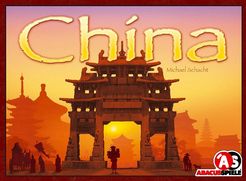
China – Going Beyond is as Bad as Falling Short (Published 22 Jan 2018)This review has also been published at Boardgamegeek. IntroductionChina is a vicious game about warfare and diplomacy during the Warring States period of Ancient China... well, not really. China is an abstract area control game that could have been set anywhere at any time (and is in fact a reimplentation of Web of Power, which is set in the medieval Europe). I don't mind abstract games and I'm a fan of area control games but does China really stand out among the many similar games that fight for control of this crowded area (pun intended)? AreasTo answer that question, let us first look at what constitues an "area" in China. Actually, the designer Michael Schacht did not settle with one or two but three different majorities. RoadsFirst, we have "majorities" on roads or rather length of roads. Whoever has at least four connected houses will score a road bonus. 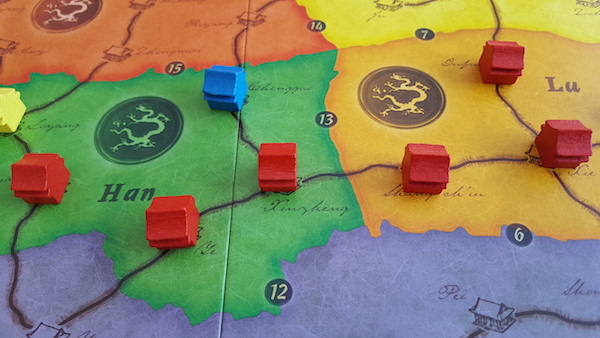
RegionsSecond, we have majorities within regions. A region has room for four to eight houses and whoever has the most houses in a region holds the majority. 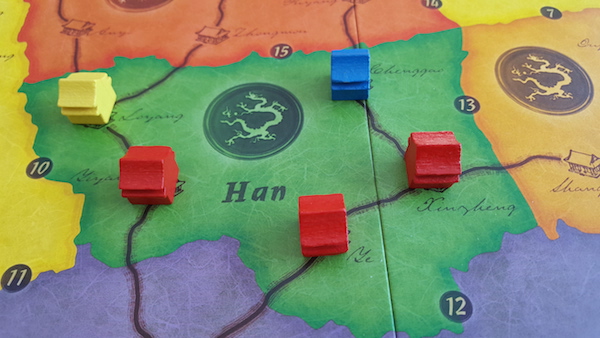
AmbassadorsThird, we have majorities between regions. A region can hold a number of ambassadors and whoever has the most ambassadors at both sides of a border between regions holds the majority. 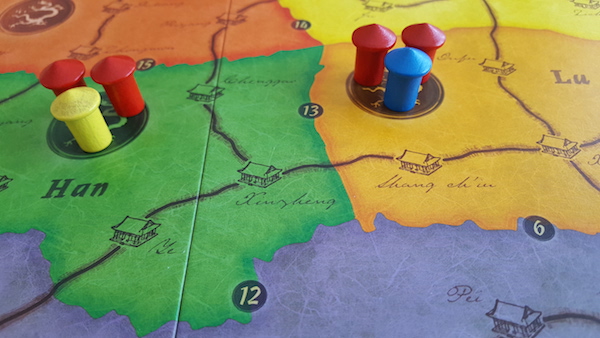
ScoringBut having three types of majorities instead of one is not enough to make a game stand out and China does indeed offer more in terms of the scoring. Whereas many area control games have a fixed majority scoring, the scoring in China is based on the majorities themselves. RoadsThe roads have a simple socring of one point per house. The more houses you manage to connect, the greater your score. This leads to interesting crossroad races and blocking placements. RegionsThe regions add an interesting twist to the scoring. The player with the most houses earns one point per house in the region. Similar to the road scoring, you can increase your score by placing more houses in a region. However, the player with the second most houses also scores and his or her points equals the number of houses of the first player. (And the third player earns points equal to the number of houses of the second player and so on.) That is, the more houses you place to increase your score, the more points does the next player get! AmbassadorsThe ambassadors have a similar scoring where the player with the most ambassadors earns one point per ambassador around the border. However and unlike regions, only the player with the most ambassadors earns points. So it is safe to place many ambassadors then? Yes and no. The number of ambassadors in a region is limited to the number of majority houses in the region. Placing additional houses in a region suddenly invites more ambassadors there as well, but will they be yours or will a competitor beat you? 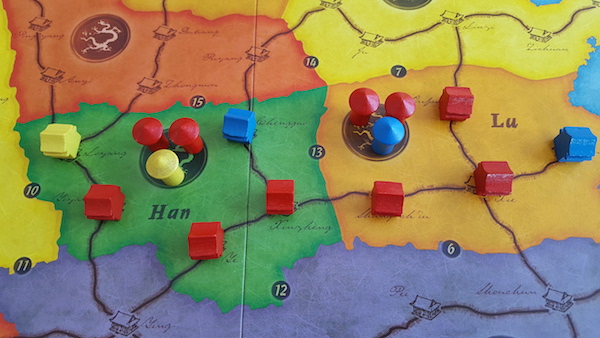
Red would here score 5 points for Han, 4 points for Lu, 6 points for the border between the two, and 5 points for the road. PlacementThis intricate dependency between majorities and scoring is what really makes China stand out. Not only do you have to fight for control in three different aspects but you also have to take into account the placement and scoring opportunities that may open up for the other players. But Michael Schacht has one more thing up its sleeve. 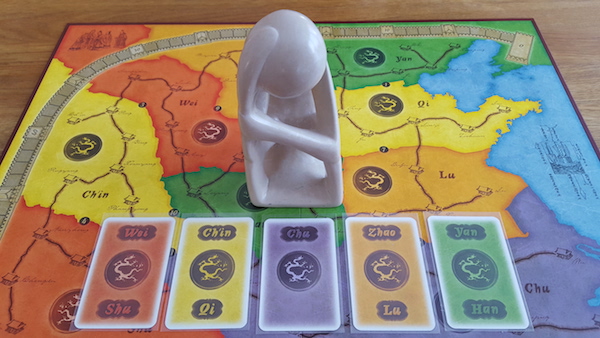
With free placement, China would be a thinky, almost solvable, game where either strong players check each other in a boring zugzwang game or where weaker players give away the game. China solves this through the common "healthy randomness" mechanic, whereby you draw cards that dictate where you may place. However, you retain some control through the ability to choose open cards (but reveal your plans to the other players) or through the option to play two similar cards as a wildcard. Another elegant restriction to free placement is the so called 3-2-1 rule: you may play up to three cards to place up to two pieces in one region. As in many good games, you want to place everything everywhere but are forced to make agonizing choices and prioritizations. 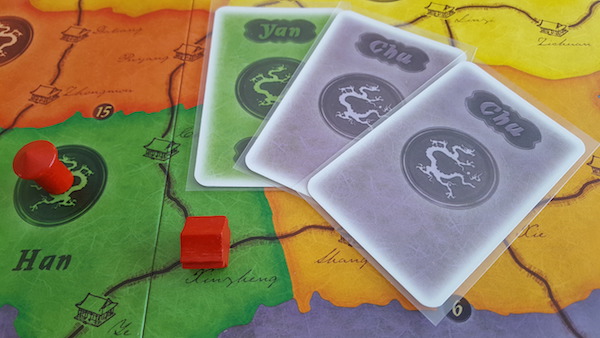
Elegance = Gameplay?So does China's elegance provides a good gameplay or is the game so well balanced that there is little the player can do to affect the outcome? In my opinion, China does deliver. It is true that you must be attentive to short-term opportunities in China, such as placing a single house in a region that will earn several points or placing the last possible ambassador in a region that will guarantee the majority. But at the same time, you must have a long-term plan for your placements and manage your hand of cards to be able to fulfil both short-term and long-term goals. I have outlined some tactical and strategical considerations that highlight the depth of China in A game of moderateness. The key message is that you need to optimize your placements by having just enough pieces in just enough places. In that respect, China is surprisingly thematic since it rewards the Far East virtues of patience and moderateness. SummaryThe way all those simple mechanics for majorities, scoring and restrictions intertwine and work together to create a bigger whole is to me the definition of elegance. The player who manages to navigate through this web and identify both short term and long term opportunities will be rewarded. I completely understand players who want more theme to their games but if you belong to the category of players who appreciates the beauty of games like chess and go, China has a lot to offer. 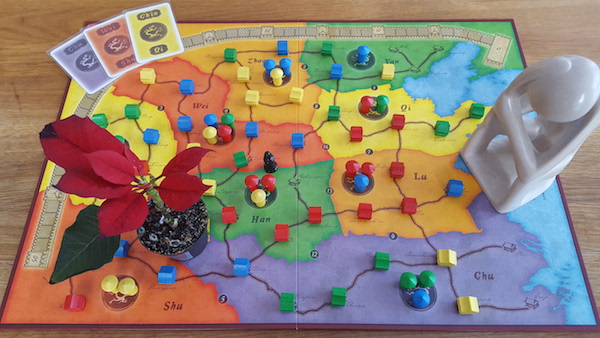
|
|