
 |
The Quest for the Perfect Game - Reviews to Extract the Essence of Games by Nicholas Hjelmberg | |




















|
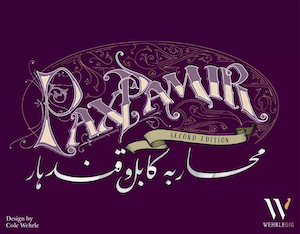
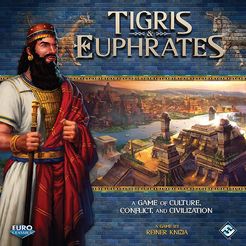
Pax Pamir - The Friendly Conflict Game? (Published 28 August 2023)This review has also been published at Boardgamegeek. About Conflict GamesIs it possible to design a conflict game without reducing it to a game of take that? I grew up in the age of Risk, when conflict games were all about choosing whom to attack and rolling dice to determine the outcome. All games were similar: you fought initial battles to stake out your territory, after which you bashed the leader to restore the balance until it was time to go home. They were not about tactical and strategic skills but rather about avoiding being singled out by the other players (though I must admit that the ability to lie in wait and draw suspicion to other players has been useful in other competitive games). Fast forward to the age of modern board games and we suddenly find several creative mechanics to make conflict games that are not popularity contests. My personal favorite Tigris & Euphrates makes use of different and shifting motives. You don't attack a player out of spite but rather because you need a certain color and that player's kingdom happens to be the easiest route to obtain it. Knizia's masterpiece also limits your options by dealing you certain tiles and forcing you to make the best out of your current resources so even if you do want to play a take that game, your hand may prevent you. Other excellent mechanics are the shared interests and war by proxy found in games like Imperial. At first sight, this looks like Risk with nations staking territories. However, a player does not "own" one nation but rather shares in several nations and fights the battles with the sole purpose of increasing the value of said shares. Leadership and alliances will shift but the actual conflicts will be separated from the players and not cause any hurt feelings. This leads us to the game about The Great Game: Pax Pamir. 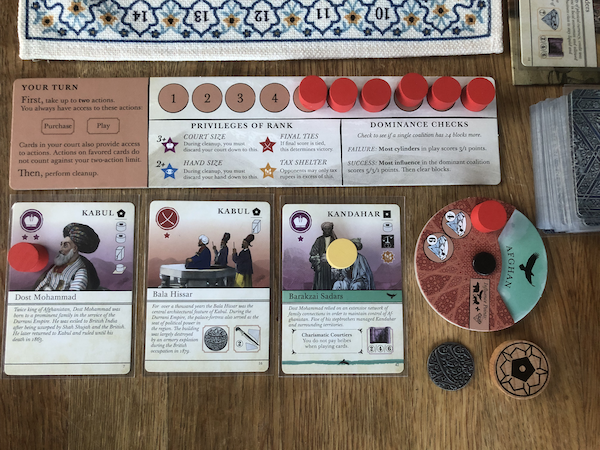
Red player is loyal to the Afghans, has Dost Mohammad and the Barakzai Sadars on his side and controls the fortress Bala Hissar. The Great GameAccording to Wikipedia, "The Great Game was marked by distrust, diplomatic intrigue, and regional wars". Thus, Pax Pamir should have all the ingredients for a ruthless conflict game full of bullying and backstabbing. Yet, we see very little take that and bash the leader in the game and the reason for this is that the players not only have to play each other but also the ever changing game state. Pax Pamir succeeds in creating this game experience thanks to the above mentioned modern mechanics so let's go through the different elements of the game and see how they make use of them. The Coalition Game - Loyalty and CylindersHistorically, The Great Game was a struggle between three coalitions: Great Britain, Russia and Afghanistan. However, in Pax Pamir those coalitions are mere tools for the players, representing local Afghan leaders, who act on their behalf. Mechanically, the players pledge loyalty to one of those coalitions and maneuver their units on the map. If a coalition is "dominant" (more about that under The Map Game below) at certain checkpoints, the loyal players are rewarded. So why don't all players pledge loyalty to the same coalition, you may wonder? The answer is that not all coalition partners are equal. The loyalty is measured in influence and may be increased through patriots, prizes and gifts (more about that under The Card Game below) and the player with the highest loyalty will get the most victory points. The game ends either when a player is at least four victory points ahead or after the fourth dominance check. It may be wise to pledge loyalty to the strongest coalition and help it become dominant but if another player will earn more victory points than you every time, it's wiser to betray him or her. Pax Pamir offers several ways to do so. You may try to increase your influence more than that of your opponents, you may try to decrease your opponents' influence or you may simply switch loyalty. Of course, you may also negotiate (i.e. threaten with betrayal) to get your fair share of the victory points. But what happens if no coalition is dominant? This is where Pax Pamir's cylinders come into play. Unlike the "public" coalition units that are "owned" by its loyal players, there are also personal units that belong to individual players. They may represent tribes (if placed on the map) or spies (if placed on cards) with various effects but when it comes to the dominance checks, they will determine which players get the most victory points. This is a fine example of how a few simple rules open up many interesting possibilities. Perhaps there is one strong coalition, within which the players compete to be the most loyal partner. Or perhaps there are several aspiring coalitions, which the players use to fight a proxy war against each other. Or perhaps there are players who don't want any coalition to be dominant so that they may take advantage of having the most cylinders in play. I must admit that this was what really drew me into the game world of Pax Pamir. The idea of players engaging with each other in so many different dimensions was very intriguing. Cooperate or compete? Tip the balance or maintain the status quo? Accept an inferior alliance role, only to betray your ally at the last moment? So many opportunities... 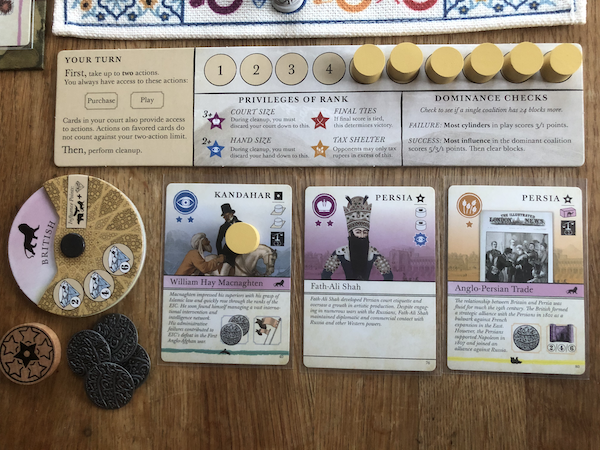
Tan player is loyal to the British, has William Hay Macnaghten and Fath-Ali Shah on his side and controls the Anglo-Persian trade. The Map Game - Areas and UnitsRISK has 42 areas, Imperial has 54 areas and Diplomacy has 75 areas. How many areas does a game like Pax Pamir need? The answer is six. What? What kind of conflict game is possible in only six areas, I hear you ask. Actually, you don't need more than this. Pax Pamir isn't a game about maneuvering units, building strongholds and taking advantage of geographical constraints, it's a game about coalitions. I don't know how many different numbers of areas the designer tested but six is certainly not too few for the Great Game. The rules for the units on the map are equally simple. Take actions to place them in areas (as armies) or between areas (as roads) move them across the roads and fight them by removing them. For dominance, a coalition must have at least four more units on the board than any other coalition. There is also an area majority mechanic on the map, where a player with plurality of "ruling pieces" (tribes or loyal armies) becomes the ruler. This gives certain privileges, such as demanding bribes for associated cards to be played. The simplicity of the rules lets the player think more about what they want to do rather than how to do it. Do you need to add more British units or bring down the number of Russian units? Do you need to build infrastructure to improve "your" armies' mobility? Do you need to "open" a region to be able to play cards bring down a competitor's influence? Those are questions that are answered by complex rules in other games but so abstracted and predictable in Pax Pamir that the players may focus on the coalition game. 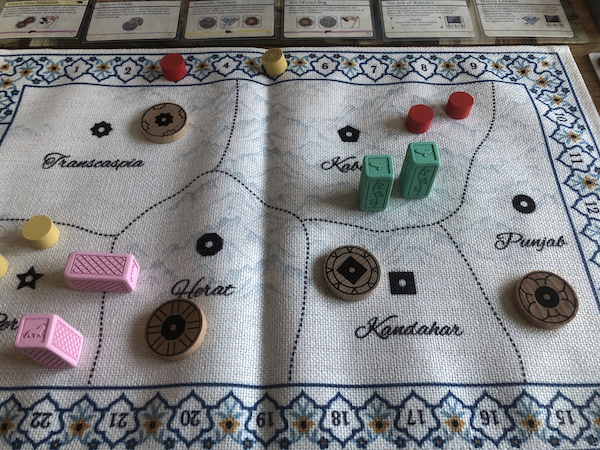
Red player and Afghani armies control Kabul but Tan controls Persia and British units are approaching Herat. The Card Game - ActionsPax Pamir is ostensibly a tableau builder and cards do indeed play a major role in the game. However, I will stick my neck out and claim that the table building is of little importance in the game. According to Boardgamegeek, a tableau "determines the quality, quantity, and/or variety of actions to which they have access throughout the game". But while it's true that played cards give access to extra actions (for free if the card suit matches the current map suit), Pax Pamir is not a game about building an engine and then running it. Instead, the cards represent the ever changing threats and opportunities that the players must react to in order to play the coalition game well. The cards enter the game through drafting from a card queue, where later cards are gradually more expensive, and they have many different functions.
The last point deserves some elaboration. Player units may nove not only on the map as tribes but also on the cards as "spies. When on a card, they may force the owner to pay to use it ("hostage") or even assassinate it to get a the above mentioned prize, which increases the loyalty. This may sound like the game is all about the cards and taking advantage of combos and such. However, a player has only two actions at his or her disposal (plus the extra actions if map and card suits match) so the cards merely provide the game state to which the player must adapt. Which coalition do the cards favor? Which will be the key regions to act in? Which actions do I have access to and which actions do the others have access to? Most importantly, the dominance checks are represented by cards and it is when a player acquires such a card (or when it is discarded if no player acquires it) that the dominance check is triggered. If you try to play Pax Pamir by building the best possible tableau, Afghanistan will not be kind to you. I may add that I'm not normally a fan of card-based games. I prefer a transparent game state and don't enjoy being surprised by a player playing a card I didn't even know existed. However, with Pax Pamir I never get this feeling. Each new game is different based on which cards that come into play and all cards that come into play are visible to the players. Still, Pax Pamir never feels chaotic. The game state will change but the changes are induced by the players themselves and since the actions are deterministic, they can often be predicted. Pax Pamir is not a game where the cards play you but rather a game where you have to play the card dealt to the game. 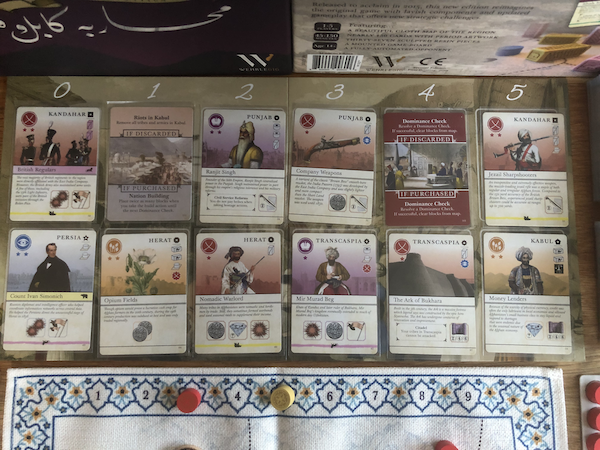
The card queue contains many military (red) cards, Kabul will soon riot and a dominance check is imminent. Which is the best course of action from here? Theme and ComponentsIn my reviews I usually focus on the gameplay but I can't help mentioning the love that has gone into the design and production of Pax Pamir. The game does a good job of putting the players in the positions of local Afghani leaders seeking to manipulate the intruders for their own purposes. Every single card (and there are plenty of them!) has a connection to a real person, place or event in the turbulent Afghani history. The components are beautiful without being over-produced, particularly the cloth mat and the resin pieces, and it's a delight to play with them. Although not necessary for playing the game, I strongly recommend you to read some of the literature listed at the end of the rules to really bring Pax Pamir to live. 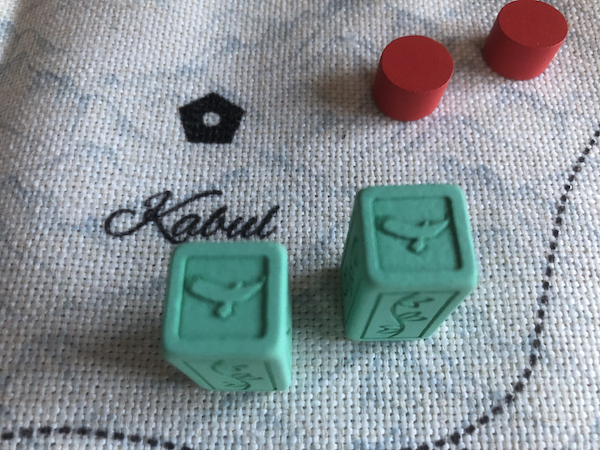
Close view of the cloth mat and the resin pieces. ConclusionPax Pamir is a masterpiece in many respects. The gameplay is interactive and engaging and gives the players plenty of opportunities to manipulate the game state in their favor. The rules are rich and deep where necessary for the game experience (such as in the multi-dimensional coalition game) and abstract and simple otherwise (such as in the elegant and deterministic map game). The many different cards bring variation both within and between games and forces the players to constantly adapt their strategies and reconsider their allies. Yet, this isn't a game of kingmaking. Winning is not about bullying and losing is not about being singled out, hence the title of this review. It's true that Pax Pamir may not be a game for everybody. Players who dislike negotiations and backstabbing or want to set up plans that aren't easily interrupted won't be comfortable in The Great Game. However, players who enjoy the challenge of constantly finding the right path in a seemingly chaotic but predictable gameplay will certainly enjoy Pax Pamir. Congratulations to a fine achievement, Cole Wehrle! 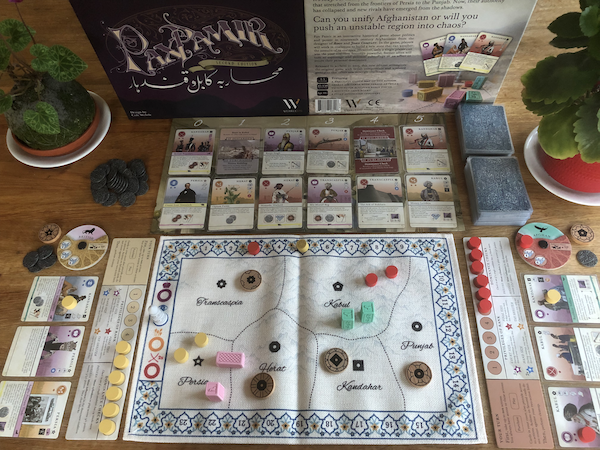
"You have brought an army into the country, but how do you propose to take it out?" - Afghan Tribal Chief |
|