
 |
The Quest for the Perfect Game - Reviews to Extract the Essence of Games by Nicholas Hjelmberg | |








|
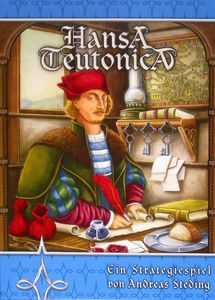
Hansa Teutonica - A Study in Good Game Design (Published 15 April 2018)This review has also been published at Boardgamegeek. Our first MeetingWhen I first met Hansa Teutonica, it was love at first sight. Well, perhaps not at first sight (the box cover isn't that engaging) but at least at first encounter. The elegant unlocking of abilities on the player board, the fierce competition along the routes on the map, the completely different strategies available in the game... the game just felt so unique. As I got to meet other games, the initial impression began to fade. It turned out that none of the many intriguing parts of Hansa Teutonica were particularly unique but rather standard design elements of many eurogames out there. In fact, individual elements even seemed better designed elsewhere and my copy was often left behind when I went out gaming. But yet, every time I returned to the game, I was offered a great and varied experience and everybody I've played it with so far agree that Hansa Teutonica is a fun game. Let's look closer at the design of Hansa Teutonica to see if we can understand why. The BasicsHansa Teutonica is basically a game about placing cubes (traders) and cylinders (merchants) on trade routes between cities. Once all spaces between two cities are occupied, you may claim the route and receive a reward. There are many different rewards to choose from but they all boil down to resources (improved abilities) or victory points (immediate or at the end of the game). One interesting feature of Hansa Teutonica is that placed workers, sorry traders, only partially block other players as they can be pushed (but the pusher has to pay and the pushed gets paid). One other interesting feature is that the game contains nothing of what one may normally associate with a game about building trade routes. There are no vehicles to transport them on, no market to sell them at, no money for trading them, no buildings to build for them. In fact, there are no goods at all in Hansa Teutonica. So where's the game then? The answer is that all the game elements have been abstracted into the wooden components. Won't this remove all fun from the game? No, this is actually what makes the game fun! 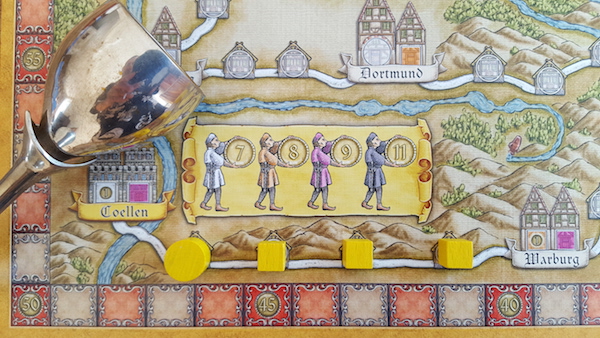
The Multi-Skilled CubesAs in many eurogames, the core of Hansa Teutonica's gameplay is the balance between resources and victory points. Produce resources to build up a strong engine and switch to victory point production at the right time. Your "engine" is your player board and the fuel is your action cubes (traders or merchants). Removing cubes from your player board not only gives your more action cubes to work with on the board but also unlocks abilities that gives you stronger actions. This simple mechanic is the first key to the Hansa Teutonica's successful design. There is no fiddly resource conversion that interrupts the smooths gameplay. Everything that happens in the game is taken care of by this multi-skilled cube. It's an action cube when you take it from your supply, it's a trader when you place it on a route, it's an office when you place it in a city and so on. Heck, even its absence means something in the game thanks to the mechanic of unlocking abilities. However, "stronger" actions does not mean more and more resources but it literally means stronger actions. Hansa Teutonica is not a game of crazy combos where you get so many resource modifiers that you start forgetting about them. No, Hansa Teutonica modifies your actions in a way that may help you get resources, but only if you know how best to use your actions. This is the second key to Hansa Teutonica's successful design so let's look closer at your action board. 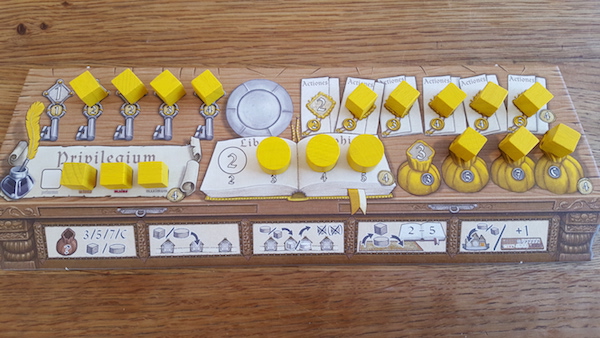
The Action AbilityThe ability that usually gets the most attention is the number of actions. The more cubes you remove, the more actions you get to take each turn. Easy to use and powerful, particularly the first cube, that gives you 50% more actions (3 instead of 2). Beginners are often recommended to start here and I'm inclined to agree, since I've never seen anyone win with only 2 actions. But removing more cubes to get more actions (2 more cubes for 4 actions and another 2 cubes for 5 actions) is not necessarily worth the actions required to accomplish this. There are other abilities that may be more interesting. 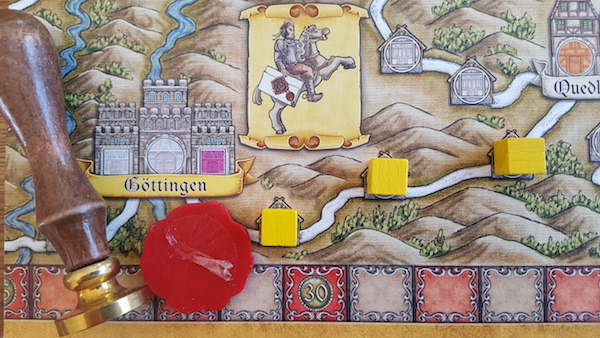
The Income AbilityAnother important ability is the income. When you take actions, your action cubes are moved from your supply via the map to the general stock, from where you eventually have to retrieve them. Initially, you may only retrieve 3 cubes so and unless you unlock this ability, you may have to spend your hard earned actions to retrieve cubes. 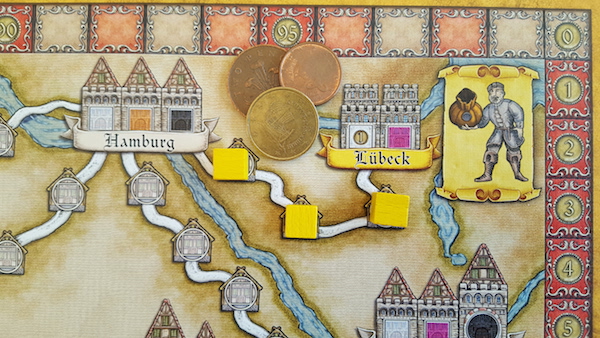
The Blocking GameBut isn't there an alternative to get your cubes back? Yes, let's pause our action walkthrough to learn more about perhaps the most distinguishing feature of Hansa Teutonica, the blocking and pushing game. By placing a cube on an opponent's unfinished route, you block him or her from completing it. Your opponent may push away your cube but not only does this cost him or her an extra cube, this also gives you an extra cube from the stock to place at an adjacent route. A good blocking game can earn you a lot of cubes and make income less important. But what's the point of having many cubes on the board if they're scattered along different routes? This is where the next ability becomes interesting: the "Liber Sophiae". The Liber Sophiae AbilityThe Liber Sophiae tells how many cubes you may move around on the board in a single action. With a powerful Liber Sophiae ability and a well played blocking game, you can essentially take more actions in a turn than a player with many "normal" actions. Another advantage of unlocking Liber Sophiae is that this is the only ability that gives you more cylinders (merchants) to work with so let's take another pause and talk more about them. 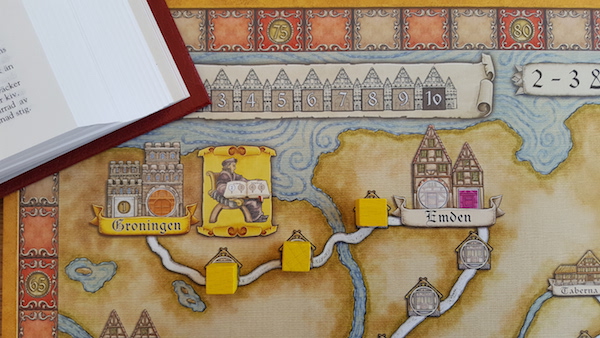
The Traders and the MerchantsIn most respects, there is no difference between cubes and cylinders. They are placed on routes and retrieved as ordinary cubes. However, the merchants are "heavier" than the traders. Not only do they cost more to push for your opponents but they also give you more when pushed. (Because of this and their round shape, we always refer to them as "fat guys".) Another important distinction between traders and merchants is that they have dedicated spaces on the map. One of the rewards for claiming a route is to leave a merchant or a trader in the city but some city spaces are squared while others are round. I leave it to the reader to figure out who goes where. The Privilegium AbilityAnother restriction when placing trades and merchants in a city space is the color of the space. Is there an ability to unlock for this as well? You bet! It's called Privilegium and the more you unlock this ability, the more cities are open to you. But why would you want to place your traders and merchants in the cities rather than unlocking abilities? The answer to this question leads us to the victory points of the game. 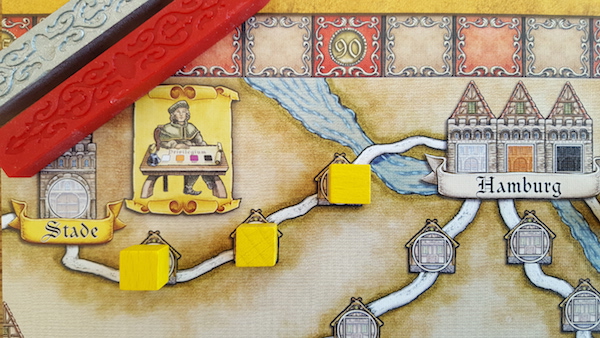
The Victory PointsNo matter how fun it is to unlock abilities, they don't earn you any victory points (unless you unlock an ability completely, which earns you 4 victory points). It's actually common that new players get so engaged in unlocking abilities that they forget the objective of the game. The bulk of your victory points comes not from the abilities but from your traders and merchants in the cities. Controlled cities at the end of the game (where you have the most or the rightmost trader or merchant in a city) earns you 2 victory points, connected cities at the end of the game earns you 1 victory point each and a certain route across the middle of the map earns you up to 7 victory points immediately depending on whether you're first or not. Not too bad, but this is something to focus on later in the game, after you've built your engine, right? No, there is a reward for placing traders and merchants in cities early. Not only are the city spaces limited and restricted (remember the Privilegium ability) but more importantly, the controlling player earns 1 victory point EVERY time a player completes an adjacent route. Control of both cities around a route can turn into a very fat cash cow if the route is popular. The Victory Point AbilityThe fifth and final ability is the least powerful when it comes to actions. However, it's a multiplicator for the victory points earned per city in a network. A completely unlocked multiplicator ability will give you five times as many victory points - nothing to sneeze at! 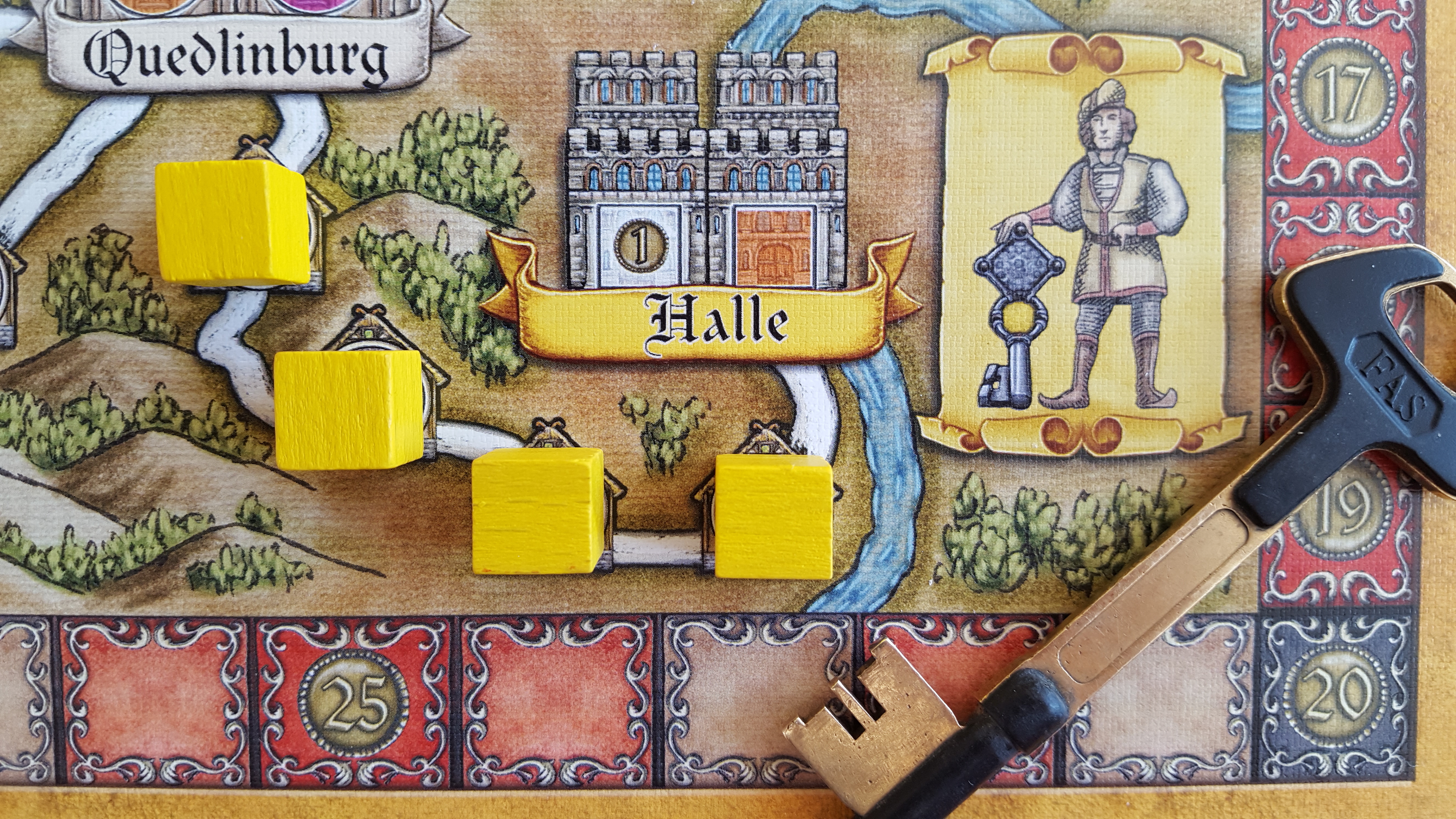
The Bonus PlatesSo far, the game is completely deterministic but there is one element adding the often needed healthy randomness: the bonus plates. Completing certain routes give randomly drawn (but known in advance) bonus actions. One example is a number of free actions, another the ability to place a trader or merchant outside the normal city spaces. They are also worth victory points in the end, whether used or not. 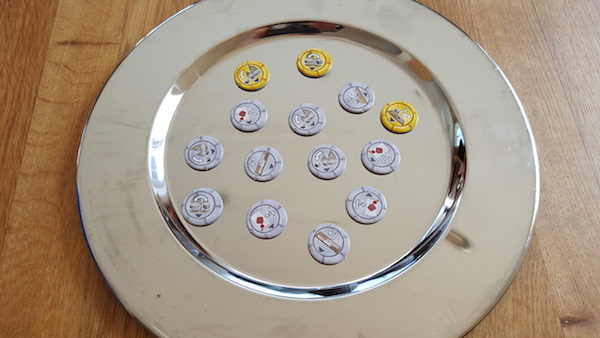
The EndWhat we've seen so far is an action board with literally many different paths towards the victory but there is more to come. We haven't answered the common question of when the game ends yet. The answer is another key to Hansa Teutonica's successful design: it depends. There are several end game triggers, all of them controlled by the players. The most common trigger is that a player reaches 20 victory points during the game (excluding end game victory points). However, 10 full cities or depleted bonus plates may also trigger the end. The key point is that you must adapt your strategy to the expected game length and/or work to shorten or prolong the game to fit your strategy. The Map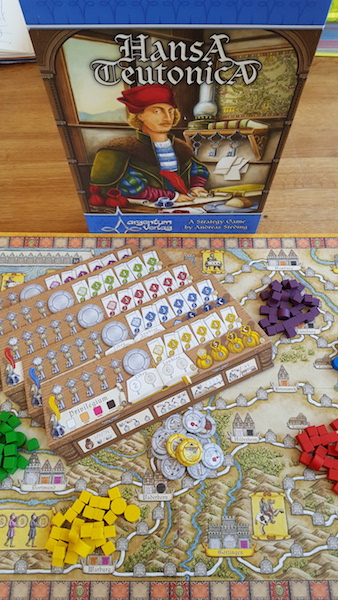
The only thing that may seem less elegant is where all the actions take place: the map. For the uninitiated, it may look like a random mix of route lengths, routes scores, bonus plates, city shapes, city colors and cities for unlocking abilities. However, a closer look reveals that a lot of thinking has gone into the process of designing the map. The cities that unlock abilities are located along the edges, making it difficult to unlock abilities and build a network at the same time. The 7 victory points route is located in the middle of the board, far from other valuable routes, while the bonus plate routes are scattered. The map offers a lot of variability and engagement as players try to match different part with different strategies and is another important key to Hansa Teutonica's successful design. I'm sure a lot of thinking has gone into the distribution of shapes and colors because I never seem to get the "perfect" placement of my traders and merchants. ConclusionSo where does this case study lead us? We have a game that may be using known mechanics but in the most fun way. Your engine doesn't simply give you more resources to pile but rather more fun actions. The constant blocking and pushing turns this into one of the most vicious eurogames out there. The many different strategies require completely different actions and approaches as well as good timing. All this is accomplished in a very smooth and streamlined gameplay thanks to the multi-skilled cubes. Hansa Teutonica is far from the multi-player solitaire optimization games that are too often seen today, this is game where you must understand what the other players are up to and how best to take advantage of them. But is it really about traders and merchants of the Hansaetic League? Well, not really but who cares? |
|