
 |
The Quest for the Perfect Game - Reviews to Extract the Essence of Games by Nicholas Hjelmberg | |
































|
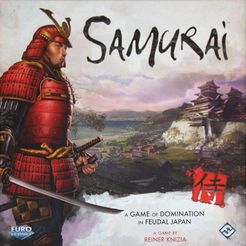
Samurai - The Emperor of Area Majority (Published 12 February 2018)This review has also been published at Boardgamegeek. The Tile-Laying TrilogySamurai is part of Reiner Knizia's Tile-Laying Trilogy, the other games being Tigris & Euphrates and Through the Desert. The three games offer completely different takes on tile-laying and do not have anything else in common (besides all being good). On the other hand, the fact that they are different, not only compared to each other but also to other games, shows the versatility of Reiner Knizia. We will look at what makes Samurai so unique but start with an overview of the gameplay. The Goal of SamuraiYou play a warlord in Medieval Japan with a number of forces at various strength at your disposal. Your goal is to obtain influence of the three different factions Militaries (Helmets), Priests (Buddhas) and Farmers (Rice Paddies) in the country. Whoever obtains the most influence will rise to become Shogun of Japan. Well, to be honest I made this up since not even the rules provide any background story. Nevertheless, the whole idea of carefully balancing your forces across the map to exercise the right influence at the right time and the right place does align with the Japanese theme and the elegant components further strengthen this feeling. Let us now move on to the meanings of majority in Samurai. Meanings? Yes, there are many aspects of majority in Samurai. Area MajorityThe core of the gameplay is to lay tiles to obtain majority in areas and earn figures. The tiles represent your forces, the areas represent cities and villages, and the figures represent the three factions. The player with the most forces claims the figure - the other players get nothing. So far nothing new under the sun but there is more, much more. 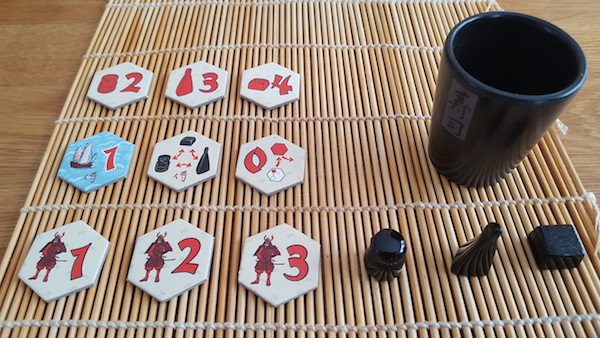
Majority from OutsideThe tiles are not placed in an area but next to an area so that each tile will always count towards the majority in two areas, never more, never less. Perhaps you can compete in both areas, perhaps it can be worth giving up the majority in one area if you can be guaranteed the majority in the other area? One little extra rule adds a completely new dimension to the area majority. 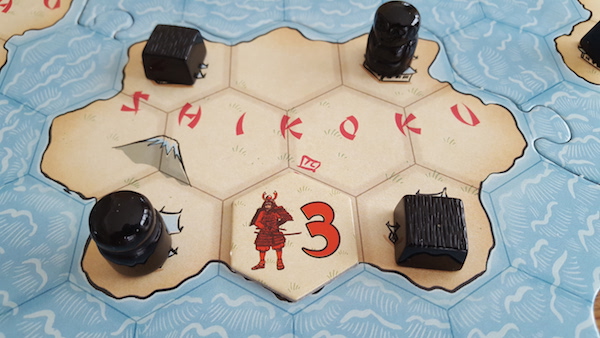
Surrounding an AreaHow often do you score an area? Once (and only once) when (and not before) the area is completely surrounded by land tiles. Here is another little rule that adds a lot. If you start surrounding an area, will you also obtain the majority or will you only help an opponent to do so? Remember, the runner up gets nothing, neither do uncompleted areas. Every tile placement is an agonizing decision, but we are far from done yet. 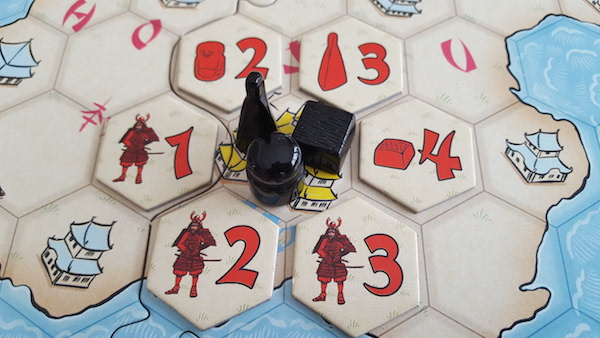
Numbered TilesAll tiles are not equal in Samurai. Their strength ranges from one to four. But how do you use them? Placing a weak tile may invite a stronger opponent tile to complete the surrounding and claim the figure. Placing a strong tile may deter opponents, leaving to you to complete the surrounding yourself. Remember that a big majority does not earn you more than a small one and only means that you have wasted tiles that could have contributed to a majority elsewhere. Oh, the agony, and yet there is more to come. 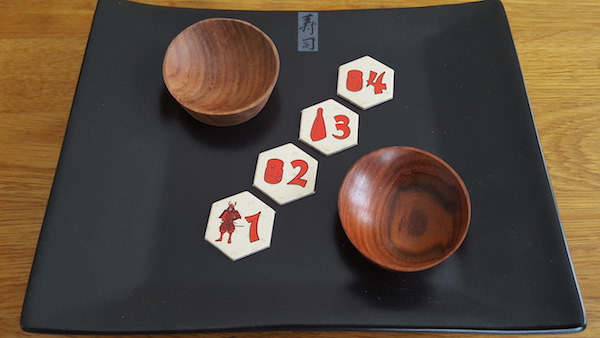
Faction TilesMost of your tiles are linked to specific factions and will only influence figures of this faction. A Buddha tile with strength four will indeed put a strong pressure towards an area with a Buddha figure but will be useless against another area with a Helmet. As a matter of fact, such a tile may even help an opponent to complete the surrounding of the other area and claim the Helmet. Are we done yet? No! Fast Tiles and Special TilesNormally you may only place one tile at the time but there are also "fast" tiles that you may place several of in the same turn in addition to a normal tile. Most of them are ships or sea tiles, which do not help you completing a surrounding but may help you get that extra strength you need for a majority. There are also two special tiles designed to surprise your opponents. The Token Exchange lets you move a previously placed tile to a new place, effectively using its strength twice in the game. The Figure Exchange (which is also a "fast" tile), lets you switch places between two figures. Perhaps that useless Buddha mentioned in an earlier example is not so useless anymore. 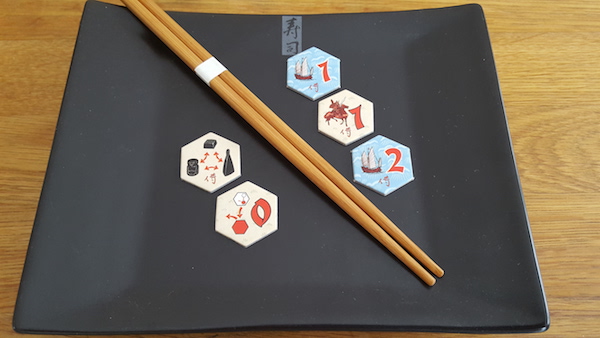
But what if there is no Majority?Sorry, no shared victories. If no player has the area majority, no player gets the figure and it is removed from the game. This is also one of the end game triggers (the other one being the exhaustion of one figure type) - the game ends if four figures are removed. Having a figure removed may be better than letting an opponent having it but who will benefit from an early game end? 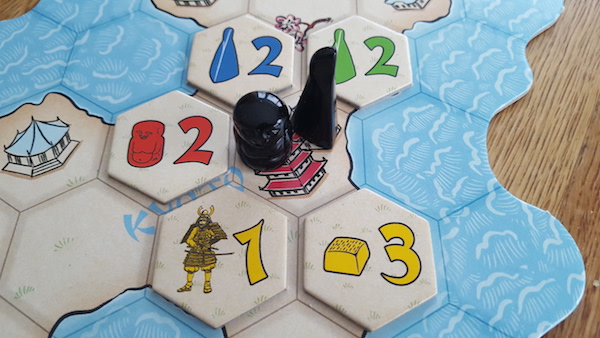
The city of Kyoto is surrounded. Red claims the Buddha. Blue and Green are tied for the Helmet so it is removed. Yellow is strong in Rice but to no avail since there is no Rice to claim in Kyoto. The ScoringHave we had enough of majorities now? Then take a deep breath because here comes the famous "Knizian scoring" of Samurai. The goal of Samurai is to get figures but it is not the number of figures that is important but the figures where you have a majority compared to the other players. A majority in two of the three factions will win you the game immediately whereas no majority at all will put you out of the contest. Similar to the rule about tied area majorities above, tied figure majorities do not count so a player may theoretically win with only one majority. 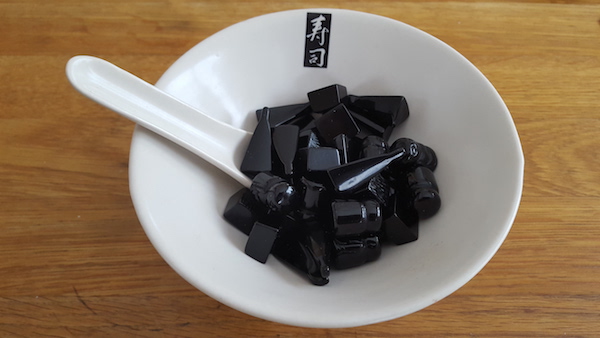
What if several players have one majority then? Well, then you count the number of OTHER figures. Again, a big majority only means that you have wasted tiles on figures you did not need in the end (unless it was necessary to prevent other players from obtaining majorities that is). In case you have missed it, the idea of balancing your efforts is a red thread throughout the entire game. I have discussed this further in the strategy article A Samurai prefers Fighting Alone. The "Healthy" RandomnessBut is not a game like this prone to the dreaded analysis paralysis? Indeed, but three small rules help mitigating this. One is that you draw your tiles and never have more than five to work with. Another is that your tiles are hidden from your opponents. A third is that the score is hidden. The first and the second rule limit your decision space by reducing the number of options that you have and obscuring the possible opponent responses that you need to take into account. This does add an element of push your luck (will I get this majority or does my opponent have the Buddha four necessary to thwart my plan?) that I'm normally not a fan of but here I think it is preferrable to the analysis paralysis that would otherwise be the result. 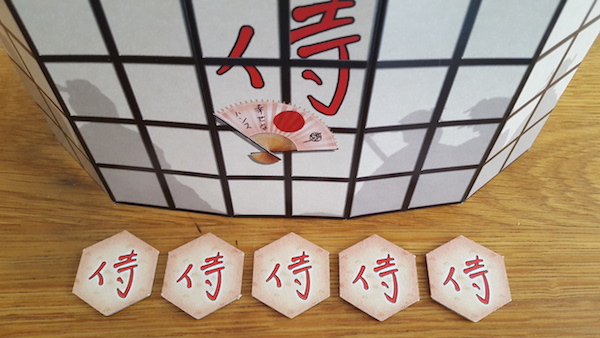
More controversial is the hidden but trackable scoring. Given the tight majorities and the special tie breaking rules, I fear that open scoring would lead not only to analysis paralysis but also kingmaker discussions towards the end. I would not strongly object if the other players would like to house rule open scoring but I see the benefit of closed scoring and prefer playing Samurai as intended by Reiner Knizia. The "Seating Problem"Another more valid argument against Samurai is the seating problem. A weak player may very well give away areas to the player to the left and hence the victory too. Any attempt to fix this would ruin the tight game of checks and balances that makes Samurai such a great experience. Beginners should be introduced to basic strategies but Samurai is definitely best played with equally strong players. ConclusionSamurai is truly a game of balance. Place your limited tiles around the areas where their number and figure has enough (no more, no less) impact to obtain enough (no more, no less) majorities. Every placement will be an agonizing decision and you will often find yourself inadvertently helping an opponent. But at the same time, you need to "cooperate" with your opponents to use your own tiles as effectively as possible. The winner will be the player who makes the most of those cooperations and establish the right presence at the right time and the right place. If there is an Empire of Area Control, Samurai is a worthy Emperor. 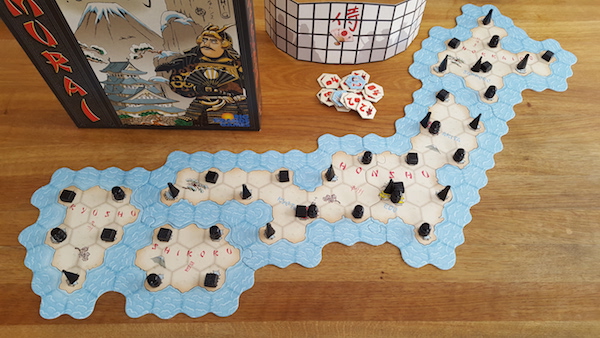
|
|