
 |
The Quest for the Perfect Game - Reviews to Extract the Essence of Games by Nicholas Hjelmberg | |



























|
Bug - A new Game under the Sun (Published 5 July 2021)This review has also been published at Boardgamegeek. Introduction"I commend the designer for a brilliant achievement. This is a game that feels like it was just waiting for someone to discover it. In a time where many designers seem content with copying old mechanics, I am so glad to see that there can be new games under the sun. It will be difficult to return to my own feeble attempts. Thank you for sharing this and good luck with Bug!" The words are my own and originate from December 2017, when I first heard about this abstract combinatorial game. Such games have fascinated me ever since I learned how to play Chess and realized that games do not need to rely on dice or other random factors to provide an exciting experience. Yet, new combinatorial games have often failed to surprise me in the same way as new boardgames sometimes have. While modern boardgames had to compete with trivial games like Monopoly and RISK, modern combinatorial games had to compete with games like Chess and Go, ancient games refined to perfection during centuries. Why play a game about defeating enemy pieces when you can play Chess? Why play a game about controlling territory when you can play Go? Then Bug appeared. What makes Bug unique is that it is played with polyominoes - shapes made up of smaller components - that are created, expanded and eaten by the players until one side is unable to expand and thus has reached its full potential. For a detailed description of how the game came to be, including how it is played and won, I warmly recommend the designer's post Bug: perceptual binding, identity and meaning in a new sort of polyomino game. What this review will explore is whether this innovative gameplay translates into a fun game experience. 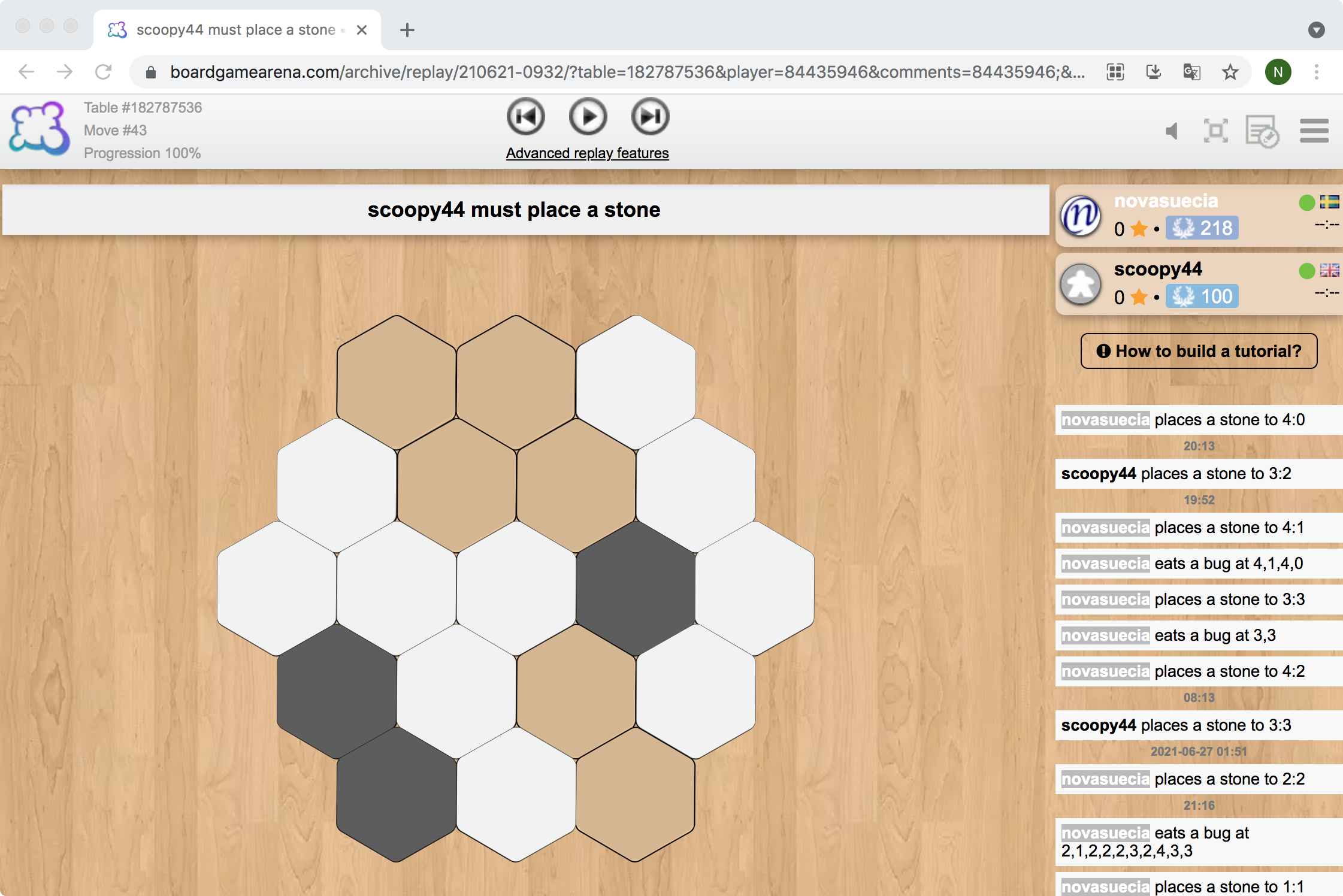
The end of a game on the excellent implementation at Boardgamearena. GameplayLet's first briefly go through the (very few) rules and see how each rule provides interesting and challenging decisions. A game of Bug is played with black and white stones on a board of hexagons (the size of which may vary but as we will see that even a small 19 hex board is sufficient for a large decision tree). A turn consists of the three actions Grow, Eat and Bonus Grow. GrowGrow is the action of placing a stone in an empty hex. Broadly speaking, this decision has two dimensions. First, you may consider which shape or "bug" your connected stones will form as this will determine your bug's chances of eating (or be eaten) in the next step. Second, you may consider which spaces you will leave for yourself and your opponent. (There is an important rule that bugs may not merge so spaces between bugs are inaccessible.) Remember that you want to exhaust your available spaces to win the game. We will return to this "shape vs space" decision later but let's first look at the next action. EatEat is the action of removing adjacent enemy stones. The condition for doing so is that they are of the same shape as your stones. A single stone eats an adjacent single stone, two connected stones eat two connected stones and so on. In the early game, shapes are small and easy to "replicate", but as the game proceeds, the shapes will be larger and the empty spaces smaller so eventually there will be bugs that cannot be eaten. Bonus GrowBonus Grow adds another stone to the bug after a successful eat. This is important because Bonus Grow is the only action that lets a bug grow bigger than the currently biggest bug on the board. This rule brings the game towards the end as bugs will keep growing until they run out of space. Without it, they would just eat each other over and over. Beware, though, if you can't grow you can't eat either and may instead be eaten by your intended prey. Game TacticsSo far the game may sound simple, even scripted. A bug of size 1 eats another bug of size 1 and grows to size 2, after which it cannot grow and inevitably will be eaten by a bug of size 2 and so on. This may also be the impression after the first few games. However, there are several tactical tricks you may utilize to get the upper hand in such an eating race. For want of better, I will use some Chess terminology.
Continuing the chess analogy, tactical eating will help you win your first games just as tactical piece gains will help you win your first Chess games. The more stones you get to the board, the more likely it is that you will run out of actions first. However, eating is only one of several means to an end in Bug. The key to understanding Bug (well, one of the keys at least) is to understand when to eat and when not to eat. This brings us to the interesting shape vs space discussion. A Bug Through the Looking GlassLet's look at a study of an end game. White has no stones on the board and Black has only two available spaces left. Surely Black should run out of moves first. Or? 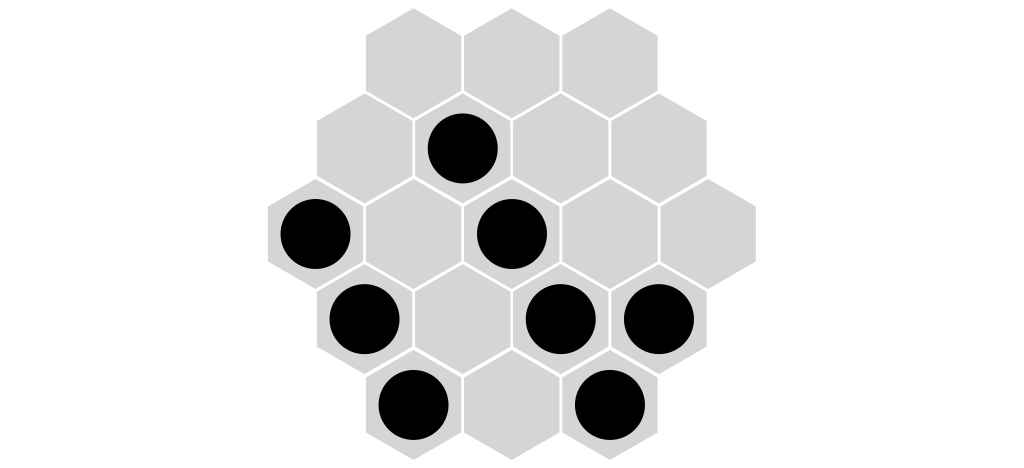
In fact, I believe Black is lost (but please feel free to correct me if I've missed something in my analysis). Look at the bigger of the Black bugs. Although it stretches almost across the entire board, there are two possible White shapes (partly covered by the smaller of the Black bugs) that may replicate it. If White can gain enough tempi to place the necessary five stones to do this, she will win. 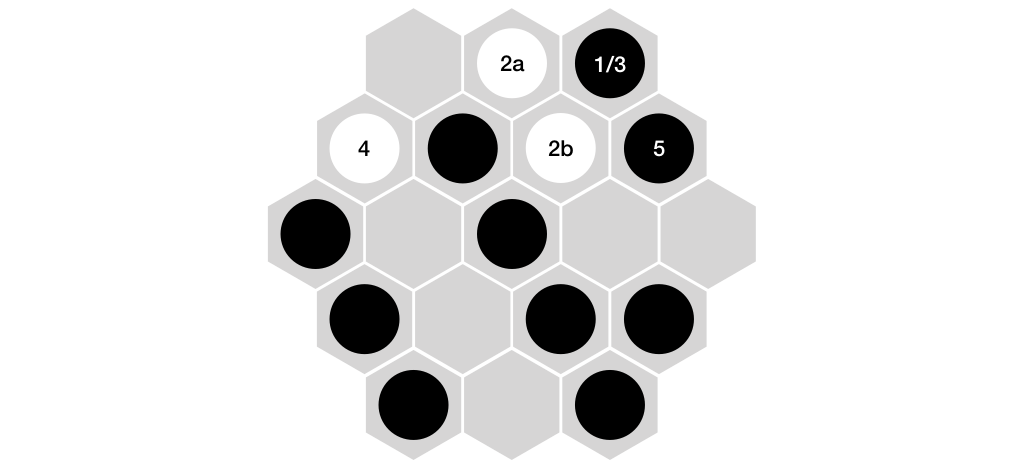
It must be White's turn in this position, since Black must have eaten the last White stones, but let's for fun say that it's Black's turn and see that not even this extra move will help Black. (White in turn would simply play 4 as her first move.) Black is in zugzwang and must play 1, after which White eats it with 2a and grows with 2b. Black replicates with 3 and White coolly plays 4 at the other end of the board. Doesn't this let Black play the only remaining move 5 and eat? 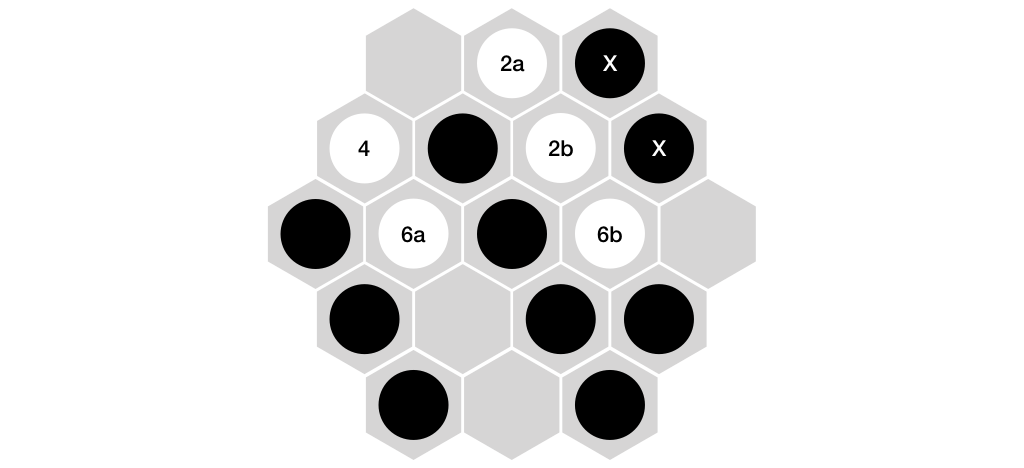
Actually, Black can't grow and thus can't eat so instead White plays 6a, eats the Black stones marked "X", and grows with 6b. Compare this with the starting position. Black has exactly the same stones as she started with while White has managed to play five stones. 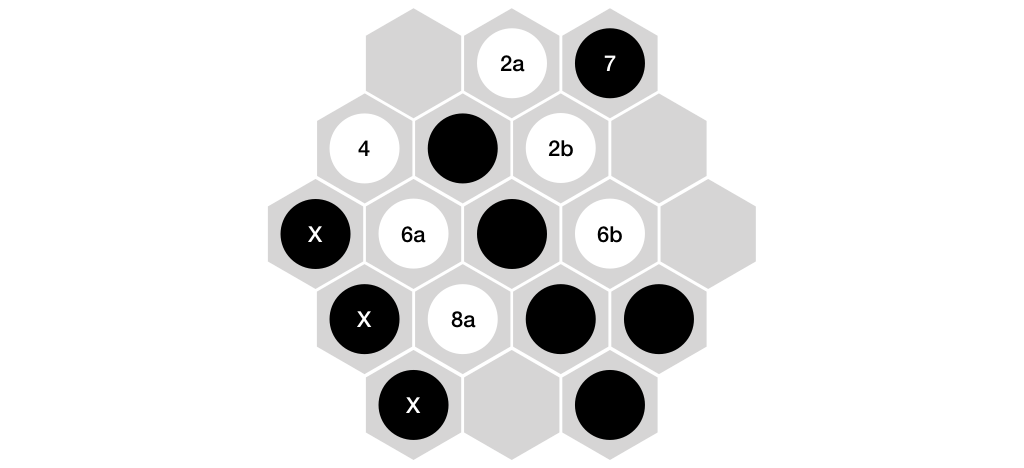
Black starts over again with 7 but it's too late as White gains another tempo with 8a, which eats three more Black stones. 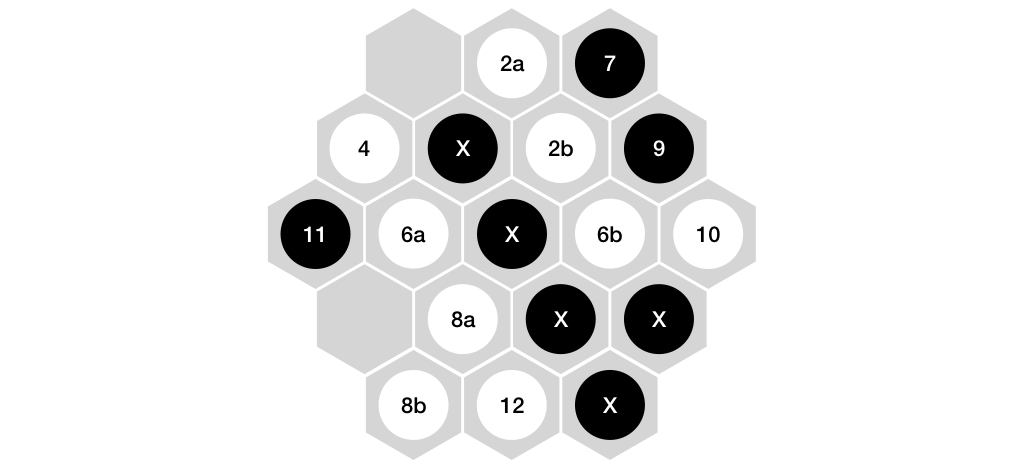
White grows to 8b and even has time to stop Black's future counterattack 9 with 10. Now nothing can stop White's 12, which will eat the big Black bug and grow to the last remaining space for White. An astonishing comeback for the uninitiated but a natural cause of events for the one understanding the possibilities of Bug. In order to eat the size 5 bug, White had to gain tempi by first eating a size 1 bug and then the size 3 bug. So is it a Perfect Game?I hope I have shown that Bug is not only an elegant mechanic but also a game full of tactical tricks and strategic challenges. So what's not to like? Players may think that the opening is too opaque. In Chess and Go, you can move a piece or place a stone with a specific purpose. In Bug, you won't know whether your first stones will survive and there is nothing you can do to protect them. The end game on the other hand may feel scripted once the decisive moment has taken place. In the game example above, the concluding moves were almost forced and there was nothing Black could do to complicate matters and steer White away from her winning path. Personally, I think it's the tension up to this decisive moment that is the exciting part of Bug. Bugs come and go on the board as the players slowly build up their presence and carefully monitor how many spaces they have left, which shapes that can be replicated and how they can take advantage of forks, zugzwangs and tempis. Whoever finds this decisive moment first will win and the loser can't blame it on coincidence. So what's the Optimal Bug Size?Last but certainly not least a few words about the scalability of Bug. I've mostly played on the small 3 hexside board, a size that is more than enough for a varying gameplay thanks to the way that the eating and growing changes the game state. On larger boards, the opening does take longer before things start to get interesting. However, once the patient players have reached the middle game, they will be rewarded with entirely new challenges. Whereas the small board middle game was dominated by one big bug around which all end game strategies revolved, there will now be several bugs of different shapes and sizes that may co-exist because of the larger distances and the increasing difficulties to replicate them in the quickly shrinking non-bug spaces. The game may end with one player having formed one "super bug" or it may end with both players having some large bugs each and racing to fill the remaining spaces to run out of actions first. Similar challenges as the ones on the small board but on a grander scale. I've even seen discussions about a multi-player Bug and although such an idea needs extensive testing, I think the game may be stable enough to accommodate several players. Unlike Chess and Go, where a struggle between two players may weaken both in favor of a third passive player, such a player in Bug will always be a step behind thanks to the eat and grow mechanic. After the battle between the two bugs has ended there may simply not be enough space left for a third bug. Concluding ReflectionsWhen I first approached Bug, I felt as lost as when I first approached Go and vainly tried to apply my Chess thinking to it. Bug is a unique game that requires a unique thinking. It is neither Chess nor Go and although I have a fairly good winning rate so far (>80%) I feel there is much more to explore. All of you who are interested in abstract combinatorial games but have grown tired of the endless Chess and Go clones, there are still new games under the sun. 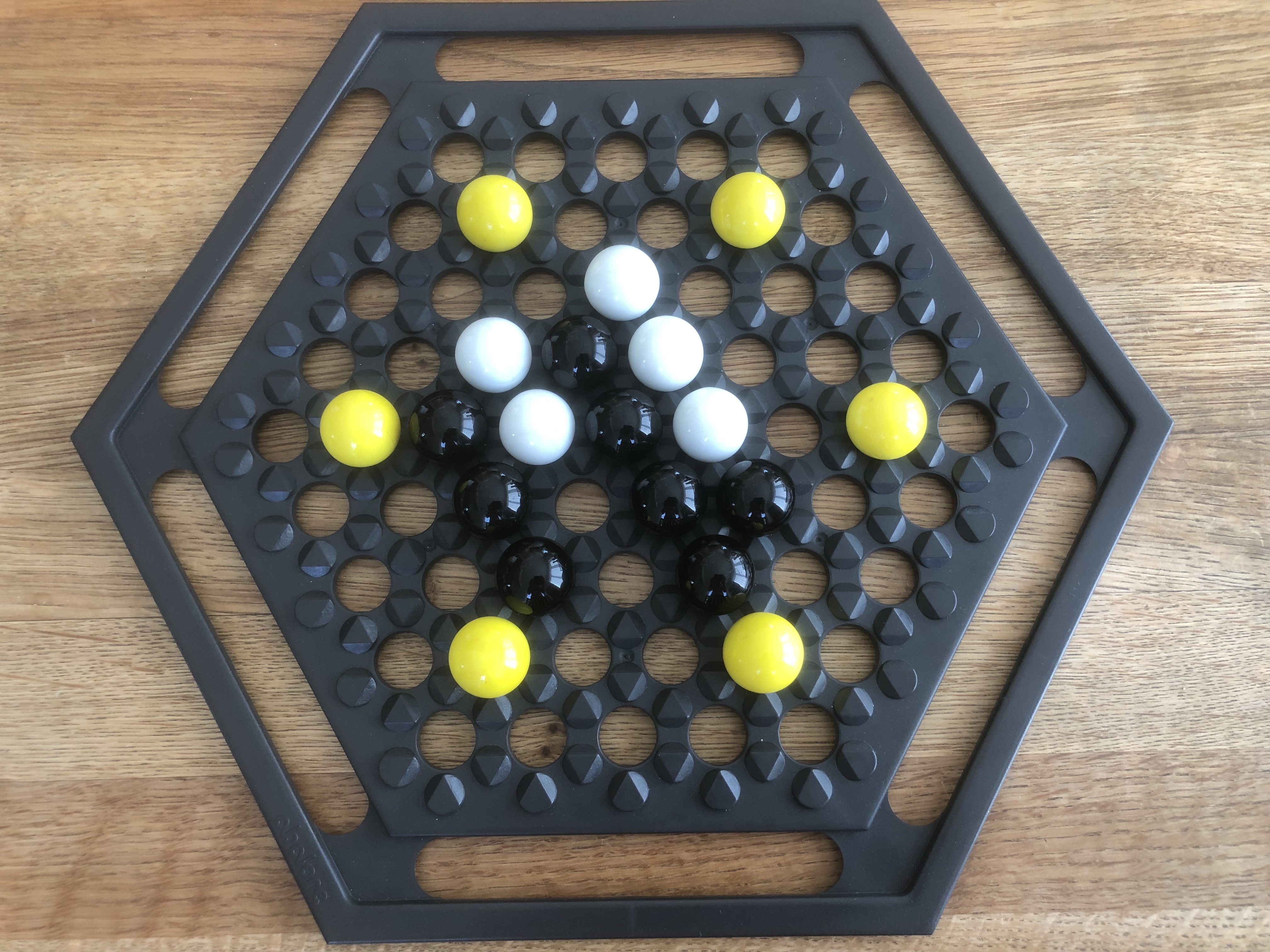
Finally a good use for my old Abalone board. (The yellow stones mark the borders of the smaller board.) |
|