
 |
The Quest for the Perfect Game - Reviews to Extract the Essence of Games by Nicholas Hjelmberg | |

























|
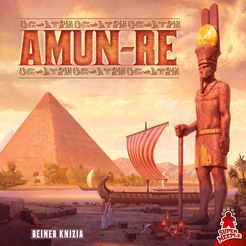
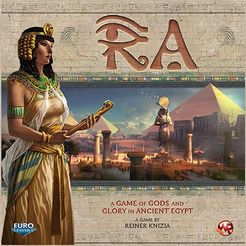
Ra - Is this Really an Auction Game? (Published 21 January 2019)This review has also been published at Boardgamegeek. The Auction ChallengeThe auction mechanic is sometimes criticized for being a lazy mechanic, applied by designers who don't bother balancing the game components. Instead, it's up to the players to do the designer's job. The course Game Balance Concepts provides a fictional game example where players bid for characters, with the result that strong characters will be balanced by having less money. As the author states, "there is a correct answer here, but instead of taking the trouble to figure it out, you instead shift that burden to the players and make them balance the game for you." Lazy is the word. Also, as pointed out by iSlaytheDragon, auctions may increase the learning curve, since experienced players will have a better sense of the game components' value. In a game like Power Grid, inexperienced players often over- or undervalue the power plants up for bid. In the first case, they won't have enough money for resources to power their plants, and in the second case, they will miss out on the best power plants. Games with a fragile economy, such as Container, may even break down if the players don't know how to properly assign values to the goods bought and sold. (This doesn't mean that those games are bad, on the contrary they are both great and I hope to show why in future reviews.) But even if players do know how to value the game components, an auction may often be a frustrating experience. Assuming that the players' average value equals the "true" market value, the winner will be the player with the highest estimate. This leaves the loser unhappy because he or she didn't get anything while the winner may suffer from "winner's curse" because he or she overpaid. How then can a game based on auction be fun? How could the "Good Doctor" Reiner Knizia design not only Ra but also several other successful games based on this mechanic? To answer this, we will look at the context of the auction: the why, what, how and when of the bidding. The Why - Why are you bidding?The goal of Ra is to collect sets of tiles during three rounds or epochs. However, the sets are not your normal Poker straights and flushes.
Gods earn you 2 VP each but also serve as wildcards that may be exchanged for other tiles. Rivers earn you 1 VP each but only if at least one of them is a flood. Rivers are kept after each epoch except floods. Pharaohs award 5 VP but only to the player or players with the most of them. The players or players with the least of them lose 2 VP. They are kept after each epoch. Civilizations award 5 VP for 3 unique tiles, 10 VP for 4 unique tiles and 15 VP for 5 unique tiles. The players with none lose 5 VP. Monuments award VP both for similar ones (5 VP for triplets, 10 VP for quadruplets and 15 VP for quintuplets) and for unique ones (1 VP each, 10 VP for 7 unique and 15 VP for 8 unique). They are kept after each epoch but score only in the last epoch. To make the sets even more difficult to value, there are also "disaster tiles", which discard an ordinary tile (if available). A bid that may give you your missing monument may also cost you your precious flood. 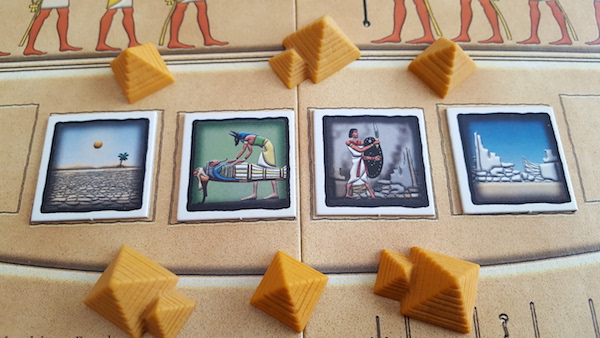
So what's the average value of a tile? It depends on which sets you're collecting. This seemingly simple mechanic creates an important condition for a successful auction game: the tiles quickly get different values for different players and mitigates the problem of unbalanced tiles and winner's curse. A tile that may be worthless to one player not needing it for his set may invaluable to another player desperately seeking to complete her set. The What - What are you bidding for?In Ra, set collection is not only your ends but also your means. Each turn, you have two choices: either start an auction ("call Ra") on the tiles currently up for grabs, in which case you must bid if nobody else does, or draw another tile to add to the loot. (Actually, you also have the third choice of playing a Gods tile but this is a rare one.) So basically you bid for sets of tiles to complete sets of tiles and it's you and your opponents that collectively decide how big those sets should be allowed to grow before you start the auction. This adds many interesting decisions to the standard "how much should I bid" decision. A set with few tiles may still be valuable to you while a set with many tiles may contain mostly useless tiles. Drawing another tile may increase the value for you but what if it increases the value even more for another player and thus increases the competition for that set? The average designer might have been happy with this "double set collection mechanic" and designed an ordinary "bid money for VP" mechanic around it. However, Knizia had much more up his sleeve. 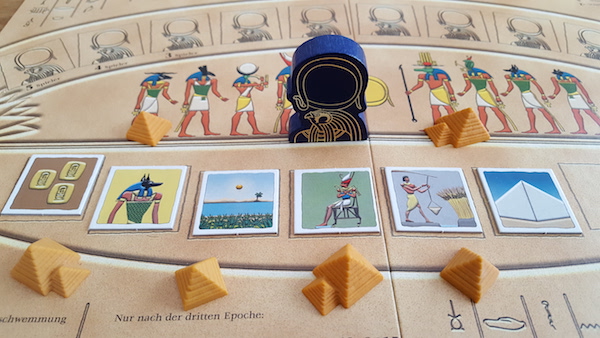
The How - How are you bidding?The currency of Ra is not money but sun disks. Each epoch you have three or four of them at your disposal and each sun disk has a unique value. Similar to how you have two choices in a turn, you have two choices in an auction: participate by playing one of your sun disks or abstain. If you win the auction, take all the tiles on the board and replace your sun disk with the sun disk currently on the board. (You may not use it until the next epoch.) That's it. No long bidding rounds, no granular bids, no complex tie-breakers. Wait, what? Did Reiner Knizia first add decisions through double set collection only to remove them again through this discrete bidding? Yes, and this is an important part of Ra's brilliance. Imagine the analysis paralysis if you had played with money instead. You would have to calculate the VP value of each tile in the set in relations to the sets you already have and translate this into a monetary value. Imagine how much analysis paralysis this would result in and how long the bidding rounds would be. Instead, you "simply" decide whether you want the tiles and which of your sun disks you're prepared to commit. 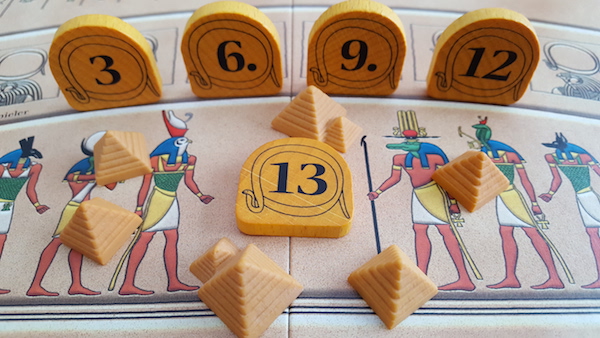
The When - When are you biddingWe've already mentioned that the players themselves may trigger auctions. But given that all sun disks have unique values, doesn't this break the game by giving the owner of the highest sun disk the power to keep adding tiles, knowing that he or she will win the bid? No, there is a timing mechanic represented by the dreaded Ra tiles. Depending on the player count, there is a track for the Ra tiles. Whenever a Ra tile is drawn, an auction is triggered automatically (and unlike the normal auction, no player is obliged to draw). This means that if you do have the highest sun disk, you have to decide whether to bid (and miss out on additional tiles) or pass (and risk that someone else grabs the tiles with a lower sun disk). In addition, as soon as the Ra track is completely filled, the epoch ends immediately. No final auction, no end of round, nothing. If you didn't play all your sun disks, you have only yourself to blame. Now, this sounds like a push your luck mechanic and I'm not normally a fan of it. However, the way it's implemented in Ra, it's actually push others' luck mechanic. Say that you have the lowest sun disk. Do you have to wait until all the higher sun disks have got what they want? No, challenge the other players by calling Ra prematurely. In the best case, they'll waste their precious sun disks on less tiles than expected, and in the worst case you'll get a fair amount of tiles for your "useless" sun disk. This challenge wouldn't be nearly as interesting with money. 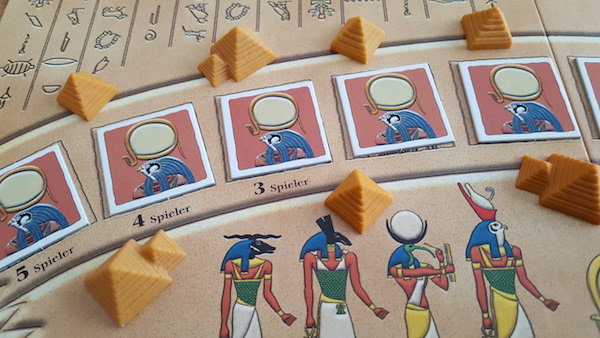
So What's to Like?What Reiner Knizia has accomplished in Ra a is a complex auction game distilled into only two decisions at the time. Before an auction, you either draw a new tile or call Ra to start an auction. During an auction, you either bid or pass. But although those decisions are seemingly simple, the values of the bids are hard to compare to the values of the sets you're collecting so the game doesn't really reward precise valuation. Instead, Ra focuses on the interaction between the players, challenging each other to bid for tiles they don't want and pass for tiles they do want. One could liken Ra to a combination of Poker, where you also "collect sets", and Blackjack, where the players collectively ask to be hit (and can be hit really hard if an epoch ends earlier than expected). Ra has been a particular hit with non-gamers, that quickly recognize the familiar game mechanics and appreciate the innovative use of them. (I hesitate to admit this but in one recent three player game, one new player scored much more than the other experienced players together.) 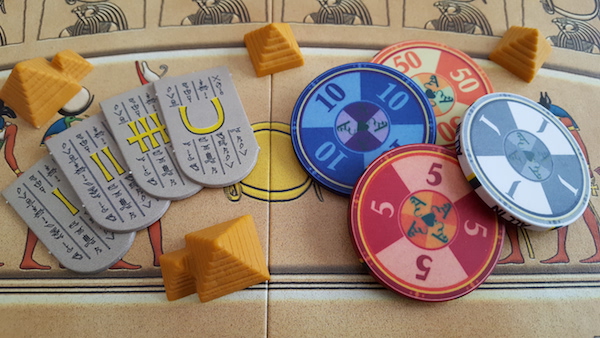
... and What's not to Like?Many players consider Knizia's games to be dry and unthematic. While I often disagree, Ra doesn't really make me feel like I "enrich civilization through art, religion, astronomy, writing, and agriculture; build monuments to greatness which will endure through the ages; implore the gods to bestow their favor upon you; immerse myself in the wonders of Ancient Egypt and the power of Ra" as the rules claim. Some (but certainly not all) seasoned gamers have lacked a purpose with the bidding in the game. I respect this view, since I personally dislike games that are all about amassing victory points without any underlying goal. However, I do think that this view fails to understand that the bidding and the set collection mechanics are not the game but merely tools for the competition and interaction between the players. That said, Ra is certainly not a game for everbody (but is any game?). So is Ra really an Auction Game?Of course Ra is an auction game, you might think, but is it really? An auction participant should be rewarded for precise valuations. A collector should be rewarded for complete collections, free from redundant items. But a game designed on those principles would see players focusing only on their own collections so that each new item offered is likely to be most valuable to only one of them. It sounds dreadfully boring to me. But what Knizia did was to remove player agency and reduce complex player decisions to simple boolean variables. Take it or leave it! Did this make Ra even more boring? No, quite the opposite! The seemingly blunt auction and set collection mechanics are merely tools for a "truth or dare" mechanic where the players constantly challenge each other. The individual parts of Ra are no more innovative than the individual nuts and bolts of a clock. However, put together they turned the game into an extremely well-oiled machine with high interaction and low downtime. If you like auction games, Ra offers a unique angle. If you don't like auction games, Ra offers a deep experience far below the auction surface. Take it or leave it! 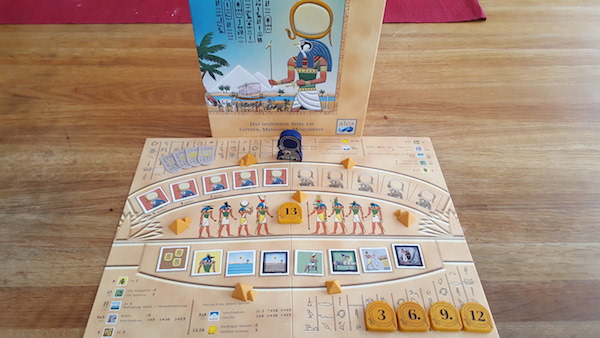
|
|
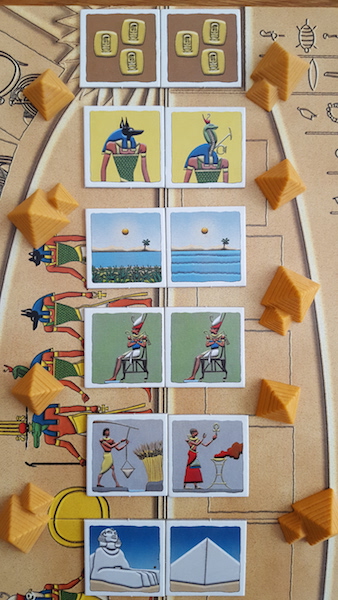 Gold simply earns you 3 VP each.