
 |
The Quest for the Perfect Game - Reviews to Extract the Essence of Games by Nicholas Hjelmberg | |




















































|
Arkwright - X (To be published in August 2024)This review has also been published at Boardgamegeek. Economic gamesWith 20 years of experience in modern board games and over 600 games rated, my tastes have become more selective, and it's rare for a game to provide the "wow factor" that many gamers desire in new releases. Tigris & Euphrates' use of the tile laying mechanic, Hansa Teutonica's unlockable player board abilities and Keyflower's double purpose meeples are some examples of games that managed to go through the eye of my needle. One thing those games have in common is that the players' actions directly affect the game state and thus provide indirect player interaction. In my opinion, this is the perfect middle way between the take that interaction of many Ameritrash games and the multiplayer solitaire of many recent Eurogames. My preferences often lead me to economic games, where the players compete for resources and customers on a common market. Classical economic theories like the law of supply and demand lend themselves very well to game mechanics, as shown by games like Power Grid, where the players' demand increases the resource prices. Arkwright has gone further by giving the players control of even more market parameters: prices, supply and (indirectly) demand are all the results of the players' actions and every single action affects the economy in the game. Increased production requires more workers, which leads to higher wages as well as higher demand, which leads to better return on automation investments and so on as the wheels of economy spin faster and faster. The economist in me was moved when I read the rules and realized all the interdependencies. But do those sophisticated mechanics translate into a good game? Let's find out! Excel - The BoardgameWhen I first learned about Arkwright, it was introduced as "Excel - The Boardgame" and the game board does indeed look like a spreadsheet with its many market tracks. This is actually a compliment in my books but I fully understand if it puts off others. The objective of the game is to build the most valuable portfolio. You do this by investing in factories, hiring workers, producing goods, and selling them on a competitive market. Every step you take is a small optimization game, where you have to carefully navigate through those aforementioned spreadsheets, predicting and reacting to the ever changing conditions. Nevertheless, once you understand the mechanics, you will find that the gameplay is surprisingly smooth and intuitive. Market Share Table - The Appeal spreadsheetThe first spreadsheet we'll have a look at is the central market spreadsheet. This spreadsheet tracks the appeal of your goods, a critical concept which determines your chance to sell your goods. Basically, the appeal limits the number of goods you may sell and it also lets you sell before your opponents. In the image below, blue player may sell up to 2 food, but if the total demand is only 3 food, yellow sells 2 food, blue 1 food and black 0 food. The appeal in turn is determined by two other critical concepts, quality and price. The higher the quality and the lower the price, the higher the appeal will be. This creates a constant tension between the players, where each player has to find the equilibrium that optimizes the profit. Should you go for high quality or low prices? Should you expand on an existing market or try to find new markets with less competition? Should you even abandon a market completely by exporting the goods instead or closing the factory? Those are real-life management decisions that have been beautifully abstracted into the three simple game concepts appeal, quality and price. Let's now move on to the spreadsheet where you make all those decisions: the production spreadsheet. 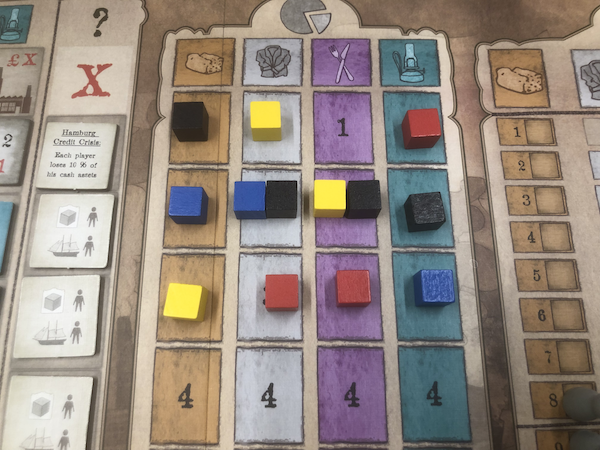
Appeal - X. Factory Mat - The Production spreadsheetThe factory contains one row per good in the game: food, clothes, cutlery and lamps. Each row has a track for the price, where you can adjust your price, and three spaces for tiles, where you can adjust your quality. The "quality tiles" include factory markers (where the base quality equals the building cost), quality markers (which give a low but permanent quality increases) and distribution markers (which give high but temporary quality increases). This does require some math, since the appeal needs to be recalculated every time any of the above changes, which may not appeal to everybody (pun intended). However, if you're OK with this level of math, you will be rewarded with many brain-burning challenges when applying it in your strategy. There are also spaces for production ("production rows") and each such space must be completely filled by workers or machinery tokens for goods to be produced. Let's move on the next spreadsheet to learn more about them: the worker spreadsheet. 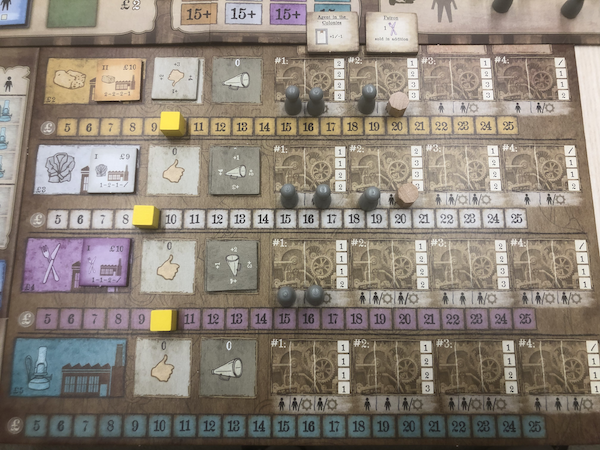
Factory - X. Job Market - The Worker spreadsheetThe job market serves a dual purpose. First, it determines the wages that have to be paid when the factory goods are produced. Workers are hired from left to right, top to bottom, and the more hired workers, the higher the wages. Second, the job market determines the demand. Each good has its own demand column on the job market and every time a worker is hired, the now empty cell tells the demand of the specific good. Similar to real-life management decisions, there will be a point where the high wages make machineries more profitable, but if workers return to the job market, not only wages but also demands will fall. This is another excellent example of how player decisions change the game conditions for all players. Arkwright is not the kind of game where you build your engine in isolation without paying attention to what the other players are up to. OK, so now we know more about the different cog wheels of the game but how do we choose the actions to make them rotate? The answer is in another spreadsheet: the planning spreadsheet. 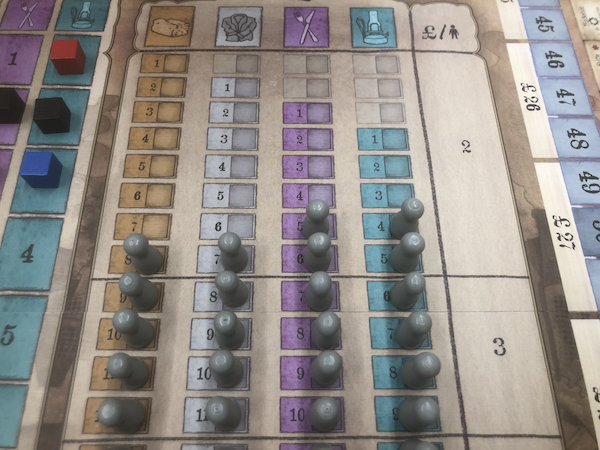
Job Market - X. Administration Chart - The Planning spreadsheetThe administration chart is an action selection mechanic with the designer Stefan Risthaus' special twist. Instead of placing workers in action spaces, you place action tiles in work spaces. Each space is associated with an administration cost and some action tiles get stronger if you meet the action's cost threshold. Take the machinery action tile as an example. If you pay at least £3, you get 1 machinery, if you pay at least £6 you get 2 machineries, and if you pay at least £13, you get 3 machineries. (I've only seen this particular mechanic in the designer's fine game Gentes.) The actions are all related to building and developing your factories. Factory lets you build, upgrade or close factories, Workers lets you hire workers, Machinery lets you buy machineries, Quality and Distribution increases quality and Stock Exchange lets you take various financial actions, among them trading shares and contracts, more about that later. Another aspect of this mechanic is that production is not an action. Instead, each cycle of player actions is followed by an automatic production of a specific good. This means that once you've collected revenue for one factory, you have only one action at your disposal to prepare for the next factory and only four action altogether before the next round starts. This leads to several challenges. Which action should go to which space to be cost efficient? Which actions should be skipped in a round and which should be duplicated (something that can be done but costs more)? In which order should the actions be taken in? Is it better to improve a factory before production (to maximize the revenue) or after production (to get money to optimize the action)? Both money and actions are scarce in Arkwright! 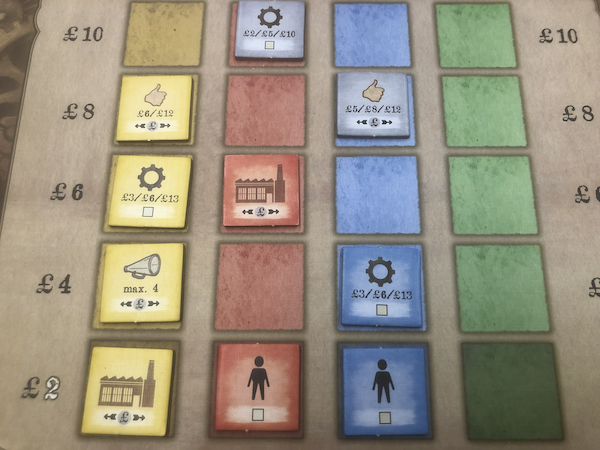
Administration - You get what you pay for. Special Markers - The Improvement spreadsheet 1
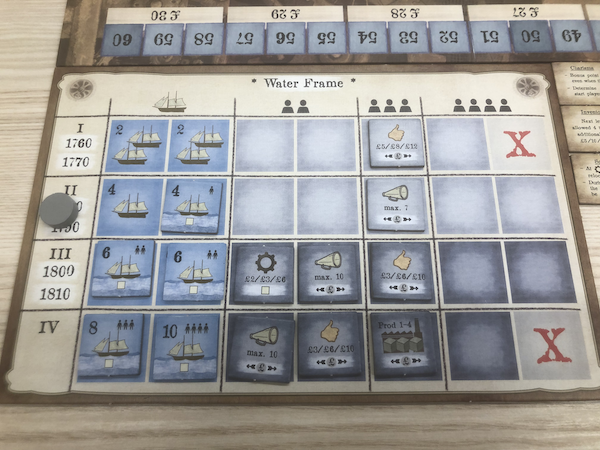
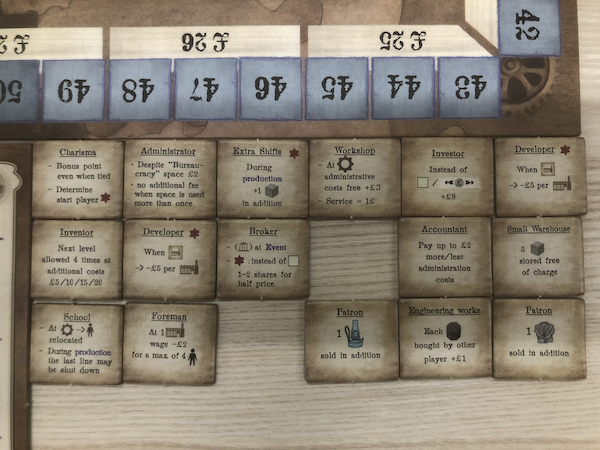
Development - X. Development - The Improvement spreadsheet 2
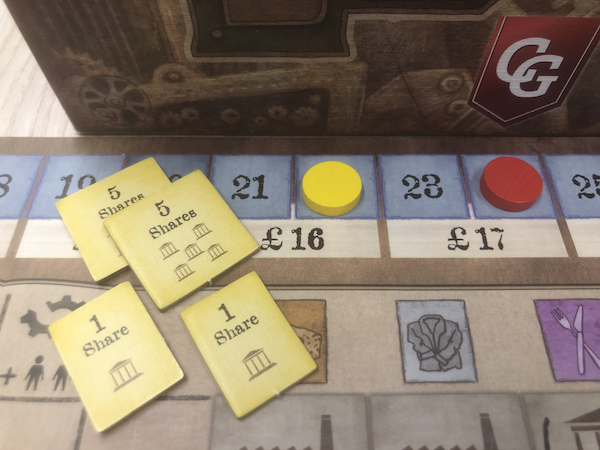
Development - X. Share value - The Stock spreadsheet
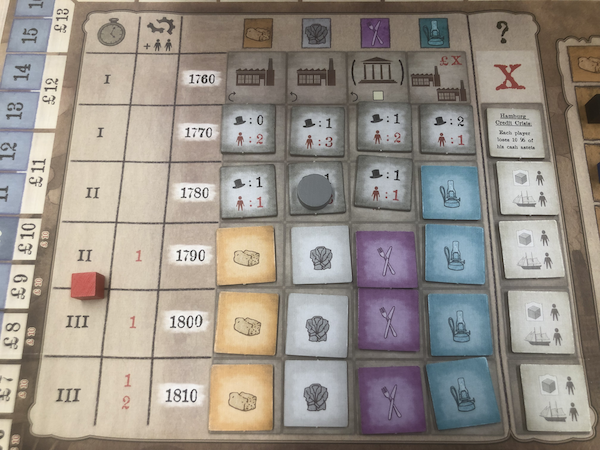
Development - X. Time table - The timing spreadsheet
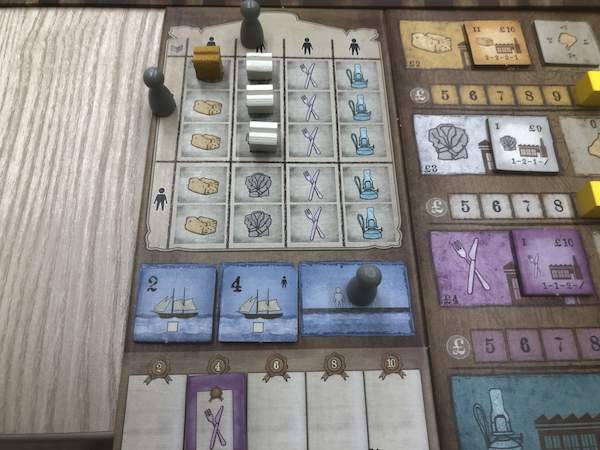
Time table - X. Harbor - The Storage spreadsheet
Harbor - X. Conclusion
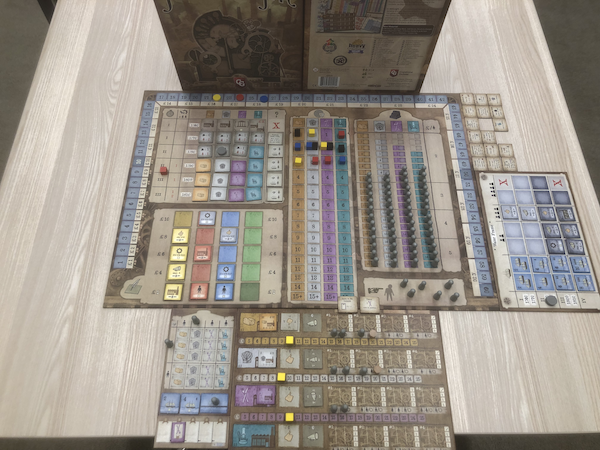
It's not that intimidating anymore, is it? |
|