
 |
The Quest for the Perfect Game - Reviews to Extract the Essence of Games by Nicholas Hjelmberg | |
















|
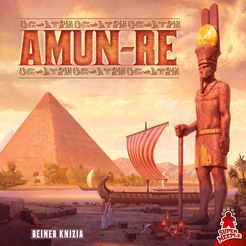
Amun-Re - From the Heights of these Pyramids, forty Victory Points look down on us (Published 18 February 2019)This review has also been published at Boardgamegeek. The BeginningsMy previous review was a game by Reiner Knizia set in Ancient Egypt where you bid to collect sets through different epochs to please Ra, namely Ra. Thus, it was a natural step to review a game by Reiner Knizia set in Ancient Egypt where you bid to collect sets through different epochs to please Amun-Re, namely Amun-Re. Wait, what? Is Amun-Re simply a reimplementation of Ra? Historically, it would make sense. The god Amun-Re was a fusion of the Theban patron deity Amun and the Sun god Ra so perhaps Knizia wanted to fuse the game Ra into the game Amun-Re? But no, in spite of the seemingly similar mechanics, the Good Doctor wanted to make Amun-Re unique (and I don't think there is any Amun game among Knizia's 600+ other games anyway). In fact, the particular game flow is different from any other game I've played and this review aims at finding out why. Amun-Re holds a special place in my game collection. It was the third game to enter it (after Catan and Tigris & Euphrates) and also inspired my first fumbling attempts in game design. My game also used bidding to acquire areas to produce resources to contribute to the common good. Not surprisingly, while the many different mechanics in my game became disjointed, they run very smoothly in Amun-Re and we shall now find out why. The Game Flow - The Twists and Turns of Amun-ReAt first glance, a game of Amun-Re may seem fragmented. It's divided into several distinct phases, each with its setup and cleanup activities. First, you bid open gold for provinces. Then you buy farmers (to earn gold), stones for pyramids (to earn victory points) and power cards (to earn abilities). Then you bid hidden gold to Amun-Re to earn benefits. Then you collect gold. Rinse and repeat for 3 rounds, after which you also collect victory points. Finally, and unlike your normal euro, return everything you've so meticulously acquired and play 3 more rounds. All this is unlike many later euro games, which focus on quick actions and constant progress. You can't even play the phases as mini games, since the only purpose of a phase is to feed in resources into the next phase. By all definitions, Amun-Re shouldn't be able to fly but yet it does and the secret is exactly what the later euro games tend to forget: it's not the parts of a game that are interesting, it's the whole. It's when you realize that every phase is a stepping-stone on the way to the top of a pyramid that you learn to appreciate Amun-Re. Let's proceed towards this realization by looking at how those stepping-stones are linked to each other, starting from the top (the goal) and working our way down (the way to get there). 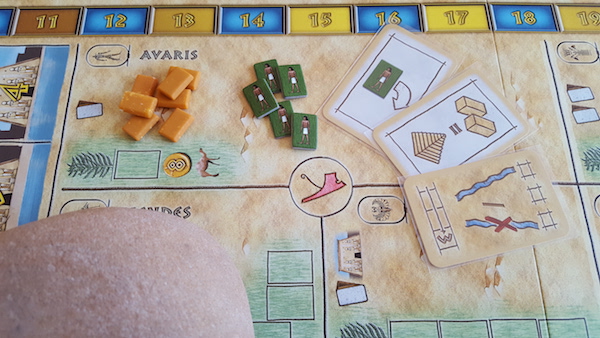
Stones, farmers and power - everything a Pharaoh needs. The Victory Points (The Scoring Phase)There are three victory point sources in Amun-Re. First, there are the pyramids. They earn you 1 VP for each pyramid, 3 VP for each complete set (1 pyramid in each of your 3 provinces), and 5 VP for having the province with the most pyramids on either side of the Nile. Second, there are the temples. they earn you VP depending on how pleased Amun-Re is. (More about this later.) Third, there are the power cards, that rewards you if you fulfill certain conditions. All those victory points require gold in one way or another so let's move down one step and learn how to get those. 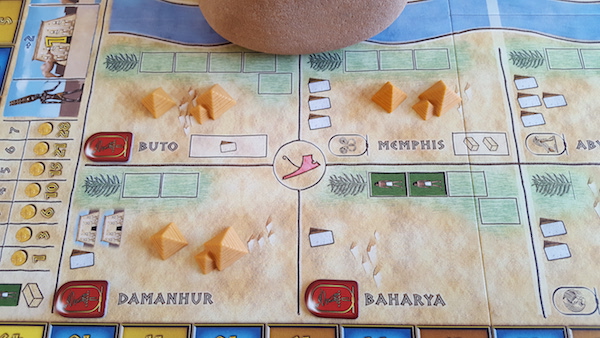
Red earns 9 VP for 9 pyramids, another 9 VP for 3 complete sets, and possibly 5 VP for the most pyramids west of the Nile. The Money (The Harvest Phase)The number three comes back in the Harvest Phase as there are three gold sources in Amun-Re. First, there are the mine provinces, earning you a fixed income. Then there are the farmer provinces, earning you an income depending on how many farmers you've invested in and how pleased Amun-Re is. Finally, there are the caravan provinces, earning you an income only if Amun-Re is displeased. This means that some players will want to displease the Sun God, some will want to please him and some will simply don't care. This is an interesting conflict of interests that will take place in the preceeding Sacrifice Phase, so let's move one step further down and learn about this. 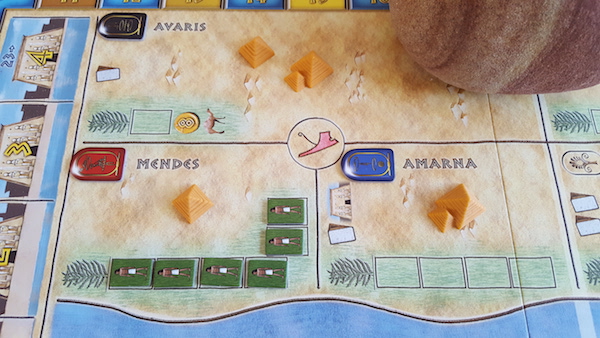
Black earns 8 gold for his caravan province if Amun-Re is displeased and Red earns 1-4 gold for each of her 6 farmers depending on how pleased Amun-Re is. Blue earns no gold but her temple is worth 1-4 VP depending on how pleased Amun-Re is. The Sacrifice to Amun-Re (The Sacrifice Phase)The sacrifice to Amun-Re is your chance to show your devotion to the sun god. Well, actually it's your chance to set the conditions for how much gold that should be allocated to all the players. Each player "bids" a secret amount of gold and the total amount of gold determines how pleased Amun-Re is. As we've seen, this determines how much (or little) gold the different provinces earn you. There are also rewards for the players bidding the most (3 for the most, 2 for the second most and 1 for everybody else translated into stones, farmers or power cards) as well as for the players not bidding at all (they simply steal 3 gold). This adds an interesting challenge in the game, since some players will want to steal while other players will want to offer (but not too much, only enough to reach certain thresholds). The intentions may be predicted but the actions is a matter of gambling. Do you take a heavy burden yourself or do you risk the free-rider route? As often is the case in Knizia's games, the answer is in the interaction between the players. Now that we've covered the victory point sources and the gold sources it's time to take another step down and learn about the resources accomplishing all this. 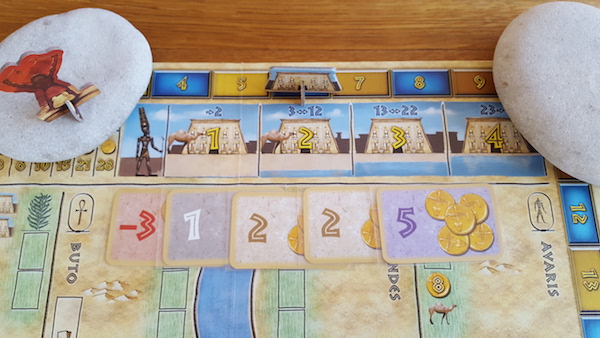
With only 7 gold sacrificed (10 actually, but someone stole 3 of them), Amun-Re is displeased so the farmers only earn 2 gold each but the caravan traders are happy. The Resources (The Action Phase)The holy number of three is also the number of basic resources to buy and use in Amun-Re: Stones for pyramids, Farmers for farming and Power Cards for, well, special powers. The more resources of the same kind you buy, the more expensive do they get (1 gold for the 1st, 2 gold for the 2nd, 3 gold for the 3rd and so on).
Power cards are drawn at random so you there is a luck of the draw moment here but the powers are fairly equal and won't make or break your game (but you should probably not ignore them). OK, so now that we know the resources, how do we get the provinces to place them in? Well, since this is a Knizia game, you bid for them. Let's move down to the first step and learn more about this. 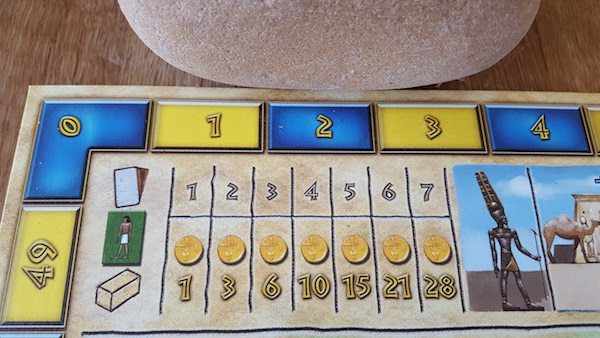
7 stones? That will be 28 gold. Do you want power cards with that? The Provinces (The Aquisition Phase)In the Acquisition Phase, the players take turns to bid for provinces. Through blind bids, like in the Sacrifice Phase? No, Knizia may like auctions but he doesn't repeat himself and manages to find a unique twist to each one. The Province Auction has two twists. First, the bids are fixed to certain amount that increase exponentially. The 1st bid costs 0 gold, the 2nd costs 1 gold, the 3rd costs 3 gold and so on up to 36 gold for the highest bid. You don't have to start on the lowest bid and it's sometimes wise not to, since it will be expensive if you have to raise your bid. Actually, it will be very expensive due to the the second twist. If you're overbid, you must move your bid to another province and only if you're overbid there as well you may return your bid to the first province. In a way, this is also a blind bidding but with other means. The better you predict your opponents' preferences for provinces and willingness to bid, the less you have to bid to get to your provinces. Bid less and you may have to pay more (or don't get your province at all). Bid more, and you pay too much. Altogether, this creates a bidding full of agony. 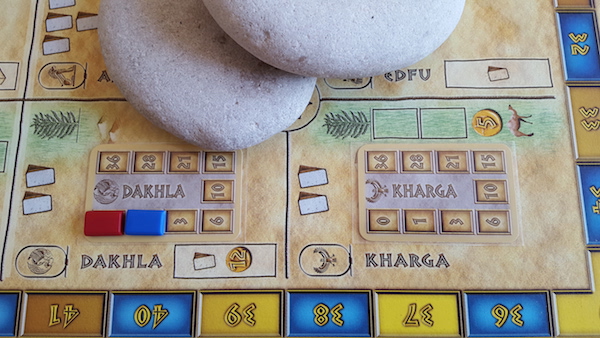
Red has been overbid at Dakhla and must find another province for her next bid. The Second KingdomWith that we've reached the base of the pyramid. Is this all there is about Amun-Re? Get gold through farmers etc. first and then switch to pyramids through stones at the right moment and spice it with some power cards? No, there is also the element of two different kingdoms. Between the First Kingdom (round 1-3) and the Second Kingdom (round 4-6), EVERYTHING is cleared from the table and reset except for the stones and the pyramids. That's correct, your carefully built engine in the first kingdom is not only lost but the most valuable part of it, the victory point scoring pyramids, are up to grab for the highest bidder in the second kingdom. This means that it's not enough to optimize your gold/victory point engine as in ordinary euro but you must also keep enough gold from the first part of the game to survive the second part. How much gold is enough? Oh, that's simple, you just have to keep more gold than your opponents. A third kind of blind bidding if you want, since gold is hidden. Agonizing? Yes! Brilliant? That too! The ChallengesAuction games often pose challenges for new players when it comes to valuation and Amun-Re has three kinds of auctions. New players may bid too little for provinces, sacrifice too much to Amun-Re and not save enough gold for the second kingdom. Is it an impossible threshold? Not in my experience. The group dynamics serve to restrain the player actions. Engaging in crazy bid wars will only benefit players refraining from them. Not even the valuation of the provinces is an issue, since the values of them depends on so many factors that there are no "true" values but rather new values for each new game. Amun-Re still rewards experience but my impression is that new players will quickly grasp the game flow and learn to tell a good bid from a bad bid. A more critical challenge is the player count. Amun-Re gets better with more players, preferably the full player count of five. With five players, the balance between farmer provinces and caravan provinces is maintained and the bidding gets more tense with overbids getting more likely. Amun-Re is still a good game with less players but it loses some of what makes it special. The End of the JourneyOur journey down the pyramid has shown us how the different phases are linked to each and how each of them offers an interesting game that plays an important role in the overall game. No phases feel unnecessary, no phases feel uninteresting. To succeed in the eyes of Amun-Re, you need to balance between farmers (for gold) and pyramids (for victory points), between pleasing Amun-Re (to further farming and get power cards) and displeasing Him (to further caravans and get gold), and between the First Kingdom (build provinces and save gold) and the Second Kingdom (spend gold to get the best provinces). In all those balancing acts, it's not the game you're gaming but the other players. Save too much compared to the other players and you won't get enough victory points returned. Spend too much and you won't have enough to compete for the victory points. There are many traps along the way and a fall down the pyramid is long and hard. Last but certainly not least, no Amun-Re review is complete without a reference to the legendary session report by BGG user Gola. Read, enjoy, and avoid his mistakes when you play Amun-Re yourself! 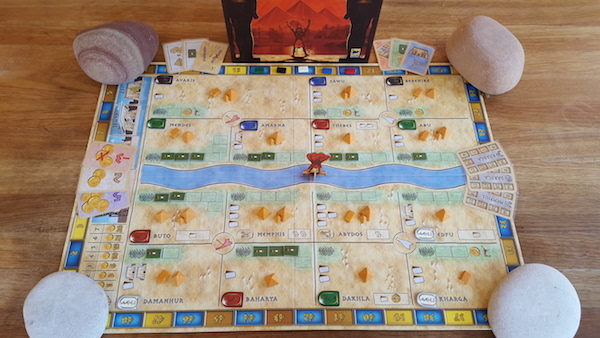
|
|