
 |
The Quest for the Perfect Game - Reviews to Extract the Essence of Games by Nicholas Hjelmberg | |

























|
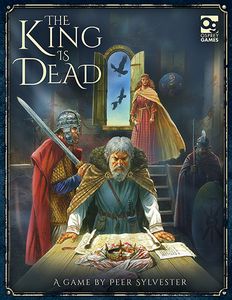
The King is Dead - How to Break a Tie to Unite a Land (Published 7 January 2019)This review has also been published at Boardgamegeek. A Minimalistic DesignThe King is Dead appears to have been designed with a minimalist approach, as if the designer had decided to give the players as little wriggle room as possible. The result is an extremely tense game that often lead to ties and tiebreakers. Is this a broken game then? No, this IS the game. Let's start by going through the three main mechanics of the game: area control, stock holding and hand management. The Area ControlThe game is about the control of Britan after the dead of King Arthur. Britain is divided into 8 regions and there are 3 factions struggling for the control: Romano-British (yellow), Scots (blue) and Welsh (red). The game is played over 8 rounds or power struggles, one for each region, during which the players manipulate the factions' followers (represented by cubes) in the regions. Once a power struggle has ended, the specific region is locked for further manipulations and whichever faction has the most followers there takes control. There are no rewards for second place - the winner takes it all. The faction which controls the most regions at the end of the game wins! So far, nothing new under the sun. As in most area control games, you'll want to claim the region majority with as few followers as possible so that you don't "waste" followers that could have fought for the majority elsewhere. But wait, which faction is yours? This is where the stock holding comes into play. 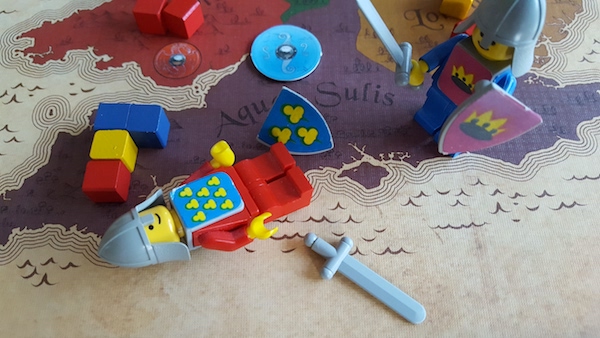
Scots (blue) have taken control of Aqua Sulis The Stock HoldingThe fight for the majority does not only take place in the regions but also in the factions. A player may take actions with followers of any faction and ends the action by taking 1 follower to his or her hand or court. (Each player also starts the game with 2 random followers.) The player with the most followers of a faction at the end of the game controls that faction and if that faction controls the most regions in Britan that player wins! So what we see here is a double area control game where you have to control not only regions but also factions. There is anoter catch as well: the follower you take to your court to increase your control of that faction is taken from the board, thus decreasing that faction's ability to take control of regions. How do you deal with that dilemma? Similar to region control, you'll want to claim faction control with as few followers as possible so that you don't waste followers that could have fought for the majority elsewhere. Do you begin to understand how limited your wriggle room is? Then it's time for the third and most agonizing mechanic. 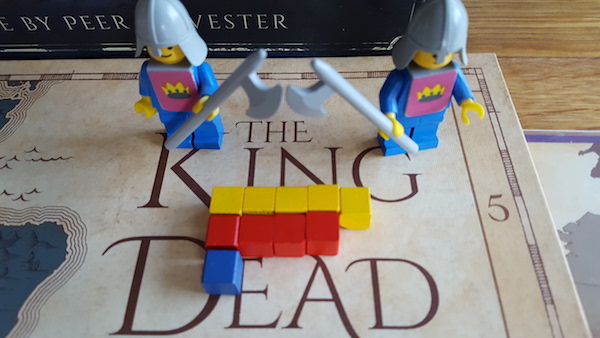
Strong control of Romano-British (yellow) and Welsh (red), less so of Scots (blue) The Hand ManagementWe've hinted about actions for manipulating the followers in the regions. The actions themselves are not that spectacular. The actions are executed through action cards and there are cards for adding followers, moving followers and changing the order of power struggles, 8 in total. So you take 8 actions in each power struggle? No, you take 8 actions in total. But aren't there 8 regions to act in? Yes, so if you use more than 1 action card in one region, you'll have to skip actions in another region! This is fine example of how a designer may add tension in a game by simply removing options. Not only does a player have to household his or her actions but he or she must also carefully monitor which action cards the other players play or save. Are you trying to wear down one opponent by playing many cards while the third opponent saves cards for future power struggles? Probably a bad idea, since you'll be left without actions to respond. Or are you trying to save your cards for a final push in the last power struggles? Perhaps an even worse idea, if regions get locked in a way that makes most of your actions useless. When playing the King is Dead, you must look at the other players' cards as much as at your own cards. OK, but with all those limitations the game is bound to end in a tie, isn't it? Indeed, and that's why you must play with a tiebreaker in mind so let's look at them next. 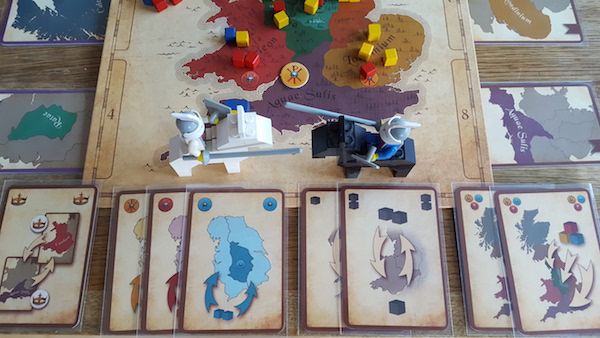
From left to right: actions for the order of power struggles, adding followers of a specific faction, moving followers, and adding followers of any faction The tiebreakersAs you may expect, there are several tiebreakers. However, those tiebreakers are also contradicting, meaning that something that may give you the victory in one case may deny you the victory in another case. The Power Struggle TieIf, after a power struggle, no faction has a majority in the region, the control goes to the invading Saxons instead. Initially, this only results in fewer regions to fight for. However, if 4 regions fall to the Saxons, the game ends immediately. Does the player controlling the strongest faction still win then? No, in this case the player having the most complete sets of followers wins! This tiebreaker means that if the game ends with a faction controlling Britain, your strategy should be to ignore the followers of the other factions, but if the game ends with the Saxons controlling Britain, your strategy should be not to ignore any followers. But how can you choose if you don't know the winning strategy until the game ends? Well, you'd better play with both strategies in mind!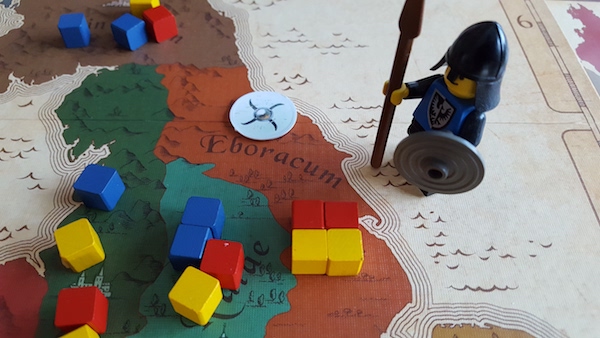
Et partitus regula - no faction has the majority so the Saxons invade The Region TieIf, after the eight power struggles, no faction has a majority in Britain, the faction which last won a power struggle wins. This is a sound design priniciple, since it allows trailing factions to catch up and often keeps games open until the very last round. In addition, it gives trailing players two options. Either you play for follower majority in the winning faction or you play for region majority for another faction. The Faction TieIf, after the eight power struggles, no player has a majority in the strongest faction, the majority in the second strongest faction counts for victory. This tiebreaker goes against both the "British strategy" (focus on one faction) and the "Saxon strategy" (focus on all three factions) because it rewards a strategy of focusing on two factions. Again, you don't know which strategy to choose until the game ends. The Action Card TieHave you had enough of tiebreakers yet? Bear with me because there is one left. If a British victory leaves the players tied, the tied player who last played an action card loses. However, if a Saxon victory leaves the players tied, the tied player who last played an action card wins. This tiebreaker means that you should play your action cards early in case of a British victory and late in case of a Saxon victory. What did we say about wriggle room? The Mordred VariantFor the players wishing even more tension, there is also a Mordred variant that adds loyalists (black cubes) to the board each power struggle. If they ever get a majority, the game ends immediately with the normal winning conditions. (In the case of lack of power struggles, the most followers breaks the ties.) This variant adds an interesting tension between players who play action cards early and thus want the game to end prematurely and players who play actions cards late and thus want to prolong the game. 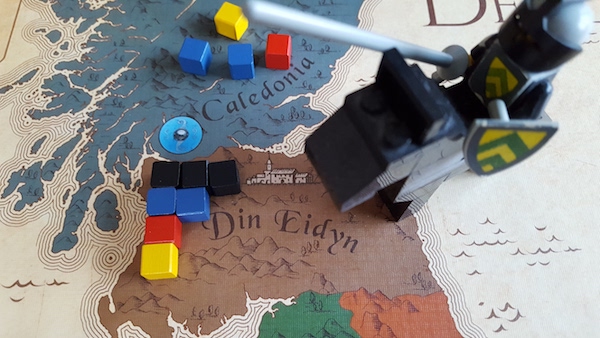
Sudden death as Mordred's loyalists claim Din Eidyn The 4 Player VariantFor 4 players, there is a team variant with - you guessed it - contradicting victory conditions. In case of a British victory, the team with the "best player" (the player winning according to the normal victory conditions) wins but in case of a Saxon victory, the players in the team count all their followers. Strategywise, this means that in the case of a British victory, one player should promote the other player, while in the case of a Saxon victory, the players should try to collectively acquire as many sets of followers as possible. An additional challenge is that the team members are not allowed to discuss tactics. 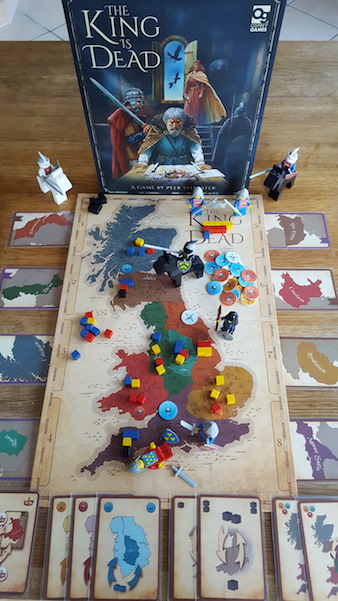
The CriticsThe King is Dead is certainly not a game for everybody. Some complain about the unpredictability (the different victory conditions aggravate strategies) while others complain about the lack of options (only eight action cards). It's telling for the game that those complaints are contradiciting - fewer victory conditions would make the game almost solvable while more action cards would make the game even more unpredictable. Others complain about the rule that, in the 3 player game, you're not allowed to play the last action card of the game if it won't win you the game. However, given that you have to play with the tiebreakers in mind, the lack of such a rule would quickly cause the game to break down through kingmaker issues. A more valid argument concerns the theme. I don't agree that the idea of controlling the controller is unthematic but I do agree that the setting of post-Arthurian Britain is strange. Not even King Arthur (or whoever the man behind the myth was) managed to unite Romano-British, Picts and Welsh so why would his successor manage that? Uniting Anglo-Saxon kings against the Vikings would have made more sense, as of course the original setting of King of Siam, but I guess King Arthur has more market value. ConclusionThe King is Dead builds on the mechanics of area control, stock holding and hand management to create a highly restricted game. The few and limited actions must be considered carefully and a strategy must take into account the many and often contradicting tiebreakers in mind. To enjoy The King is Dead, you should enjoy tense games where you must be constantly on your guard, monitoring your opponent's actions and being prepared to react to the ever changing conditions. If you want more opportunities to wage war on your opponents or prefer being at peace building your engine, The King is Dead is not for you. Otherwise, The King is Dead, or its predecessor King of Siam, is a brilliant design that should be tried by every gamer and part of every area control fan's collection. |
|