
 |
The Quest for the Perfect Game - Reviews to Extract the Essence of Games by Nicholas Hjelmberg | |




































|
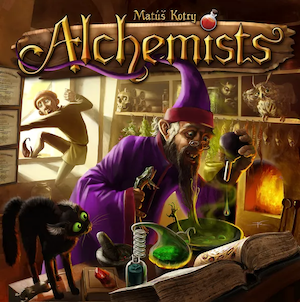
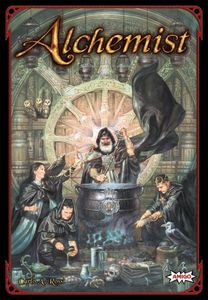
Alchemists - A Scientific Approach (Published 31 July 2023)This review has also been published at Boardgamegeek. It's not easy to design a game. Ideally, it should have an immersive theme that gives the game a direction as well as innovative mechanics that improve the game experience. Most importantly, it should be fun. Alchemists is a game where you apply the scientific method of experimentation to explore observations and answer questions. You do this through well-known mechanics like deduction, worker placement, action queues and resource management. 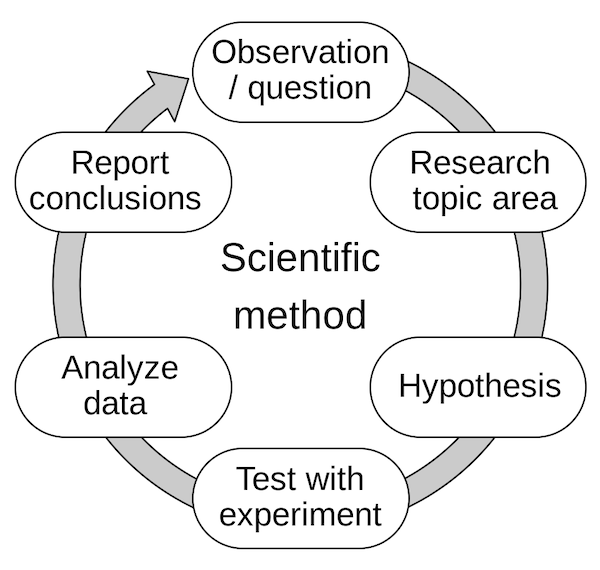
This may not sound very fun and I guess this is not how Matúš Kotry pitched the game but let's apply the scientific method in this review to find out more about Alchemists. Observation/QuestionOur three questions are 1) does the theme give a direction, 2) do the mechanics improve the experience and 3) is the game fun? Research Topic AreaThe SettingAlchemists is set in a fantasy world where alchemy is a respectable profession. It is full of townsfolk offering favors, adventurers buying potions, magical artefacts up for sale, and most importantly, alchemicals that everything in our world is composed of. (Sorry, Democritus, I guess you were wrong.) 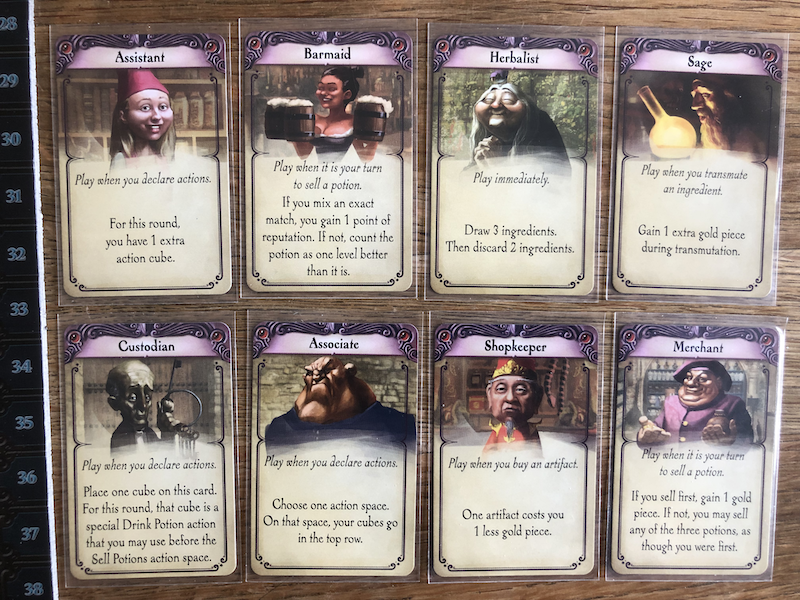
Friendly faces everywhere, humble folks without temptation. An alchemical is a combination of three aspects (blue, green and red), each of which may be either positive or negative. For example, the ingredient claw may have the alchemical red-, green+ and blue-. Furthermore, if you combine two ingredients, the potion you get is determined by the matching aspects of the ingredients. This will help you make deductions, e.g. if two ingredients create red-, you can reject all alchemicals with red+. 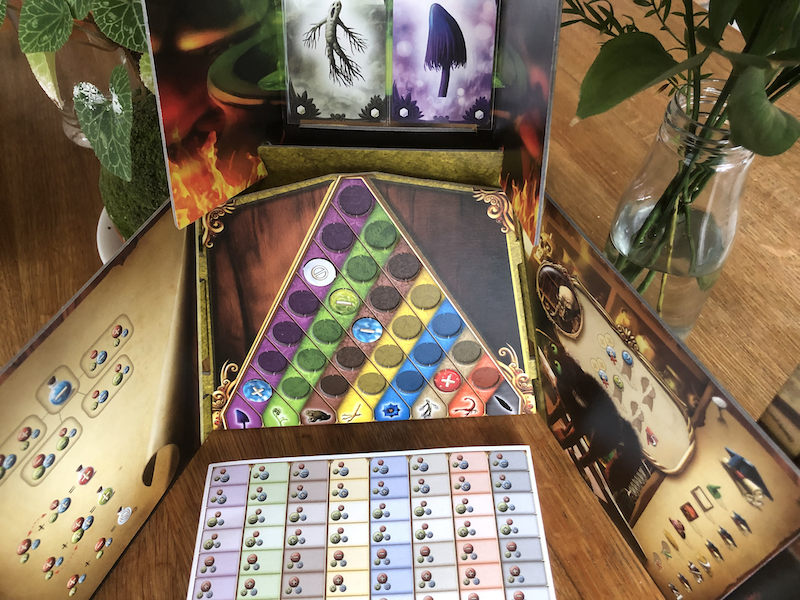
Many experiments conducted but can we draw any conclusions yet? The AppA distinguishing feature of Alchemists is the accompanying app, which not only randomizes the alchemicals for each new game but also tells you the result when you combine two ingredients. Personally I'm not a big fan of digital parts in what is supposed to be an analog experience but must admit that the app works very well in Alchemists. It's only used to add new pieces to the game state puzzle, it's simple to scan the ingredients used to mix a potion and it's exciting and (hopefully) satisfying to see the result. The app may be replaced by a game master if you still prefer playing without an app but it would make the game slower and less fun for all in my opinion, particularly for the game master. 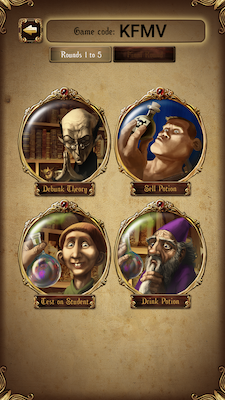
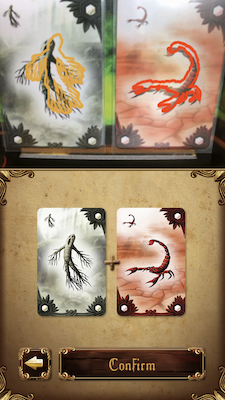

The student test reveals that root and scorpion make a red+ potion. The GoalBernard Suits famously declared that playing a game is a "voluntary attempt to overcome unnecessary obstacles" and Alchemists have plenty of them. The goal of the game, which will earn you money and victory points, is to learn and publish the alchemicals for as many of the eight ingredients as possible. To accomplish this you have several obstacles to overcome, both primary (determine which experiments to make and draw the right conclusions from them) and secondary (manage the resources necessary to make the experiments at all). 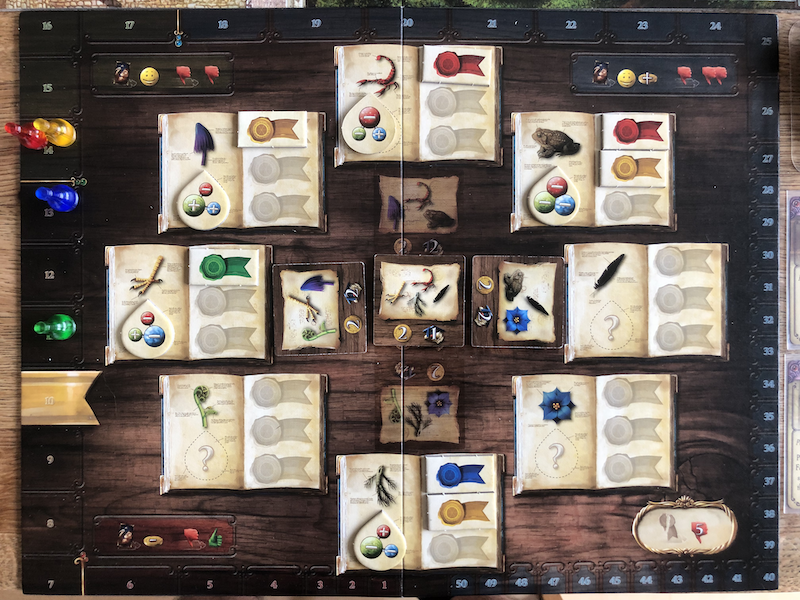
Green is convinced of the nature of the claw and put his seal on the theory. Will the others endorse or debunk her theory? We will now look into the hypotheses that those obstacles give a direction and improve the experience of Alchemists. HypothesisPrimary ObstaclesThe primary obstacles of Alchemists are to determine which experiments to make and draw the right conclusions from them. In your first game, this may seem similar to Cluedo - play random ingredients and cross out alchemicals until you have only one left for each ingredient. However, there are several factors that make this less of a mechanical exercise and more of an agonizing challenge where skilled play will get you results faster than your opponents.
Thematically, this makes sense. You will want to make experiments where you change only one factor at a time while keeping all other conditions the same (but gamble sometimes to get quicker results). You will want to publish your theories before your opponents since nobody remembers the runner up. You will want to keep a jealous eye on your colleagues to find out what they know without revealing to them what you know. OK, this may be scientific work at its worst but it's easy to imagine the sinister atmosphere of a fantasy world academy full of competitive alchemists. 
Alchemy for Dummies Secondary ObstaclesThe deduction game of Alchemists is the core game and could probably work on its own. Games like Mastermind do so. However, the path to experiments and later publishing is a long one. In particular, there are seven action spaces to consider:
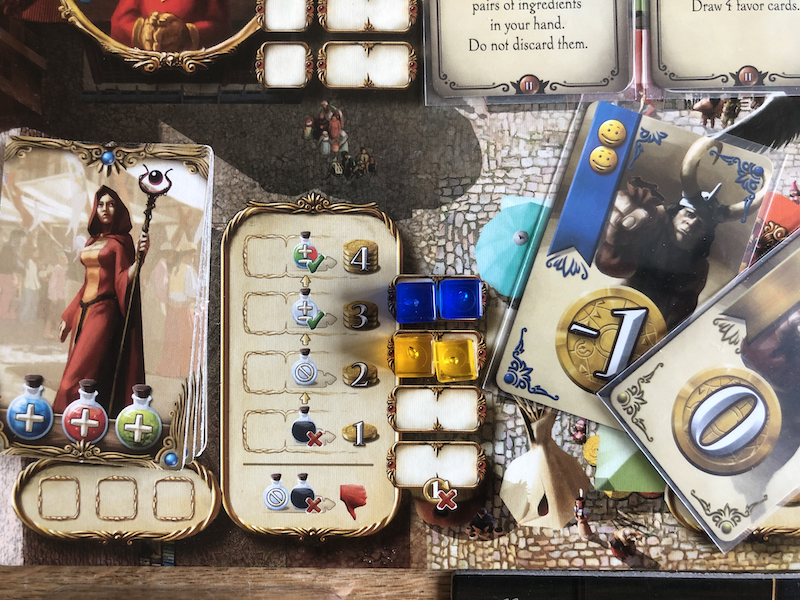
The adventurer wants to buy any positive potion but can the alchemist sell an exact match or something close enough? Actions are chosen in turn order but executed the other way around so turn order is critical. Going early gives you benefits (ingredients and/or townsfolk with abilities) while going late lets you observe which actions other players choose and execute the actions before them. Resources are also critical. Money, ingredients, townsfolk and artefacts are all scarce, as are your action tokens. Nevertheless, those mechanics are well-known and should not distract too much from the primary obstacles. You don't have to go through a long and convoluted series of actions and resource conversions to do what you want but "simply" determine what's most important to do now and how to get the necessary resources to do that. 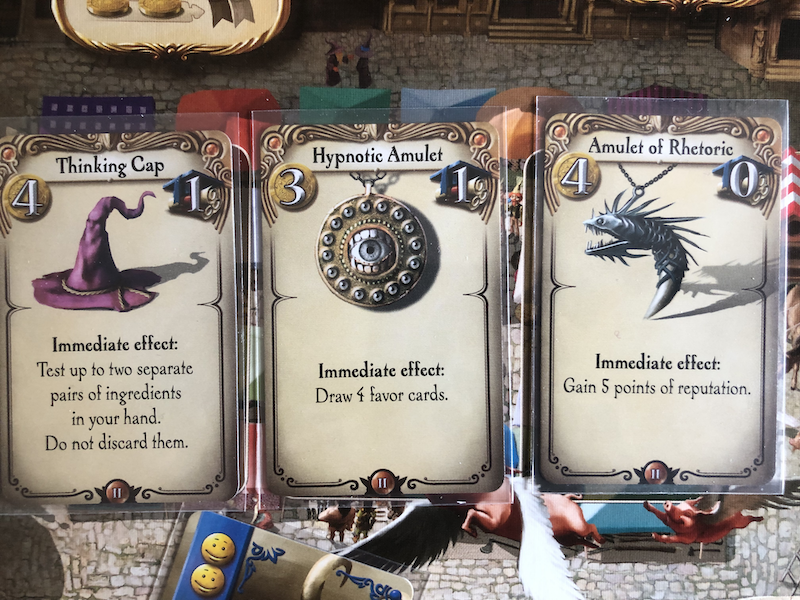
You wouldn't part an old man from his thinking cap? Test with ExperimentSo far it seems like Alchemist does have a theme and mechanics suitable for the game. The game does give you the challenges of being an alchemist (there are not that many real alchemists out there to disprove it) and the players can focus on fighting against each other instead of the rules. But could anything have been better? I do not aim at designing alternative Alchemists games but let's play with the idea. Let's start with the theme. Could the scientific approach used by our alchemists have been applied to another game? Detectives perhaps, combining people and places to find common aspects? Sounds a bit contrived. Perhaps the fact that Alchemist is still a unique game almost ten years after it was published is a proof of the suitability of the theme. How about mechanics then? Should there be more or less of them? It can be frustrating to get results with little or no information. It can be frustrating to have information but not be able to use it because someone else linked the alchemical to another ingredient. Well, the former is due to a randomness that is necessary to create tension (next time the frustration will be replaced by excitement from a perfect experiment) and the latter is due to interaction (that's what you get when you go late in turn order). Changing the mechanics so that every action brings you closer to the goal or all actions are available at all times would remove several challenges and make the game quite dull once the players have learned the deduction game. But how about other dimensions to the game? What if you could link not only alchemicals to ingredients but also aspects? And what if you could make other experiments than mixing potions where the information about an ingredient's alchemical can be used for further deductions? That would offer another way of using (and sharing) information, not by adding more of the same and diluting the game experience but by giving the players new ways of thinking in the game. Actually, those ideas have already been realized. The expansion The King's Golem has intriguing rules about a Royal Encyclopedia, where theories on aspects may be published similar to the base game's theories on alchemicals, and a Golem, which reacts not on colors and signs but on sizes of aspects. The King's Golem is a fine example of an expansion done right! 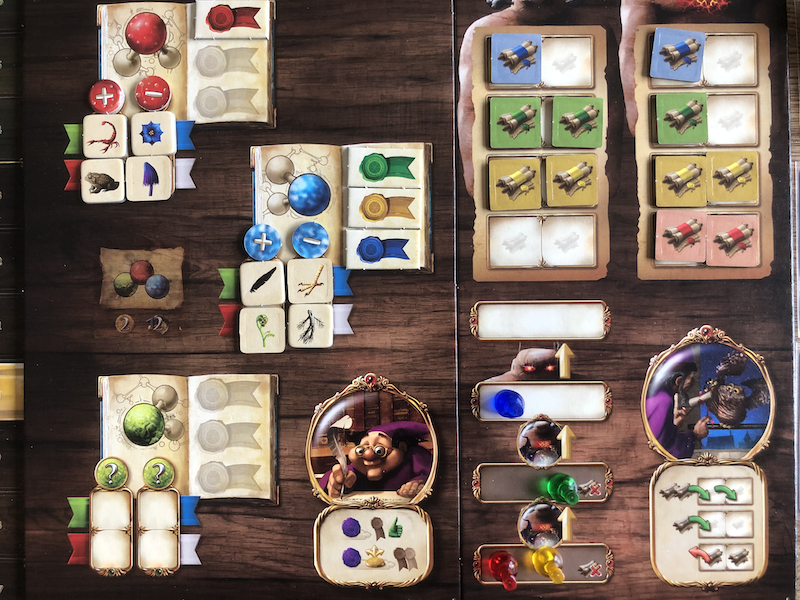
The Royal Encyclopedia to the left and the Golem Project to the right. Analyze Data and Report ConclusionsSo what is our conclusion from the scientific approach to Alchemists? We have shown that Alchemists is immersive and it's clear to the players what the goal is and which steps are necessary to get there. The mechanics are well suited to improve the game experience with a primary challenge of making the right experiments and drawing the right conclusions from them and a secondary challenge of managing turn order and resources. In spite of the secret experiments, this is not a game where the players hide behind their laboratory screens but rather constantly have to spy on... er, monitor each other. Granted, Alchemists is not a game for everybody. The initial game experience of playing random ingredients and crossing out alchemicals may put off players until they advance on the learning curve and realize hos much more there is to the game. The luck factor may only be mitigated, never eliminated, and there are few ways to catch up after initially failed experiments. However, if you are willing to give Alchemists time, you will be rewarded with a unique game experience, and if you appreciate multi-dimensional thinking and interaction, Alchemists and in particular The King's Golem will make you more than satisfied. Alchemists was an impressive debut game by Matúš Kotry which stands out even today. 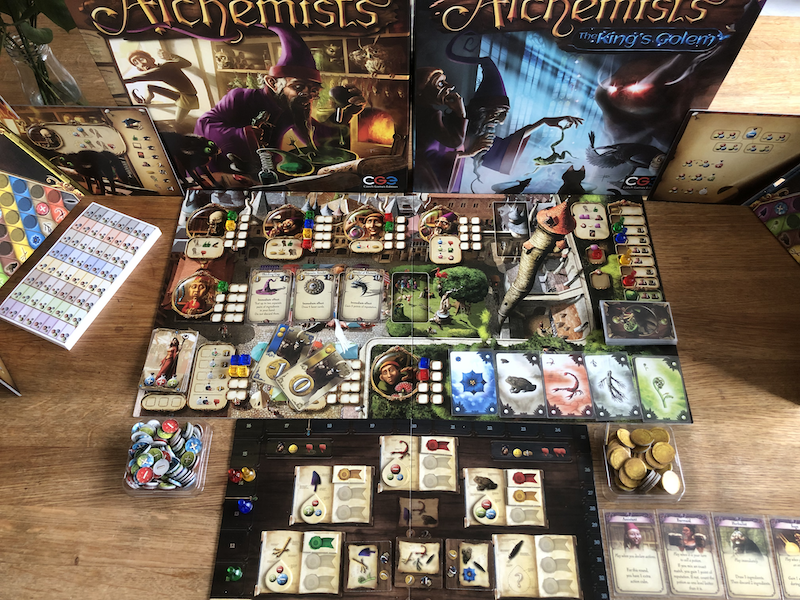
I love the smell of potions in the morning. |
|