
 |
The Quest for the Perfect Game - Reviews to Extract the Essence of Games by Nicholas Hjelmberg | |
























|
Tiananmen - A Beautiful Dance (Published 7 April 2016)This review has also been published at Boardgamegeek. Tiananmen is in many respects a unique game. It is an abstract game (played with an ordinary Go set) but highly thematic (students vs the Communist Party at the Tiananmen Square). It is an asymmetric game but not in terms of actions (both players place stones) but rather in terms of objectives (one player plays an area control game and the other a connection game). It even offers the classical Euro game dilemma of short-term gains (place stones) vs long-terms investments (save stones for later placements). If it hadn't been for the sinister theme, the way the white and black stones try to outmaneuver each other on the board could be described as a beautiful dance. (In the following diagrams, colors and numbers show where stones have been placed. "Missing" numbers means that the stones have been banked, i.e. Black 1-4 followed by Black 8-9 means that White banked 5-7.) 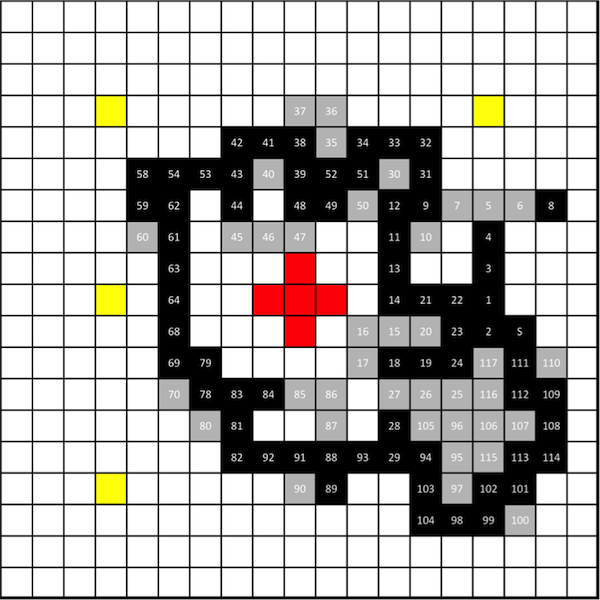
First game: The Communist Party has blocked all Student attempts to reach the edge The rules of Tiananmen are very simple. Black's objective is to enclose the central cross-shaped monument while White's objective is to connect the monument with the edge of the board. Black can only connect orthoganally while White can connect diagonally as well. The game is divided into days, where Black (the Communist Party) and White (the students) take turns to place stones. Each day, Black places 4, White 3, Black 2 and White 1. However, each stone must be placed in the first empty point north, south, west or east of the last placed stone, givng the players the ability to restrict each others' placements. In addition, a player can choose to refrain from placing the 4/3 stones and instead save 1 stone. The saved stones can be used for a future game-ending big move (place all at once) but this comes with a cost of a weaker present position on the board (less stones to work with). Those simple rules give the player plenty of interesting decisions. Where should I place my stones to further my objective while at the same time not giving away any good placements for my opponent? How can I steer the actions to the part of the board where I need to place stones without givng my opponent the option to block me once we get there? When is the right time to save stones without compromising my position on the board? The asymmetry of the objectives adds an extra dimension to the thinking process. 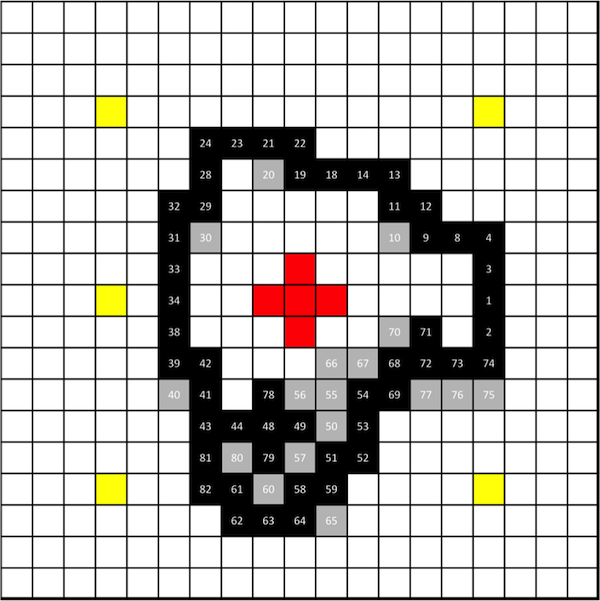
Sixth game: The Communist Party overran the Students and caught them in a trap So over to the critical question: Is Tiananmen solid or can it be solved? It's certainly too deep to give an answer directly. My initial feeling was that Black was always one step ahead thanks to always placing one more stone than White. Whenever White tried to break through, Black would soon be able to close all exits. Then I got concerned by the fact that Black has to spend more stones to accomplish her objective than White. If we assume that an average enclosure goes along the dots, it would cost Black 48 stones whereas White could reach the edge with as few as 8 stones. In addition, whereas Black must spend turns to spread all over the board to complete the enclosure, White only needs a breakthrough in one part of the board and can spend her initial turns to save stones for an endgame rush. However, Black soon learned to anticipate the rushes and preemptively block all potential exits and so the struggle continued. (So I'm sorry, Gord!, I still can't tell whether Black or White has an advantage.) 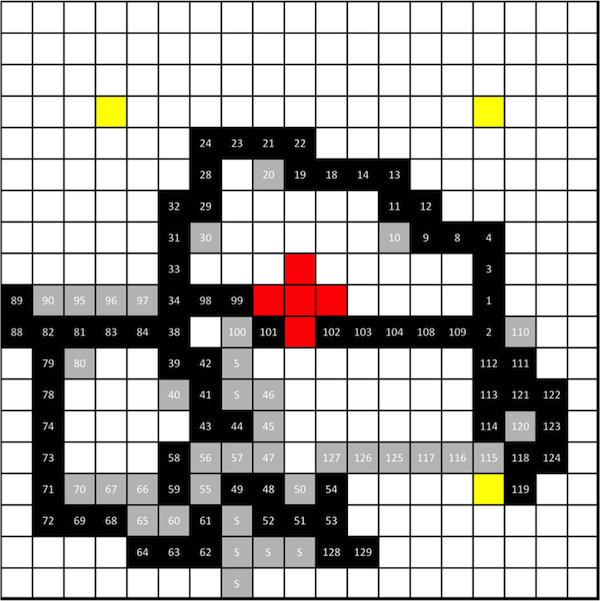
Seventh game: While the Communist Party tried to seal the Square, the Students broke through and reached the Monument (S=Stones from Reserve) No matter if Black or White is strongest in the long run, the road to find out is very interesting and I expect that even players typically not interested in abstract games will find the continuous actions and counter actions of Tiananmen immersive. A new player will enter the game with a presumption that one side is definitely stronger than the other and then engage in an addictive process to prove or disprove this. Tiananmen may very well turn into a modern classic and if I hadn't known better, I would have guessed that the game Tiananmen is at least as old as the Forbidden City adjacent to the real Tiananmen Square. 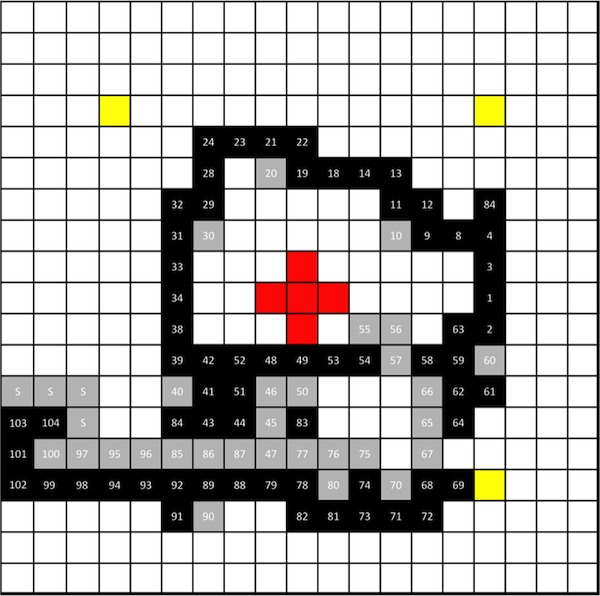
Tenth game: The Students feinted an Eastern rush, turned and made it to the Western edge (S=Stones from Reserve) |
|