
 |
The Quest for the Perfect Game - Reviews to Extract the Essence of Games by Nicholas Hjelmberg | |


















































|
Ponzi Scheme - All you need to make Money (Published 1 October 2018)This review has also been published at Boardgamegeek. IntroductionPonzi Scheme is in many ways the antithesis to a game. Whereas many games have the players build something greater than they start with, the only thing you will build in Ponzi Scheme is a balloon that hopefully won't explode first. On the other hand, isn't this what real Ponzi Schemes are all about? Let's go through the gameplay of this very peculiar game. The ObjectiveThe objective of Ponzi Scheme is a simple set collection. Acquire industries of four different categories and score victory points the more industries you have in a category (1 VP for the first industry, 2 VP for the second industry and so on.) 
4 groups of industry tiles worth 1, 3, 6 and 10 VP respectively. The MeansSo far, nothing new. However, it is not the end that justifies the game but the means, i.e. the acquistion of money. The Investors' MoneyTo acquire industries you need money and to acquire money you need to commit to future payments. In practice, you pick a fund card in your turn and places it next to your personal time wheel to mark a due payment in 3-5 rounds. There are always nine fund cards available, sorted by value and arranged in three rows where you pick from the first row for your first industry tile in a category, the second row for your second industry tile and so on. After each round the wheel is spun and whenever it reaches your fund card, it's time to pay. 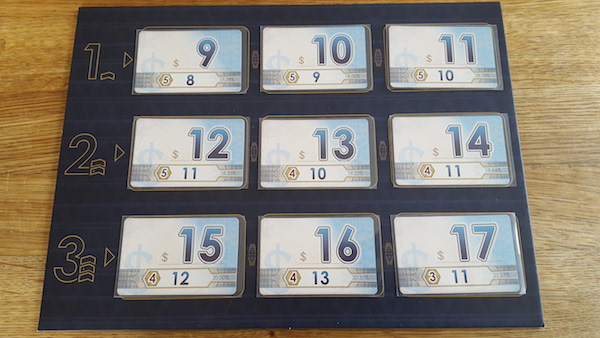
The upper left fund card earns you $9 but costs you $8 at every payment, starting 5 rounds from now. Unfortunately, you have to pay EVERY time the time wheel reaches your fund card again. To make things worse, your industries return nothing. The only way to raise the necessary capital is to... pick another fund card. The result is a game where your capital constantly decreases and where the only way to survive is to increase your debt until the inevitable bankruptcy ends the game. If you're the one who goes bankrupt, you lose, but if someone else goes bankrupt before you, you win if you have the most valuable industries, no matter how indebted you are! This is similar to games like [thing=220][/thing], where the player with the most valuable assets wins, provided that he or she hasn't spent the most money 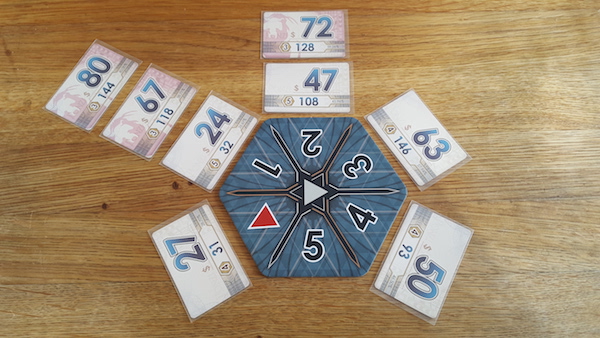
Next round, you have pay £32+$118+$144. Time to pick a new fund card perhaps? This means that you should not approach Ponzi Scheme with an economy mind. There are no investments with positive returns and the only thing you will build is a debt burden. In the real world, the best strategy would be not to borrow at all (which, of course, is the case with real world Ponzi Schemes). However, this strategy won't win you the game, since the winner is usually the one with the most valuable industry tiles and the SECOND biggest debts so that you don't go bankrupt first. The Competitors' MoneyBut a player's fund cards and industries are open to all players so you have perfect information about who is in the lead and what everyone has to pay the next few rounds. Does this mean that Ponzi Scheme can be solved and that "all" you have to do is to keep track of your opponents' inflow and outflow? No, Ponzi scheme has another action that throws the players into a whirlpool of uncertainty: the Clandestine Trade. Simply make a secret offer to another player to acquire one of their industry tiles. The trade is offered through money in an envelope hidden from the other players and the trade is accepted if your counterpart keeps the money. However, your counterpart may also match your offer and add the amount of money to the envelope, in which case you must give up one of your industry tiles! Clandestine Trade is a way to acquire industry tiles without taking fund cards (or to acquire money from an opponent without taking fund cards) and it is the only way to acquire more than three industry tiles in a category. So, do you feel lucky and have you given an offer that can't be refused? This is the true core of Ponzie Scheme's gameplay! 
Can you refuse an offer of $36? The ChallengesOK, now we know how to acquire victory points but what is the "real" value of a victory point, i.e. how much should you offer for an industry tile? Although each individual players' capital is hidden, the total capital in the game is trackable so shouldn't you be able to calculate the ratio of the total capital to the number of industry tiles in the game? Possibly, but it won't help you at all. The real value of a victory point is whatever the other players are willing to pay for it. If everybody else values victory points less than you do, you will lose your money, and if everybody else values victory points more than you do, you will lose your industry tiles. In both cases, you will lose the game. This is also similar to High Society, the only difference being that all players bid openly for assets while only two players at the time bid secretly in Ponzi Scheme. The result is a sometimes hilarious experience, where all the players are kept in the dark as to how much others value assets and then get a (positive or negative) surprise when they count the bills in the envelope. The ProblemsSo far, so good. However, the gameplay change little between the rounds. The industry tiles are generic so your beautiful (but heavily indebted) industry empire yields nothing to your gameplay so the first few rounds tend to be repetitive. Acquire fund cards at par with your opponents (as pointed out, both too low and too high fund cards may cost you the game) as long as money is injected into the game, then make sure to stay afloat as the tide turns and money starts pouring out of the game. The end may also be a bit out of your control to feel satisfactory. It may happen that you have the most valuable sets of industry tiles when you get a lose-lose offer. Accept and your counterpart will go bankrupt before you can invest the money in new industry tiles. Decline and you will go bankrupt yourself before you can turn the industry tile into the necessary cash. ConclusionIf Ponzi Scheme was merely a filler game, it would be a modern classic. If the ponzi schemes were merely a mechanic of a heavy economic game, it would be a ground-breaking mechanic. As it's know, Ponzi Scheme feels slightly too long for what you get, particularly at the higher player counts. Nevertheless, it's a simple and approachable game that is perfect for casual game sessions with gamers and non-gamers alike. The theme is particularly intriguing, since it really captures the feeling of bubble economies and the recognition factor will ensure that everybody has a good time, whether they win or lose. 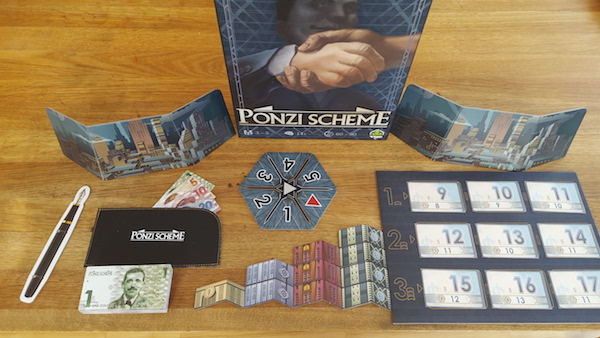
All you need to make money! |
|