
 |
The Quest for the Perfect Game - Reviews to Extract the Essence of Games by Nicholas Hjelmberg | |


















|
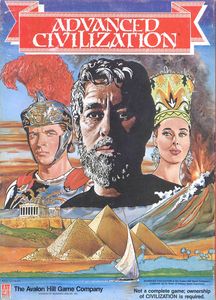
Advanced Civilization - Does it Stand the Test of Time? (Published 1 Jan 2018)This review has also been published at Boardgamegeek. Classic or obsolete?In my youth, in the previous century that is, I played many Avalon Hill games but none was more popular than the revered Advanced Civilization. A few years ago I returned to the board gaming hobby and since then I have got to know another 300+ games. But in spite of that, only one game has managed to beat this old classic on my list of favorite games (reviewed at Boardgamegeek). Is this because I still remember those epic sessions from before or is Advanced Civilization really that good? One way to tell is to play the game, which I recently did. Another way is to review the game and reflect on its qualities, which I try to accomplish here. With today's standards, it may be difficult to imagine how ground-breaking Civilization was when it was published back in 1980. This was not a game of elimination but a game where all players participated to the end. They also did it by building something greater than they started with, a characteristic that is inherent in most, if not all, modern euro games. Some mechanics, like the elegant balance between population, stock and treasury, could have been considered innovative even today, while others, like the sometimes cumbersome calamity resolutions, could have been contemporary with the dinosaurs (and perhaps the reason why they got extinct - they simply could not handle them anymore). But let us not jump to conclusions and instead examine Advanced Civilization piece by piece. This review will focus on Advanced Civilization rather than the original Civilization, not because I claim one to be better than the other, but because I'm more familiar with the advanced version. There are many threads discussing the pros and cons of the two versions and in my opinion, both sides offer valid points. Nevertheless, most of my points will be applicable to both. The goal of the game - and how to get thereThe civilization cardsAdvanced Civilization puts the players in charge of civilizations around the Mediterranean Sea from Stone Age to Late Iron Age. The overall goal is to end the game with the greatest civilization of them all. The main measurement of "great" is the value of civilization cards acquired during the game. This is something I emphasize to new players, who may confuse Advanced Civilization with a war game and focus on geographical conquests, or an economic game and build a productive engine. While both land and resources provide advantages during the game, they are only means to the end and will be forgotten by history if you fail to turn them into civilization cards. The resource cardsOK, so how do you acquire civilization cards then? By exchanging sets of resource cards AND by taking advantage of discounts provided by other civilization cards. The latter is another aspect that new players tend to neglect. Each round, you should aim at not only maximizing the value of your resource cards but also at utilizing your discounts. Postponing the acquisition of a civilization card one round to have a better set of resource cards next round may sound good but also means foregoing a discount. To get resource cards, you need cities, and to get sets, you need to trade with other civilizations. Let us look at the trade first. Trade in Advanced Civilization is not a zero sum game. One pair of resource cards is more valuable than two single resource cards, one triplet is better than two pairs and so on. Since all trade is simultaneous, you will need to be attentive to find out who holds the cards and you need to be able to negotitate to acquire said cards. This also means that the trade may be time-consuming and chaotic but there is certainly no lack of tension and interaction here. How about the cities then? Each city awards you one resource card. The more cities you have, the higher the value of the resource card and the better your opportunities for a successful trade. Building and maintaining cities is thus critical in Advanced Civilization. But to do so you need tokens on the board. 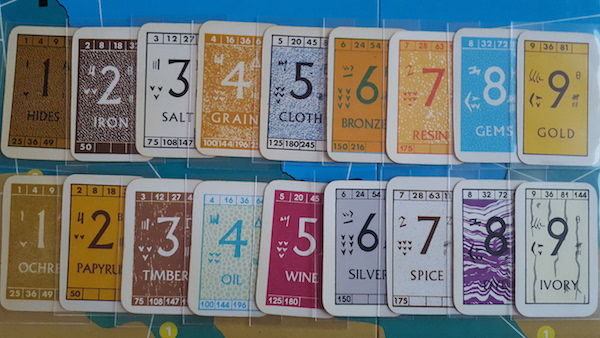
The stock, the tokens and the treasurySix tokens are needed to build a city and another two tokens are necessary to maintain it.The tokens start in your stock and enters the board where you already have tokens (but not where you have cities). In addition, each city forces you to move tokens from the stock to the treasury as tax (which can be used for to purchase civilization cards, resources cards and ships to move the tokens across water). However, there is one big catch. Your tokens are limited. A shortage of tokens will be critical whereever it occurs. An empty stock means that you cannot pay tax and that your cities will revolt. An empty board restricts your ability to build and maintain cities. An empty treasury gives you less flexibility when it comes to purchases. The latter may seem less important but being one token short to that expensive civilization card you really need is annoying to say the least. This delicate balance puts Advanced Civilization in a class for itself compared to the many more straightforward games of its time. 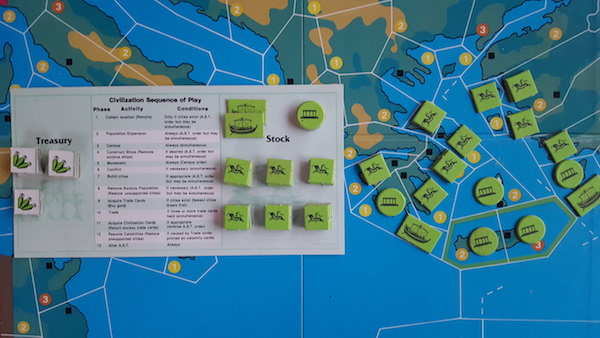
The calamitiesIf you understand how all those intertwined mechanics fit together, will you be a able to play the perfect game of Advanced Civilization? Well, I haven't mentioned the calamities, the most fun/nasty/memorable aspect of the game (depending on how they strike). Shuffled into the stacks of resource cards, and frequently and secretly traded between players, are the calamity cards. Whoever ends the trade with such a card becomes the primary victim of a calamity, often resulting in the loss of cities and tokens. 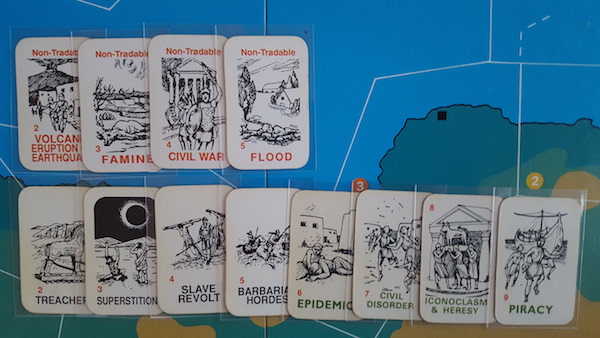
Many complain that calamities strike randomly and while this is true, they also serve other important purposes. Most importantly, they add risk assessments to the gameplay. Should you do one more trade to get that extra resource card, although you may get a devastating calamity with it? Should you play safe and go for civilization cards that reduces the impact of calamities or gamble and go for civilization cards that give you other benefits but aggravate calamities? Another important function of the calamity cards is to serve as a catch up mechanic, since the primary victim selects secondary victims to share the calamities. Finally they shake up things on the board by moving borders and opening up new opportunities, hence preventing the game from stagnating once the civilizations have reached some kind of equilibrium. The lack of control may indeed be hard to bear but I recommend you to simply accept your fate and rebuild your civilization afterwards, just like the leaders of the historical civilizations had to do. Completing the cycle
In addition, the players may choose their own paths throughout the game by choosing which civilization cards to acquire. Some civilization cards help you overcome geographical constraints (such as Agriculture, which lets more people survive in a region). Others gives you advantages in conflicts (such as Metalworking) or economy (such as Mining). There are also several cards that reduce the impact of calamities, as discussed above. This completes the civilization cycle: you need tokens to get cities to get resources to get civilization cards to help you repeat the cycle as efficiently as possible, while also mitigate all bumps on the way. This reminds about the economic engine you often build in modern euro games. However, Advanced Civilization constantly forces you to reassess your strategy to successfully navigate through the many tides and turns of History. The experience of playing Advanced Civilization is bound to be different from game to game. The game of the civilizationsWe have now covered the basic path towards the goal of Advanced Civilization. But how does this translate into a gaming experience? I will try to answer the question from three important perspectives: the decisions, the interaction and the feelings of the game. The decisionsMany players assess a game experience based on the meaningful decisions offered to the players and Advanced Civilization offer several:
The interactionsOther players have certain requirements regarding the interaction with each other. Some games suffer from too little interaction that turn them into multi-player solitaires while other games contain so much take that that the players are denied all control of their destinies. Advanced Civilization manages to find a balance between those extremes. You have a lot of control when it comes to which civilization you want to build and how to accomplish it. However, you cannot do this in isolation. You must compete with the other civilizations to get the land and the cities necessary to acquire resource cards but you must also cooperate with them to turn your resource cards into valuable sets. If you haven't made the mistake of playing on a too large map, you must use both diplomacy and force to establish the borders necessary for your growth. Yet, you are never totally at the mercy of your opponents. Each civilization has a limited supply of units, effectively preventing runaway leaders and elimination. War efforts must always be weighed against other pressing needs in your empire and even if you would face an alliance of all the other players at once, it is not likely that all of them would be able to strike at you. With flexible planning, you can often find mitigations to problems that may arise. 
In one of my latest games, I managed to execute a rather successful strategy. As Crete, I quickly stretched out in all directions to establish borders, leaving my heartland empty. Initially my neighbors avoided conflicts and left me with plenty of room to grow/recover after calamities. As my neighbors started to move closer, I was able to use my fleet to quickly move my units around, either to defend my claims or withdraw from one border and push another border instead, depending on the current strength and weaknesses of my opponents. I did not win but in spite of being the smallest nation for almost the entire game, I managed to be the first to both eight and nine cities and eventually ended up second. Most importantly, I had fun! 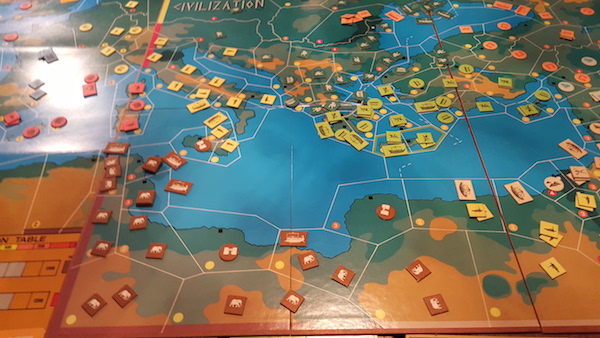
The feelingsThere are also players to which the feelings that a game evokes is the most important thing. Advanced Civilizations delivers in this respect as well. You start building your civilization from nothing, watch it rise and fall and rise again in the struggle with calamities and other civilizations, and (hopefully) end with a strong, rich and innovative empire - an advanced civilization. During this long journey, spectacular actions and events have given birth to legends remembered long after your civilization is gone. Perhaps an unexpected civil war brought an invincible empire to its feet, perhaps the remnants of an overseas revolt managed to return home just in time to save the motherland from an invasion. All this and much more can happen in Advanced Civilization. One of my many memorable moments of Advanced Civilization was when my poor Africa was struck by one calamity after another, including two consecutive barbarian hordes. In the end, only one single token remained in the African heartland. Yet, the people managed to rise again, kick out the foreign invaders and reach a second place, beaten by only two (!) points. Few other games have given me stories like that. The flaws of Advanced Civilization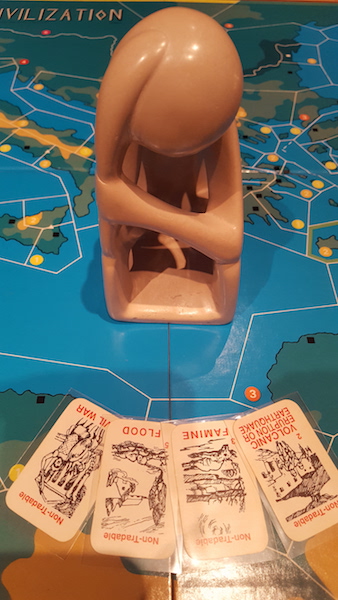
Given all the praise so far, is Advanced Civilization the perfect game? No, there are some valid complaints about the gameplay. The main one is the playing time. A full experience of Advanced Civilization requires one whole day. Many games have tried to provide the epic feeling of rising and falling civilizations in a short timeframe but in my opinion, none has succeeded. My only advice is to compare one session of Advanced Civilization to several sessions of a shorter game and decide what you prefer. I confess that Advanced Civilization does not hit my table very often but when it does, we turn the session into a social event where we include food breaks and other activities. This mindset also makes it easier to deal with downtime. If things happen at the other part of the board, take the opportunity to walk around and do some small talk. Advanced Civilization does not require full attention and detailed optimization, something that the seasoned player may find relaxing every once in a while. Another issue concerns some of the complex rules and convoluted mechanics of Advanced Civilizations. Where most modern games are intuitive and possible to learn on the fly, Advanced Civilizations has many small and easily forgotten rules. I still keep forgetting that you get to take a resource card from an opponent whose city you destroy and only recently realized that you cannot "virtually" replace an attacked city with more tokens than you have in stock. Fortunately, the fact that you start small means that you can introduce the rules gradually to new players. But even when you do know the rules, there will be time-consuming moments, particularly the resolution of calamities. Take civil war for example. Counting all players' stock to identify the beneficiary player, adding and subtracting civilization card modifiers, and selecting which individual tokens that go to which side is time-consuming. On the other hand, civil war does add flavor to the game and I cannot think of a way to streamline it. 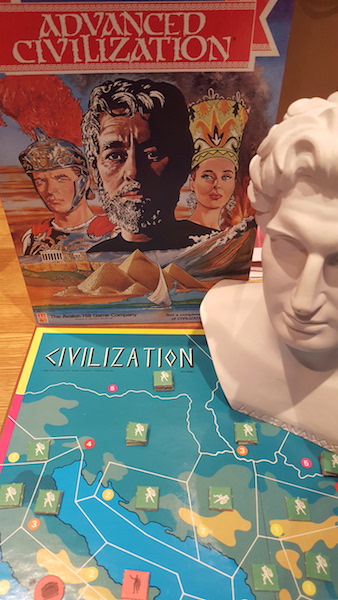
A related issue is that of the randomness, particularly of the calamities. Drawing a calamity instead of a resource card is a double blow to the unfortunate player. The likelihood that calamities will even out in the long run is a small consolation to the player who gets struck by two calamities several consecutive rounds. Sometimes I would like to see a system that gives the calamity to the "most deserving player" (civil war to the strongest player, slave revolt to the richest player, iconoclasm to the player with the fewest religious cards etc.) but would that really be better or would it just lead to an even worse situation where the players micro manage to avoid them? Whoever succeeds in elminating those flaws will have found the Holy Grail of the perfect civilization game but until then, Advanced Civilization remains the worst form of civiliazation game except for all the others. SummaryTo sum up, Advanced Civilization has many aspects and attributes that puts it in par with modern board games. There are several intertwined mechanics that offer you an intriguing maze to navigate through. To do so, you have several strategies to choose from and whatever you choose, it must prepare you for the many tactical challenges you need to face during the journey. Advanced Civilization is full of meaningful decisions and tense interaction as you create your own story of your civilization. Advanced Civilization does demand tribute from its players in terms of time and commitment and is not a game I would like to play every day. Nevertheless, I never turn down an offer to play and look forward to the session in the same way as I look forward to a vacation trip or a reunion with old friends (or combining all three). |
|
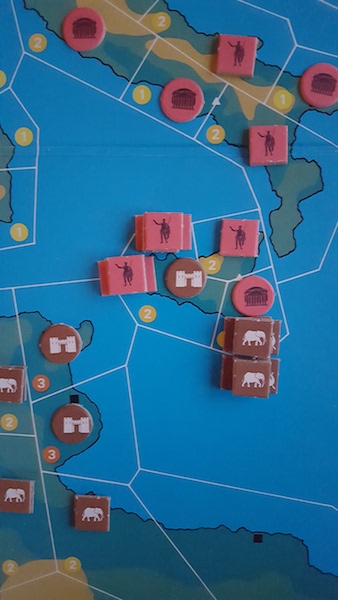 The final distinguishing aspect of Advanced Civilization that I would like to highlight is the variability of the player conditions. In the beginning, all civilizations are alike. In fact, they all start with one token each and nothing else. However, geographical advantages and restrictions will quickly mark them. Egypt has access to rich but potentially dangerous rivers while Africa on the other hand struggle to feed its population. Babylon has plenty of land to spread out to while Crete is surrounded by water and so on.