
 |
The Quest for the Perfect Game - Reviews to Extract the Essence of Games by Nicholas Hjelmberg | |





















|
Endeavor - When the Journey is the Goal (Published 17 June 2019)This review has also been published at Boardgamegeek. IntroductionThis review covers the base game of Endeavor as well as the recent second edition's Exploits and the current Expansions, the latter which I had the honor to test. If you're only interested in the latter, you'll find them described in the last sections. For the rest of you, welcome on board! 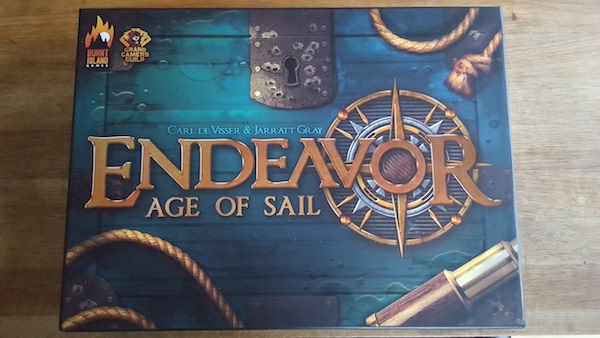
A sailor's chest full of goodies. The Engine in GamesThis opinion may be blasphemous but I'm not really a fan of engine building games. Yet, there are some game engines that I actually do enjoy running and the one in Endeavor is one of them. Let's board a ship and endeavor to find out why. Engine building games are excellently analyzed by Boardgamesnob, where the author characterizes them as "games in which players develop some construct which they leverage to gain an advantage". A classic example is Puerto Rico, where the players' acquired buildings and plantations increase their production of crops, and where the engine at the right time is switched to produce victory points. In Revisiting another Favorite Island of the Past, I argued that it was the scarcity of resources (including time) and the critical decision when to switch gear (to victory points) that made the game interesting. However, many later games seem to have abandoned those design principles in favor of fast and furious engines with the sole purpose of amassing victory points. To me, this is like using a motor boat to cross the Ocean as quickly as possible instead of going with a slower sailing boat and take time to explore the islands. I don't want to be rewarded for having built the best engine, I want to build an engine and use it to pursue a game goal and then be rewarded by how well I accomplished it. So what kind of engine do you build in Endeavor then and what's the game goal that you build it for? That's the topic for the next section. 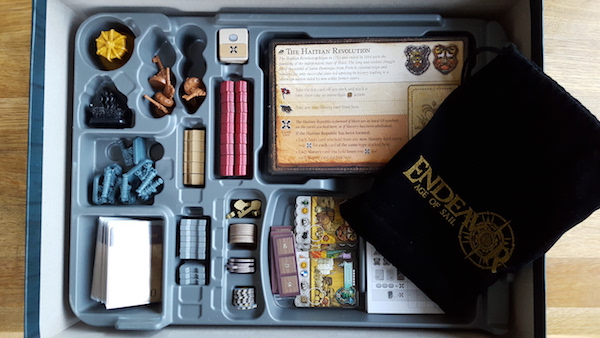
You can tell from the chest that this sailor is well organized. The Engine of the Sail ShipBasically, the engine of Endeavor has four levers or attributes, all of which are tracked on individual player boards; Industry, Culture, Finance, and Influence. At certain thresholds, new attribute levels will be unlocked which make your engine more powerful.
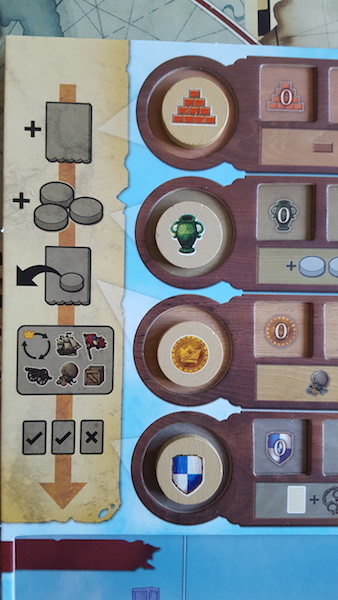
In theory, it's possible to increase the different attributes at different paces but in practice, they are so intertwined that it's usually best not to let them diverge too much. Focus on Industry and you may find that you don't have enough population markers to use your powerful buildings. Focus on Culture and you may find that your buildings are too weak to leverage your population markers. Focus on Influence and you may find that the affordable Assets Cards run out. Knowing when to increase which lever is an important and fun decision. Each attribute increase is roughly equivalent to one victory point so a normal engine building could have ended here. Build an engine to collect and use buildings and cards to amass as many victory points as possible before the game ends. Fortunately, this is not the goal of this game. No, the goal of Endeavor is to use your engine to colonize the world so let's now turn our attention to the area control on the map. The Area Control of the Sail ShipsThe struggle for control in Endeavor takes place on an abstracted map of the world, depicting Europe and the six regions to be colonized. There are two basic areas on the map; occupation spaces and ship spaces. An occupation space, which may be land or sea, lets you take a Trade token from there and replace it with one of your population markers. In addition, you get to take any trade tokens surrounded by your population markers. Last but certainly not least, most such spaces (occupied or surrounded) earns you one victory point (some even two victory points) at the end of the game - that is if you manage to hold it that long. Thus, occupation spaces reward long routes. 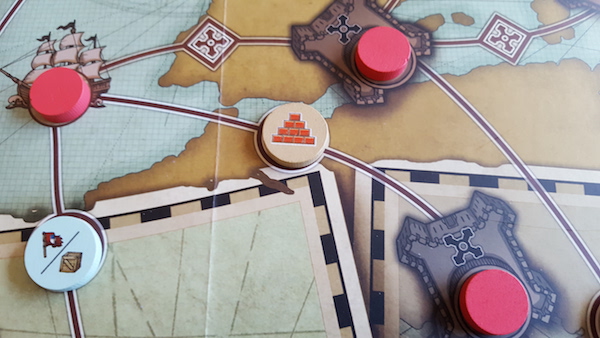
Red's route will earn her both 1 victory point in Europe and 1 Industry token in Africa. The ship spaces on the other hand are linked to one of the six non-European regions and once all ship spaces of a region have population markers, the region is considered open. Similar to occupation spaces, ship spaces award trade tokens but they don't award victory points and can't be used to build routes. Instead, they award the player with the most population markers a governor card (which increases one or more attributes) and all players with population markers "presence", which is the right to occupy the opened region. 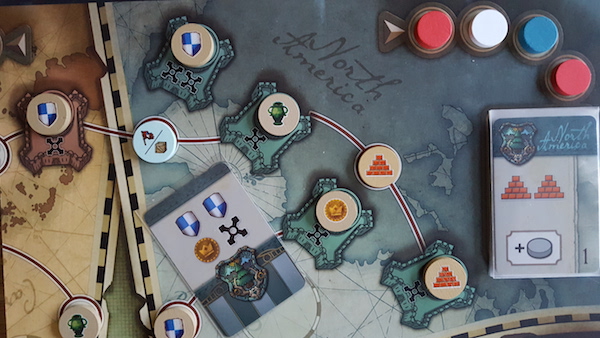
Red has a majority and will claim governorship over North America. You may wonder why you would waste population markers there, particularly if they help another player to get the governor card. One reason is that the board will fill up quickly and being shut out from a region limit your options. Fortunately, there is an open sea space where you may place a population markers to get presence but it doesn't give you any trade token. Another reason is that the more population markers you have in a region, the higher the value of that region's Asset Cards you may take. You certainly don't want to give another player monopoly in a region to claim all occupation spaces and Assets Cards for himself or herself. Does Engine + Area Control work?Endeavor isn't the only game that uses an engine mechanic to accomplish another goal. As discussed above, games like Puerto Rico challenges the players to switch from building the engine to using the engine at the right time. However, in Endeavor those two game phases are more interdependent. Each placed population marker returns one or more Trade token which improves both your engine and your score at a moderate rate. Instead of one big decision between engine and victory points, you have small decisions every turn. Some players may miss the "big moves" of other engine building games (although Exploits and Expansions enable bigger moves as discussed below) but I find the pace of Endeavor quite pleasant. Should you go for a Trade token that connects several spaces and gives you additional Trade tokens? Or a single Trade token that pushes an attribute over a threshold to the next level? Or a Trade token that gives you presence or even a governor card in a new region? Each decision has both a short term and a long term effect that must be taken into account. Don't mistake Endeavor for a purely tactical game - it's true that you must constantly adapt to other players' actions but each own action must literally link into your strategy so that you don't get beaten to critical Trade tokens, Asset cards and regions. 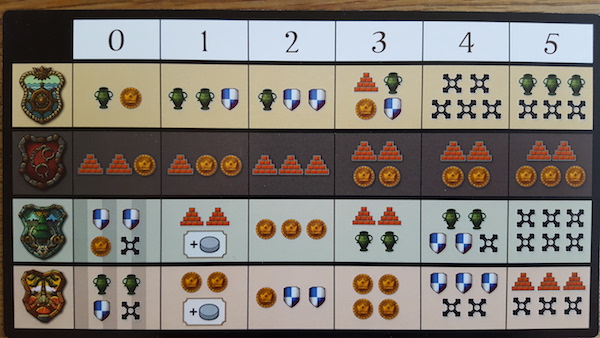
The increasing rewards of Asset cards in some of the regions. The Bookkeeping of the Sail ShipsSo far we've talked about four attributes to keep track of as well as cards and population markers moved back and forth. This sounds like an awful lot of bookkeeping, doesn't it? On the contrary, Endeavor is a fine example of a well developed game where the rounds and turns are smooth and well-oiled. The first three turns of a round may very well be played simultaneously. Pick a new building (limited by your Industry level), take new population markers (determined by your Culture level), and take back population markers from your buildings (determined by your Finance level). 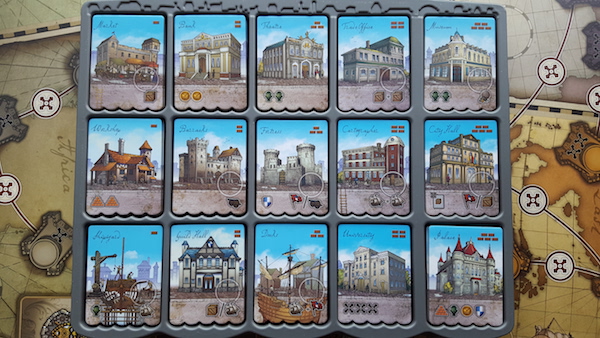
The many different buildings to choose from. Then take turns to place one population marker on a building and execute its actions (one or two), which is as simple as placing a population marker on the map or drawing an Asset card.
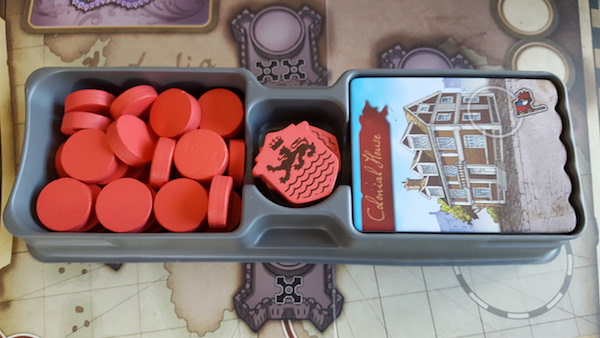
Red population markers ready to colonize the world. Some words about the attacks. They may be considered out of place for a euro game like Endeavor but don't worry. Since attacks basically cost 1-2 victory points (the population marker lost could have earned you victory points elsewhere), you want to save them for the moments where the returns are higher, for example where you can complete a route and/or pick up an extra trade token. Thus, Endeavor isn't likely to be determined by negotiations and take that. If you despise those mechanics, don't worry about playing Endeavor, but if you do prefer them in your games, look elsewhere. OK, executing actions may be simple but how about keeping tracks of your attributes? Even simpler! Everything that changes your attributes (Buildings, Trade tokens, Asset cards) stay on your player board and can be backtracked if needed. It's a matter of simple addition of the large and clear icons. 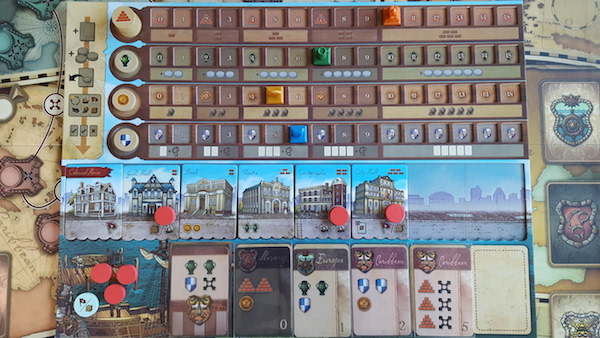
One player board to rule them all. But is the Sea always Calm?If you've stayed on board so far, you may worry that the slow and steady pace of Endeavor lacks big moments. Although there is the constant tension regarding which attributes to increase and which regions to enter, spiced with occasional attacks, there are few big moves and sudden shifts. At most you may succeed in timing and chaining some actions to claim a Governor or Asset card another player expected to get. Some players may be put off by this but it also mitigates the risks of runaway leaders and downtime due to analysis paralysis. Endeavor keeps her players engaged throughout the game. Nevertheless, there is one big moment that's rather unique for Endeavor, namely the Slavery. For good reasons, slavery is a shunned theme in games which is difficult to do right. The fantasy game Five Tribes unnecessarily added slaves as a resource among others while the plantation game Puerto Rico vainly disguised the slaves as colonists. So how did the colonization game Endeavor approach this subject? Pretty good in my opinion, both thematically and mechanically. Slavery cards can be acquired for an early economic boost (increased Industry and Finance) but the longer the game lasts, the less the comparative advantage of the slave cards, and if the top card in the Europe deck is acquired, slavery is abolished and all acquired slavery cards punished by negative victory points. This may add an interesting tension in the end game where abolitionists and slave owners fight in Europe to reach the required presence to acquire the card/prevent other from reaching that presence. For a simple game like Endeavor, this is a good abstraction of a complex theme that's also fun to play. 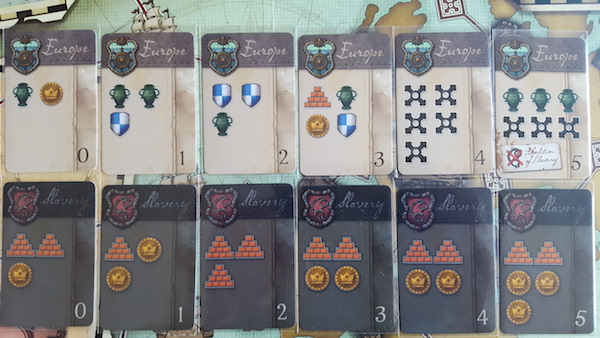
The early powerful slave cards will soon become inferior to the later Europe cards. Is this end game tension not enough for you? Then stay on board for the Exploits and Expansions of the Sails Ships! The Exploits of the Sail ShipsBesides the to be or not to be of the abolitionists, all information in Endeavor is open and presented to the players in the setup. However, the second edition added so called Exploits to bring more historical flavor to the game and potential changes to the end game. Basically, there are eleven exploits, each of which is linked to two regions. Three exploits are randomly added to the game and if both regions of an exploit are opened, the exploit is unlocked and the gameplay changed. Similar to the abolishment of slavery, an exploit is something you as a player can predicit and either work for or against. To illustrate how they work, let's look at two examples: The Haitian RevolutionThe Haitian Revolution lets you use the Occupy action to draw and place Asset cards on the Exploit while the Attack actions lets you remove cards. If at least ten symbols are collected on the Exploit, the Haitian revolution takes place. Each Haitian Asset card rewards you one victory point for each Asset card you have from the same region but each Haitian slavery card punishes you with minus one victory point for each slavery card you have. This Exploit is more than a regional variant of the abolition of slavery, it's an opportunity for the players to intervene in the Revolution to either protect the value of their slavery cards or to increase the value of their region cards. 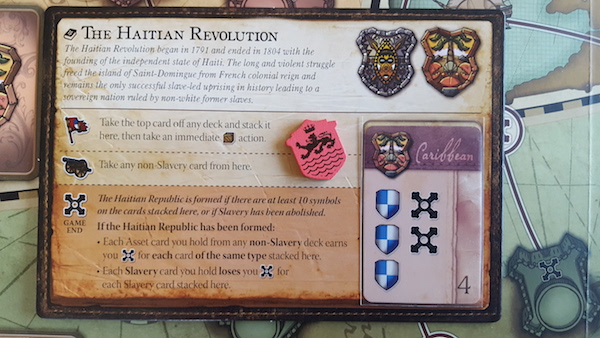
The Haitian Revolution - soon at an island near you. The Republic of PiratesThe Republic of Pirates lets you use the Ship action to let pirates occupy a city and destroy any Trade token or population marker there. In addition, the next time the pirates move, your own population marker will be placed in the city they leave. Alternatively, you may use the Attack action and discard a governor card to put an end to the Republic of Pirates and earn three victory points. This adds a cheaper attack option (no casualties) but also makes the pirate region more unstable. It's up to you to decide whether to risk using the pirates for your own objectives or to restore order to make it more predictable. Whatever you choose, the pirates will change the end game conditions. The Expansions of the Sail ShipsEndeavor: Age of Expansions adds new buildings and cards with some new concepts: Trade, Fortify, Conscription, Merchant Fleets, Subsidies, Prominence, and Events. Let's briefly go through them and see if and what they add to the gameplay. Note that the images below depict not yet finalized components. 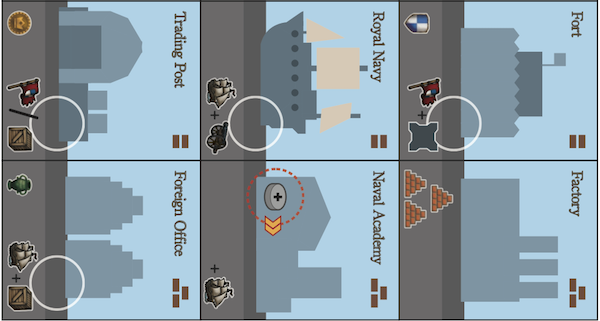
Some of the new buildings to choose from. TradeTrade is an action on some buildings that lets you swap one Trade token on your player board with ANY one Trade token on the board. While it doesn't give you any net attribute increase, it may help you reach a threshold or claim a much needed Action token. Also, the building itself typically gives you one additional attribute increase compared to other buildings of the same level. Personally, I didn't find Trade that good in the long run but I do admit that it offers flexibility and a way to kickstart your engine. Thus, Trade definitely opens up new strategic paths. FortifyFortify is an action on some buildings that lets you build fortifications which require two casualties to attack instead of one. While they do help you strengthen critical cities in your route network, they may also discourage attacks so much that the game turns less dynamic. Pacifistic players may appreciate this while aggressive players may be of the opposite opinion. ConscriptionConscription is linked to some buildings and lets you place additional population markers there. Those population markers may be used for certain actions in addition to your ordinary actions in a turn, thus providing an opportunity for "big turns" with several actions. Conscription is a welcome feature for those who want additional options for getting population markers to the map quicker but they may also lead to a waiting game. Take for an example a ship track with four spaces. If you place ships on the first two spaces, a player with conscription may take the remaining two spaces and with that also the governor card in one turn. Fun for that player but less fun for you. Thus, the opportunity for big turns requires more planning so that you benefit from them and not an opponent. If it's good or bad depends on your player style. 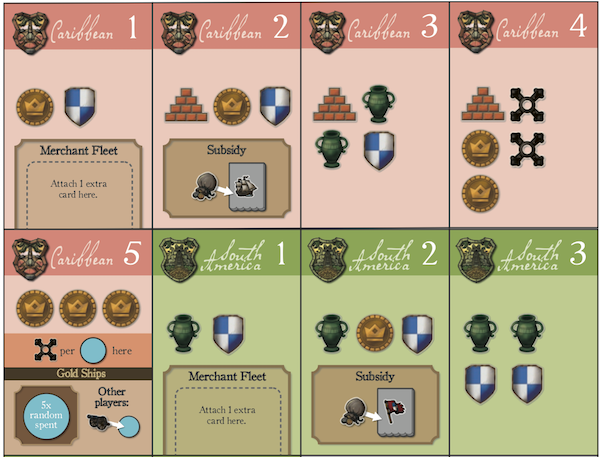
Some of the new Region cards. Merchant FleetThe Merchant Fleet appears on low level Asset cards and lets you place another card on top of it and enjoy the benefits of two cards in one card space. This gives an early boost to your engine, since it basically lets you have twice as many cards in the first few rounds. I'll return to the effect of this in the Expansion conclusions. SubsidiesThe subsidies also appear on low level Asset cards and gives you a Payment action that lets you take back a population marker from a building. Similar to the Merchant Fleet, this gives you an early boost to your engine, since population markers are scarce in the first few rounds. Prominence TilesThe prominence tiles remind a bit about the Exploits by providing additional options for your actions. Two examples are Naval Superiority and Military Buildup, both of which let you place population markers there and either use them in later actions on the map or leave them there to score victory points in the end. The best way to use the prominence tiles is probably as a strategic reserve for future flexibility. However, placing a population marker there comes at the cost of foregoing the benefit of another action (a Trade token or an Asset card for example) so I'm not sure of their strategic value. In my games, they were usually not used until the last few turns, when there were no better scoring options. Hopefully they'll get more exciting options in the finalized version. 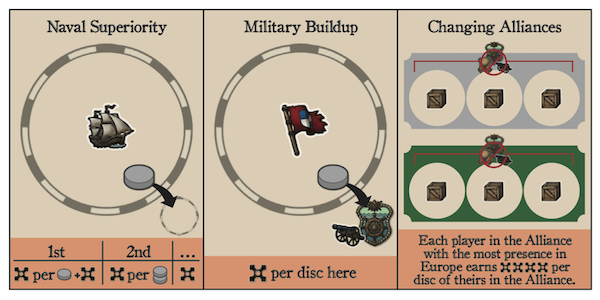
The new prominence tiles. EventsThe new European Assets cards come with events affecting all players. Examples include the Great Plague (all players lose one population marker), the Marriage Alliance (force another player into an alliance that forbids attacks in Europe against one another) and of course the Abolition of Slavery known from the base version. While adding some variation to the ordinary gameplay, most of the events have a too short and limited effect to be part of a strategy. In our games, they were merely side effects. The one exception is the Marriage Alliance and hopefully we get to see more such lasting events in the finalized version. 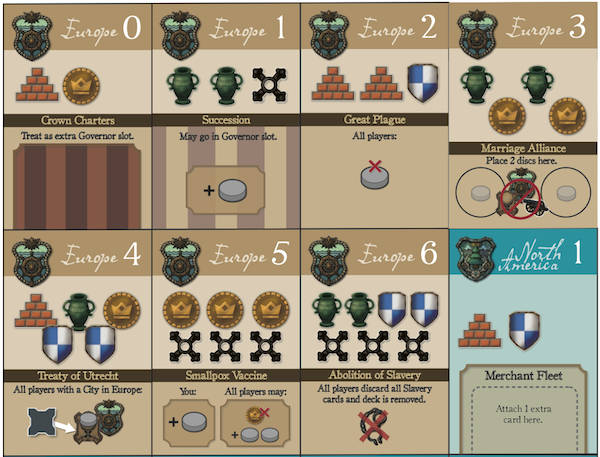
The new European cards with events. Reflections on the ExpansionAlthough many of the novelties in Endeavor Expansions offer more flexibility, there seem to be more positive modifiers than negative ones, such as merchant fleets and subsidies. I'm worried that they contribute to an "attribute inflation" where the all the attributes reach the highest levels already before the last round. This removes some tension in the end game as the players no longer have to decide which attribute to increase next. For some game groups, this may result in population markers being used for other fun purposes (attacks perhaps?), but for other groups, this may lead to an anticlimax where the players maintain their positions and just go for the safe victory points in the last round. At the time of writing, the Expansion is still subject to changes and I hope that the developers add some scarcity to the game so that the increased flexibility doesn't come at the cost of decreasing the tension. 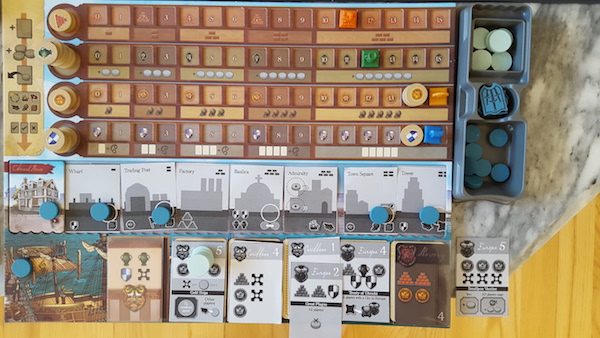
An end player board from an Expansion test game. So who should prefer Sail Engines?Endeavor is a game for the player who enjoys the interdependency between engine building and area control. Build an engine to take control of areas to get fuel to your engine. You do get to choose among different strategies but don't expect to execute them in isolation but rather be prepared to play tactically to adapt to the ever changing conditions of the game. Also, don't expect a slow build-up followed by a big bang but rather a slow and steady pace where every turn is rewarding, both in itself and as a step towards your strategic goal. The base game is good as it is but if you want to throw in player-driven changes in the end game, the Exploits are for you, and if you want to add more flexibility to your turns, the Expansion is for you. No matter what you choose, Endeavor remains a smooth and simple game with quick turns and little downtime that engages its players from start to end. Set sail for the big Endeavor! 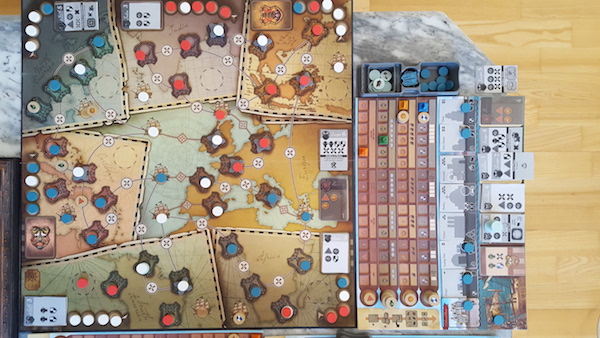
An end game board from an Expansion test game. |
|