
 |
The Quest for the Perfect Game - Reviews to Extract the Essence of Games by Nicholas Hjelmberg | |














|
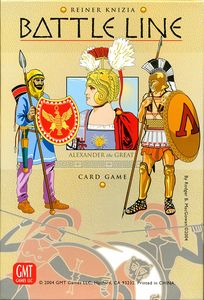
Battle Line - The Centre Cannot Hold (Published 19 March 2018)This review has also been published at Boardgamegeek. Luck versus SkillsAs an old chess player from a world of precise calculations, I have come to appreciate a "healthy randomness" in my games. In Battle Line, the randomness comes from the deck of cards that the players draw from and that limits their options. However, with seven cards on the hand with nine possible places for them, a player can't rely on luck to win. Let's look closer at how Battle Line balances luck and skills. The ObjectThe object of Battle Line is to capture flags lined up along a "battle line" between the players. Each players starts with a hand of seven battle cards, ranging from one to ten in six different suits. The players take turns to play one card to one flag and then draw a new card. Each flag has room for three cards and the side with the strongest card combination will claim the flag. The game ends when a player has claimed three adjacent flags or a total of five flags. The only rule that novices struggle with is the different card combinations and their strength but it helps thinking of them as ordinary poker hands. The strongest combination is three cards of the same suit in sequential order (Wedge/Straight Flush) followed by three of a kind (Phalanx), three cards of the same suit (Battalion Order/Flush) and three cards of any suit in sequential order (Skirmish Line/Straight). Ties are won by the highest total card value or, if equal, whoever completed the combination first. Just like in Poker, high cards are generally better than low cards but will be beaten by well combined cards, hence the skill aspect. 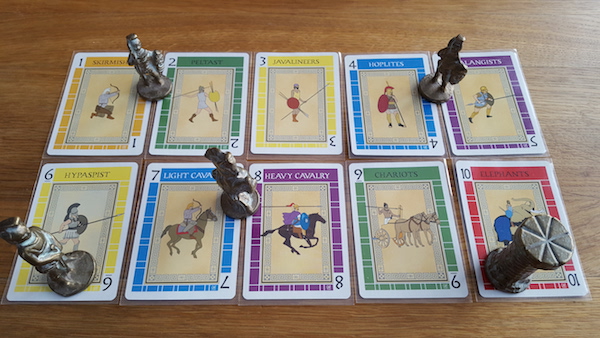
The DecisionsWith nine flags and three cards each, you can play up to 27 cards in a game. However, since you only start with seven cards, you don't have full information for your decisions. As the game progresses, more cards will appear on your hand or along the battle line, helping you to determine which combinations that are possible and not, but until then you'll have to resort to the poker virtues of gambling and bluffing. Say that you start with one complete combination, some high cards and some low cards. Should you play out your combination at once? But then your opponent will be warned and play his or her best cards elsewhere. Should you play your high cards first? But won't they be wasted if your opponent finds a stronger combination with low cards? What about playing your low cards first? But then you may block yourself from flags if you get higher cards later. You could gamble and start building strong combinations even if you don't have all the necessary cards. Observing already played cards and guessing which cards your opponent may have based on how he or she plays may help you make more informed decisions. Or you could bluff and play as if you do have all the necessary cards to lure your opponent to waste strong cards against your weak cards or give up flags that could easily have been won. Another interesting decision comes from the fact that you have to play a card to the battle line. There is no option to pass or discard cards, hoping to get better ones in return. Instead, you have to decide whether to use a flag as a "dumping ground" for a useless card or hold on to it, hoping to get cards that can be combined with it. The seemingly simple rules open up a whirlpool of decisions. Battle Line is a game where you can't get in with a preconception as to how the game should be played. Instead, you'll have to observe your opponent's gameplay carefully to know when and where to fight or give up ground. Ideally, you'll want to win your small battles along the battle line with the smallest possible effort so that you use your limited resources as efficiently as possible. This leads us to the theme of the game... 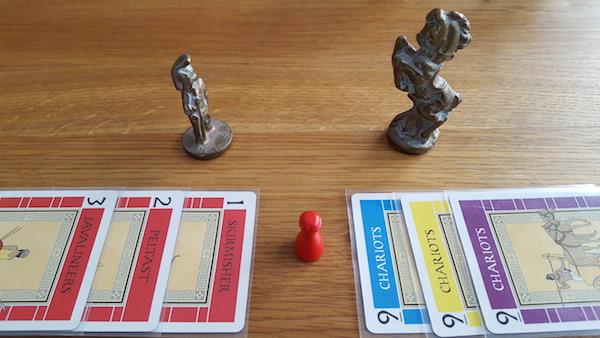
The ThemeAt the outset, Battle Line appears to be no more thematic than an ordinary deck of cards with its suits and numbers. The game has indeed been rethemed many times, for example by Roland's Revenge. However, the ancient battle technique of tight lines of phalanxes pressing against each other until one side manages to break through is very well represented by Battle Line. Is your opponent concentrating troops in the center, aiming at creating a gap wide enough to break through (i.e. to capture three adjacent flags)? Then it may be enough to strengthen one flag and focus your own effort on the flanks. Or perhaps your opponent is applying the oblique order, giving up one flank completely (i.e. to capture five of the other flags)? Then it may be unwise too position your strongest troops there. You don't need much imagination to see the theme of Battle Line. 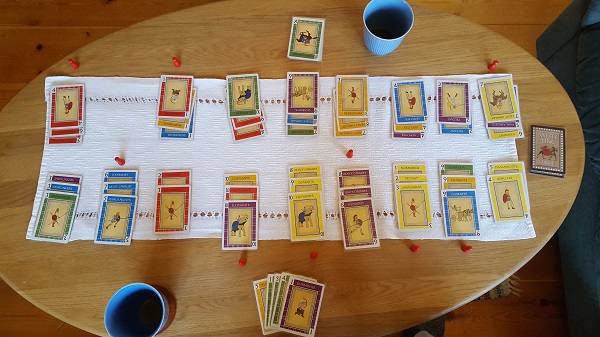
The end of a tense game. The near side has just successfully wedged through the far center and decided the battle. The Tactics CardsFor those who want to add more dimensions to the game than the suits and the numbers, there are ten tactical cards that can be drawn and played to "break the rules". One example is Traitor, that lets a player move an opponent card to his or her own side of the battle line. Personally, I think such cards add unnecessary chaos and detract from theme of pushing phalanxes. Seeing a successful deployment of troops along three adjacent flags that just about turned the balance into one side's favor being thwarted by a Traitor card is not fun to me, whether I'm on the winning side or the losing side. I wasn't surprised to learn that the original game Schotten Totten had no tactics cards but that they were added later, a bit like how the action cards of Tower of Babel were added by the publisher rather than by the designer Reiner Knizia. 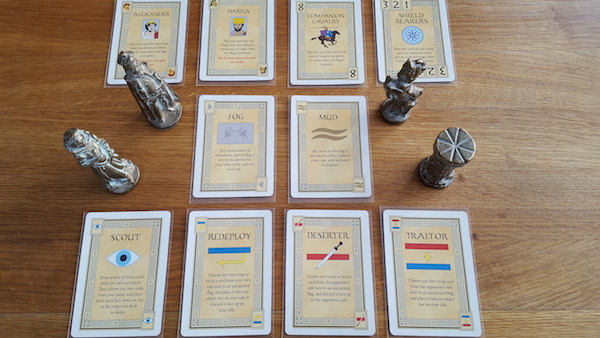
Who is this Game for?Battle Line is an excellent game to play as a filler between sessions. Games are often short and tense, ending with the feeling that you'd won if you had only got that single card. Hence, Battle Line has a high "one more time" factor. I'm not sure if you can become generally good at Battle Line or if it's more about becoming good at reading certain opponents, but winning a session always feels rewarding. 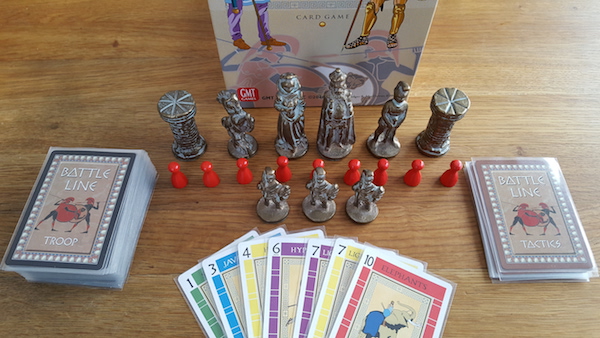
|
|