
The Quest for the Perfect Game - Reviews to Extract the Essence of Games by Nicholas Hjelmberg
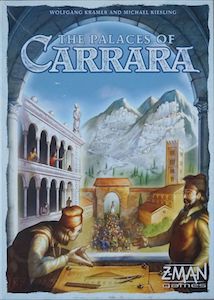
The Palaces of Carrara - The Bare Stone Euro Game (Published 27 July 2020)
This review has also been published at
Boardgamegeek.
A simple game
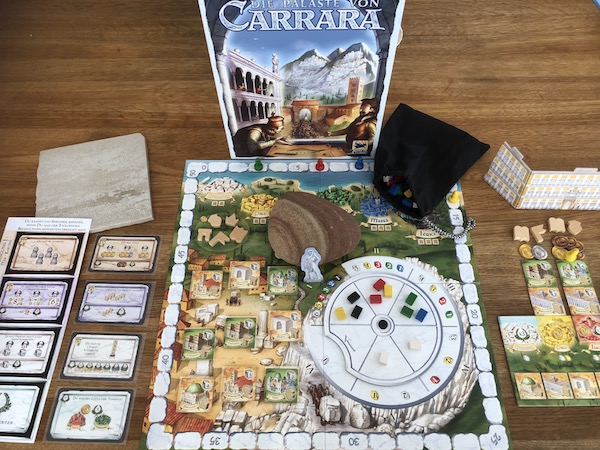
Designing a euro game is simple. Let the players acquire resources, invest in engines, and use them to earn more resources and victory points. Finally you need some kind of unique twist. Simple, isn’t it? At least this is what Kramer and Kiesling seem to tell you with Palaces of Carrara.
While many other game designers put all their creativity into various resources, convoluted conversion chains, and spectacular victory point sources, Kramer and Kiesling strip those core elements down to the bare bones in Palaces of Carrara, as if the game was discovered rather than invented. Everything is mathematically balanced, as if either a mathematician or a numerologist was involved, and there are only three actions in the game. Let’s look at them one by one.
The resource action
To build The Palaces of Carrara you need to buy stones. Period. No other building materials, no workers, no contracts. Just stones. The stones do come in six different colors with different values (more about this later) but they all have one use only: build buildings.
This may sound very generic and that would be true if it hadn’t been for the game’s first unique twist: the price wheel. The price wheel works similar to a Dutch auction. Stones are randomly drawn from a bag and placed on the first of six segments. In this segment, the stone prices range from 1 for the cheapest stone (black) to 6 for the most expensive stone (white). Every time a player wants to acquire resources, he or she must (may in the advanced version) turn the wheel one segment, after which all prices decrease by one. The player may then buy any number of stones but only from one segment, meaning that the next player is likely to get cheaper segments to choose from but with fewer and fewer stones.
This creates the opposite of a ”chicken race” towards the bottom, where a player may wait for the prices to fall only to lose the stones to another player willing to pay more. Buy now, next turn it may be too late! Few euro games have got so much tension from a simple resource action.
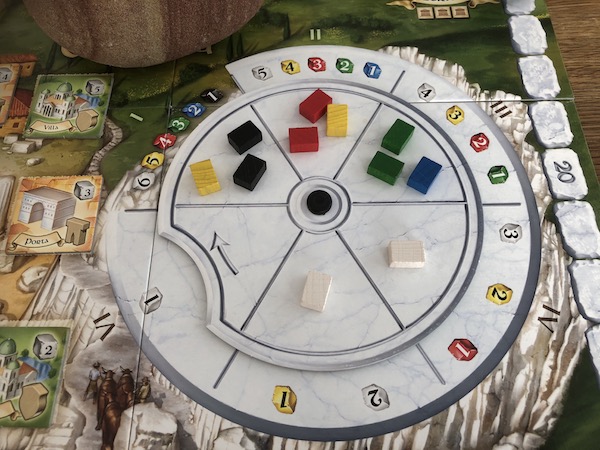
The two black stones in segment I cost 2 coins. For the same cost, you could instead pick up two green
and one blue stone from segment III or one white stone from segment V.
The building action
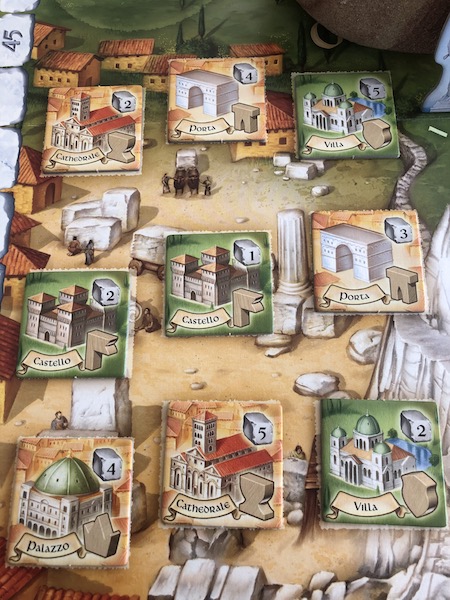
Actually, there are no less than 30 buildings to choose from, of which 9 at a time are on display and available. However, the only difference between them is cost (ranging from 1 to 5 stones) and type (6 types, differing in name only). Similar to the stones, the buildings have few uses: generate coins or generate victory points.
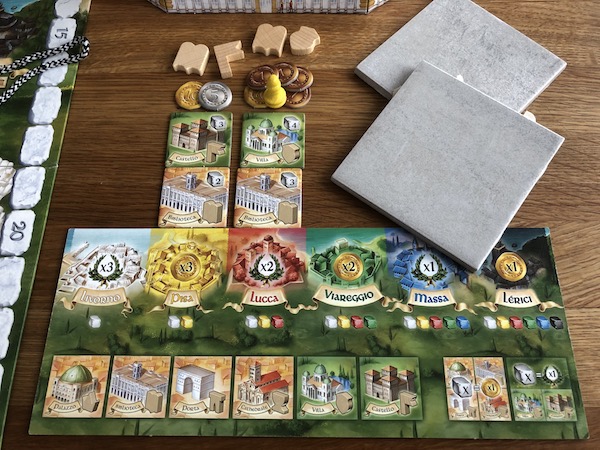
Again, this sounds very generic, even dull. However, the second unique twist of The Palaces of Carrara isn’t WHAT you build but WHERE. Every player has a player board with six cities, matching the six colors of the stones. The ”white city” of Livorno accepts only the (usually) expensive white stones, the next ”yellow city” of Lucca accepts both white and yellow stones and so on down to the sixth ”black city” of Lerici, which accepts stones of any color.
The tension here comes from the sunk cost fallacy, well-known in economics, whereby players who have invested in expensive stones want to use them for buildings in the most expensive cities rather than using them as substitutes for cheaper stones in cheaper cities. However, it’s often good to build one big but ”suboptimal” building in one action rather than wasting two actions to build two small but ”optimal” buildings. If you thought acquiring resources was an agonizing decision, spending resources may be even more agonizing.
The scoring action
Your buildings earn you coins and victory points, as in most euro games. The coins and victory points you earn depend on the building size and site. The two ”cheapest” cities earn you 1 coin and 1 victory point respectively per stone used for the building, the next two cities earn you 2, and the last two cities earn you 3.
This means that your score ranges from 1 coin for a 1-stone-building in Lerici to 15 victory points for a 5-stone city in Livorno. In addition, each scored building earns you a special symbol representing the building, e.g. a crown for the palace, that is worth additional victory points.
Scoring is either horizontal, meaning that you score all buildings in one city, or vertical, meaning that you score all buildings of a type, no matter which city they were built in. Thus, having many buildings in a city or many buildings of the same type may score a lot in one action. A simple and elegant engine.
However, not even the scoring action is without tension. Each city may only be scored once per game and although each building type may be scored once per player, the building symbols are limited. The tension is similar to that of the price wheel: the longer you wait, the better the return of your action, but if you wait too long, you risk missing the best parts.
Scoring Pisa earns 5x3=15 coins. Scoring Lucca earns 7x2=14 victory points. Scoring Books
earns 2x3=6 coins from Pisa and 3x2=6 victory points from Lucca.
The common denominator of the actions
All those actions have one thing in common, namely timing. Timing gives you the best stones for the best prices. Timing gives you the buildings that match your stones. Timing gives you coins to build more buildings and eventually victory points to win you the game. In particular, timing determines when the game ends.
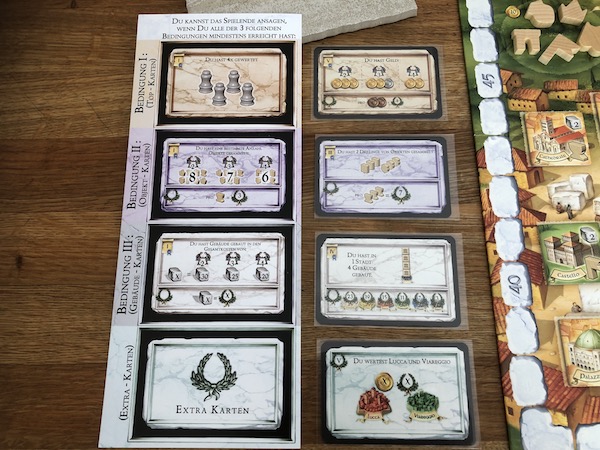
In the base game, there are three objectives that must be completed for a player to announce the end of the game. First, the player must have scored four times. Second, the player must have collected 8/7/6 symbols (2/3/4 players). Third, the player must have built buildings for 30/25/20 stones (2/3/4 players). Although it’s optional to announce the end of the game, it’s usually wise to do so, since it’s a sign that the player is in the lead and earns the player 5 victory points as well.
Ideally, your last action is a fourth scoring action with the necessary buildings built that earn you the necessary symbols. To accomplish this you need - you guessed it - timing!
The basic objectives to the left, some of the advanced ones to the right (collect coins, collect triplets of
symbols, build 4 buildings in a city, score Lucca and Viareggio).
The actions from the player’s perspective
We’ve already hinted at the tension surrounding every single action of the game. This is what may go through a player’s mind during a typical game (which, as I often warn newer players about, may end sooner than you expect).
Help, where do I start? Cheap stones or expensive stones? Small buildings or large buildings? I'd better get some of everything to be flexible.
I’m running out of coins quickly. Perhaps I should build some coin buildings first so that I can score them and then switch to victory points buildings? Sounds easy enough.
Hm, the player ahead of me goes for medium crown buildings and the player before her fills Lerici with large but cheap buildings of any symbol. Perhaps I can afford to build a couple of book buildings in Pisa if I don’t waste coins on cheaper stones?
Hm again, if I leave those red and green stones on the wheel, the players after me will get them for almost nothing. Can I afford to disrupt their plans?
Oh no, now they build in Pisa too. I guess I have to score Pisa before it’s too late.
OK, now I have coins again but which should be my next crown building and in which city should I build it?
Ah, now I’m all set for a final victory point push… What do you mean you announce the end of the game!
If you’re looking for a game that lets you build your own engine in your own pace, you’d better look elsewhere.
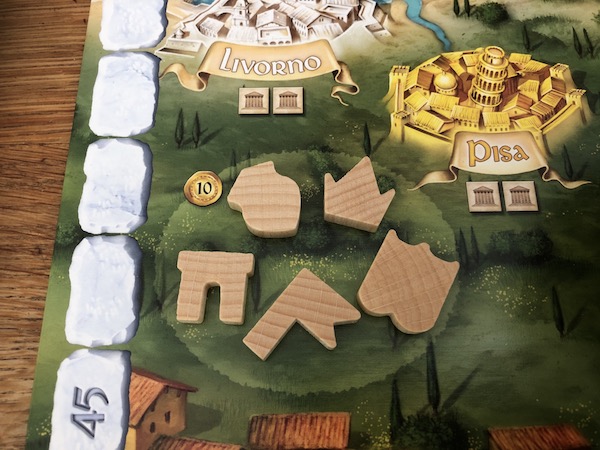
The five symbols of the game: Coat of arms, Crown, Gate, Flag, Book
The advanced game
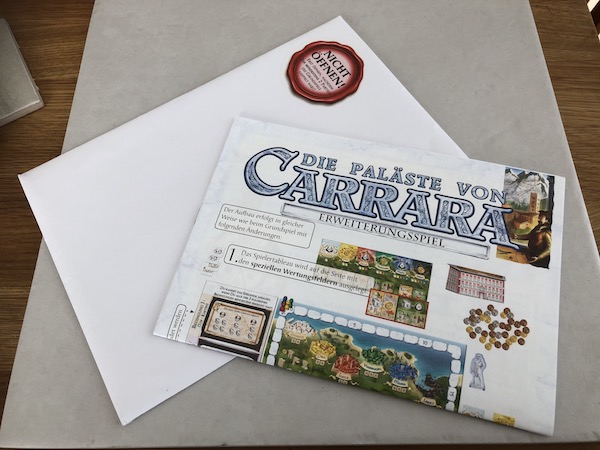
I like to describe The Palaces of Carrara as my only legacy game. This is because the box contains a sealed envelope which may only be opened after two games and which will permanently alter the game (because once you’ve played the advanced game, you’ll probably don’t want to return to the old again).
Do not open until Xmas, sorry Xperienced.
One of the rule changes is the previously mentioned option not to turn the wheel in the resource action. This does give you more expensive stones but if you can afford them, you don’t have to worry about leaving too cheap stones to the next player.
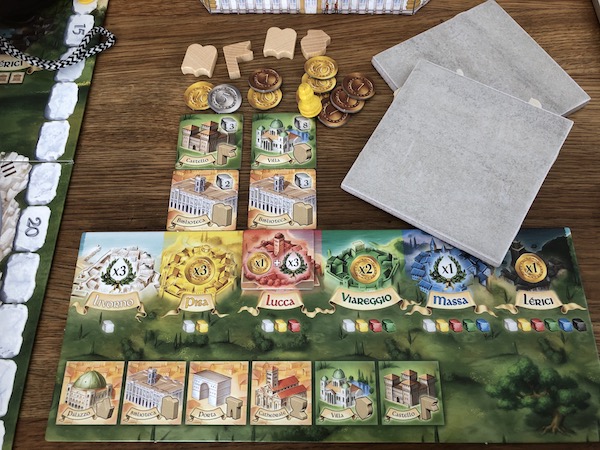
Another rule change concerns the building and scoring actions. The advanced game introduces buildings with a cost of 8 coins, which may be built either directly or by upgrading an existing building. The reward for such a building is an upgrade tile, which increases the coins or victory points earned during scoring. This is a further boost to your engine but timing remains an issue - you need time to fully take advantage of your upgrade tile so choose it wisely.
Finally the three fixed objectives have been replaced by several variable objectives. They give each game a unique mix of objectives in such different areas as buildings, coins, victory points, objects, and cities. This forces you to reassess your strategy for each new game since a successful strategy in one game may lead to a disaster in another.
The Lucca upgrade tile scores 1 coin and 3 victory points per building value. Scoring Lucca in this
example earns 11x1=11 coins and 11x3=33 victory points.
So is Carrara marble still good enough for Palaces?
According to Tom Vasel’s law ”Any game that is good will not remain out of print and will be eventually available”, the answer is no, this is not a good game. The Palaces of Carrara may be hard to find, particularly the English edition (I was happy to find a German edition), and the few games available on the GeekMarket may be offered for €50-€100. Yet, Palace of Carrara still waits for a reprint.
Perhaps simple mechanics aren’t enough for a game to stand out in today’s saturated market? Or perhaps there is no market for a medium weight games as casual gamers move towards party games (judging from recent Spiel des Jahres winners) while hobby gamers move towards heavier games (judging from criticism against recent Spiel des Jahres winners). Personally, I hope for a revival of the ”old modern boardgames”, when games were elegant and gameplay interactive. If The Palaces of Carrara does get a reprint, it may be a sign that such a revival is indeed coming.
Meanwhile, don't hesitate to go to Carrara if you get the opportunity!
The Quest for the Perfect Game is an endeavour to play a variety of games
and review them to extract the essence of each game. What you typically will
find in the reviews include:
What does the game want to be?
How does the player perceive the game?
What does the game do well and why?
What does the game do less well and why?
Is it fun?
What you typically will NOT find in the reviews include:
A detailed explanation of the rules.
An assessment of art, miniatures etc. with no impact on gameplay.
Unfounded statements like "dripping with theme" and "tons of replayability".
Unless stated otherwise, all the reviews are independent
and not preceded by any contacts with the game's stakeholders.
Is there a particular game that you would like me to review next? Please let us know!
Please leave a comment on the reviews or contact me directly at