
 |
The Quest for the Perfect Game - Reviews to Extract the Essence of Games by Nicholas Hjelmberg | |





|
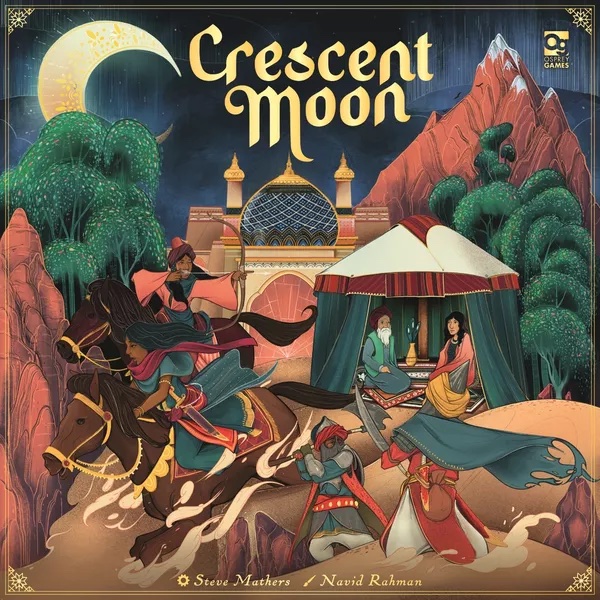
Crescent Moon - One Thousand and One Fights (Published 8 August 2022)This review has also been published at Boardgamegeek. PrologListen, King Shahryār, to my tale about the game of Crescent Moon. I know that it is your habit to play a game every night and burn it the next morning, since all the games are the same. Crescent Moon, however, is a game unlike other games and has been described by the elders at BGG as "an ambitious asymmetric area control game of tense negotiations". You may wonder why I chose Crescent Moon for your game night, although there are many other games about asymmetry and negotiation. The simple answer is that Crescent Moon was my first ever BGG Giveaway Contest prize. However, the reason why I participated in the first place was that Osprey Games hasn't disappointed me yet, another that Crescent Moon hinted towards a web of interdependency between the players. There are many things that contribute to this interdependency, my dear King, but the night is late and we'll have to start playing in the next section. The Setting of Crescent MoonListen, King Shahryār, to my tale about the setting of Crescent Moon. To understand the interdependency between the players, you have to understand the setting of the game. The art of Crescent Moon is inspired by One Thousand and One Nights with beautiful illustrations by Navid Rahman. I believe this is his first boardgame artwork but hopefully not his last. The game is supposedly set in the 10th century Middle East, where various Muslim empires struggle for hegemony. Such a setting hints towards a struggle between equally strong players using similar means to the common end of supremacy. However, this is far from the truth. Rather than ruling one of those empires, you rule a faction within an empire. Moreover, this empire is not based on one of the real empires of the time but rather a modular board constructed from different terrain tiles. The leads to a game where the players start with different conditions, adapt their strategies to a new board in every new game, and strive for different objectives. In this game, the players' paths will constantly cross, sometimes in mutually beneficial ways and sometimes in fiercely competitive ways. Quoting the designer, Steven Mather, Crescent Moon's promises an experience of "ebb and flows of power". There are four elements in the game that contribute to this, my dear King, but the night is late and we'll have to start playing in the next section. 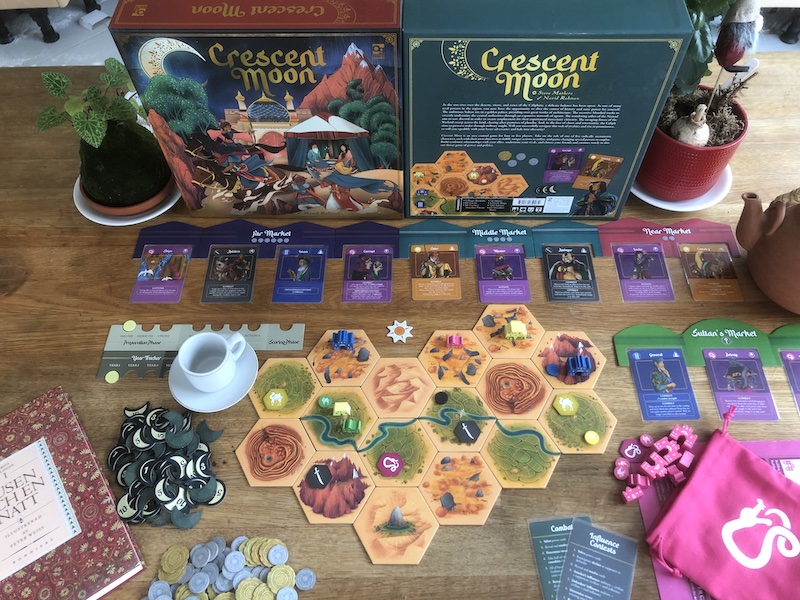
The sun rises over The Fertile Valley of Crescent Moon (one of the suggested map setups) The Gameplay of Crescent MoonListen, King Shahryār, to my tale about the gameplay of Crescent Moon. Broadly speaking, Crescent Moon has four elements that the players have to manage in the gameplay: Area Control, Terrain Features, Actions and Factions. At its heart, Crescent Moon is an area control game. Playing one each of its asymmetric factions, the players take actions to compete for control of the board, which in turn will provide them with resources and/or victory points depending on the terrain. After twelve rounds (or sixteen if you play the long game), the player with the most victory points wins. Let me tell you about each element, starting with the area control. The Area ControlOne interesting aspect of the area control game is that there are three different levels of control or presence.
This kind of "levelled" area control game may not be new but it works very well in the game's context of asymmetry and negotiations. A hex may basically be shared between up to three players, where one player is happy to have control, a second is satisfied with influence and a third only asks for a settlement there. Conversely, a player with presence only on a few hexes may compensate this with more levels of control. This makes it easier for the players to reach mutually beneficial agreements. The terrain hexes that the players strive to control have different features, my dear King, but the night is late and we'll have to start playing in the next section. The Terrain FeaturesListen, King Shahryār, to my tale about the terrain of Crescent Moon. As you may expect from a "dudes on the map" game, different terrain hexes have different features that affect the gameplay in different ways. Fertile terrain is good for income and building. Quarries make building more expensive but yield a very good income in return. Mountains and deserts are also expensive to build in but without yielding anything. Buildings generally make tiles more profitable in terms of income, strength and victory points There is also a holy site that all factions are interested in because of its victory points. Finally there is the river that (with some exceptions) blocks adjacency except at a crossing. Again, those mechanics aren't new but support the asymmetry and negotiations. Players will have different interests and opportunities on the game board to negotiate about while at the same time being restricted by the geographical constraints, such as the river. This prevents the game from being too chaotic and rewards good planning. The players have several actions at their disposal, my dear King, but the night is late and we'll have to start playing in the next section. 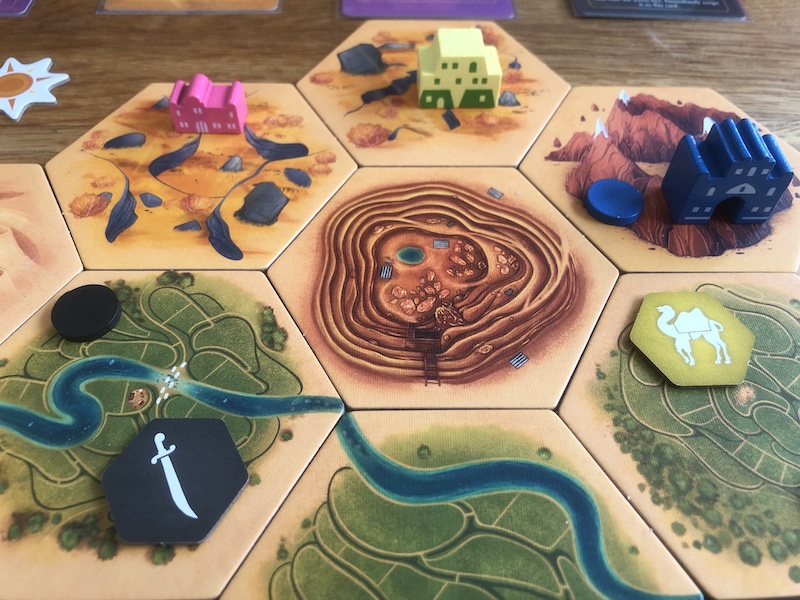
From his mountain castle, the Caliph overlooks a Sultan town and a Murshid fort in the Western wilderness and Nomad influence in the fertile land in the South. But imminent dangers awaits beyond the quarry, as a Warlord army has taken control of the river crossing... The ActionsListen, King Shahryār, to my tale about the actions of Crescent Moon. So which actions do the players have at their disposal to acquire control of those terrain tiles? As you mights expect, there are actions for placing units on the board (Recruit), moving them (Move), and gaining presence (Assault, Influence or Build depending on which presence you're interested in). One interesting action concerns mercenaries, a kind of neutral unit that may be hired but also bribed to switch side and which we'll get back to later. Another one is the ability to buy and use power cards, which provide rule-breaking abilities. Some of them are discarded after use while others may be kept and used again. The power cards are also linked to certain factions, meaning that they are cheaper to buy for this faction. This gives the players the possibility to adapt and improve their factions. One important aspect of the actions is that they are deterministic. There is no randomness that determine the outcome of a conflict, although the many steps to determine the attacker's and the defender's strength may be perceived as cumbersome before you get into it. However, the above mentioned power cards do provide an unknown factor to the actions, particularly to the conflicts, where the antagonists play a secret number of unknown power cards. This may or may not suit everybody but personally I appreciate that the unknown elements are in the players' hands and thus up for negotiation. Perhaps the most important aspect is that the factions have partly different actions, my dear King, but the night is late and we'll have to start playing in the next section. 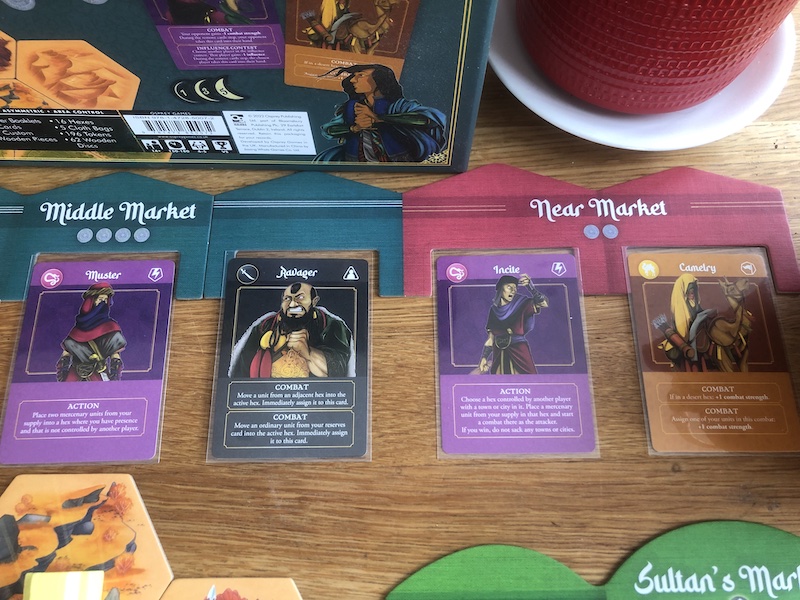
The Near Market offers Incite (Murshid) and Camelry (Nomad) for 2 coins each, giving the buyer the ability to place units in a town or city and to increase the combat strength respectively. The power cards in the Middle Market cost twice as much but in time they will move to the cheaper Near Market. The Factions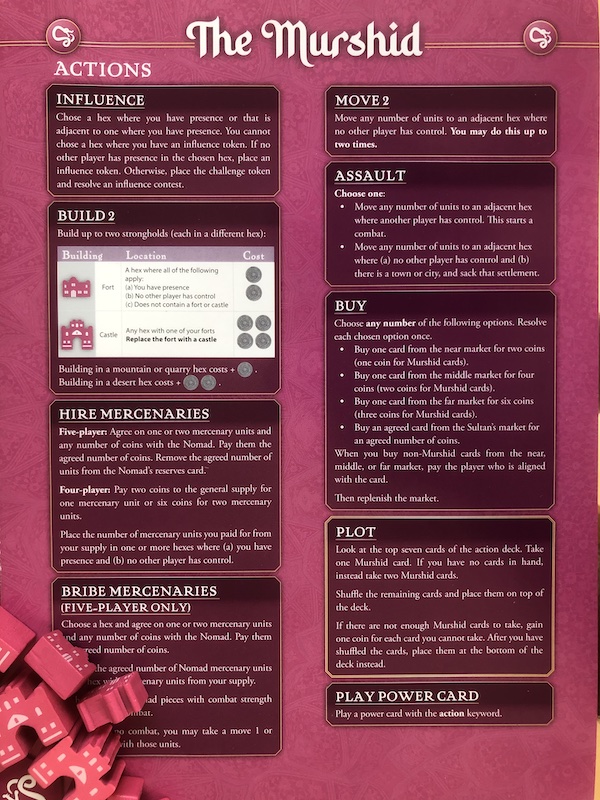
Listen, King Shahryār, to my tale about the factions of Crescent Moon. The five factions of Crescent Moon differ in several aspects. Not only do they have unique actions and attributes but they also score victory points for different things.
This may sound like the five players will play five independent games. The Sultan will build, The Caliph will control, the Warlord will destroy, the Nomad will sell armies, and the Murshid will sell influence, and whoever does this best wins. However, our game will show the opposite. Our game will show one game of interdependence where the players' crossing paths bring opportunities to all, my dear King, but the night is late and we'll have to start playing in the next section. The Interdependency of Interests in Crescent MoonListen, King Shahryār, to my tale about the interdependency of Crescent Moon. I have told you about how the game's four elements of area control, terrain features, actions, and factions have different meanings to the different players. Many other asymmetric games only utilize one or two of those elements, resulting in a game with narrow strategic paths for the players. If a player has a stronger army, that player will focus on armies and other players will refrain from doing so. If a player has better build actions, that player will focus on buildings and other players will refrain from doing so. Each game will be predictable and there will be no new games under the sun. You may think that when all those elements are present, as they are in the world of Crescent Moon, the the game will be even more scripted. But lo and behold, here the players suddenly find themselves free to negotiate for asymmetric agreements, where they contribute with different things for different results. The Sultan may contribute with buildings and the Caliph with control and both benefit from a stable empire with wealthy buildings. The Nomad may supply the Warlord with armies to bring instability to the empire without fear, since the Nomad has nothing the Warlord wants to destroy and the Warlord doesn't share the Nomad's interest in wealth. The Murshid may shift the balance in exchange for influence in valuable terrain hexes. But perhaps the Sultan begins to fear the increased power of the Caliph and calls for the Warlord to bring him down? And perhaps the Murshid finds his influence too weak to restore the balance and recruits the Nomad's mercenaries himself to accomplish this. There are One Thousand and One possibilities, my dear King, but the night is late and we'll have to start playing in the next section. 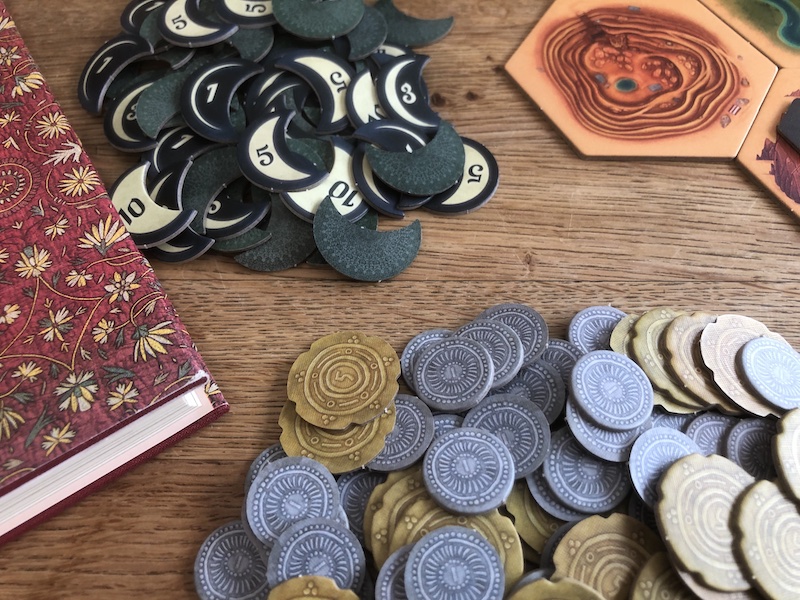
The resources of Crescent Moon: Coins to buy, build and bribe, and victory points to reward your success. So is Crescent Moon a place for you?Listen, King Shahryār, to my tale about Crescent Moon. The empire is certainly not a place for the faint-hearted. The modular board gives each new game new challenges. Each new faction you play requires a new mindset. But most importantly, you will not survive in Crescent Moon on your own. You will have to strike deals, you will bring glory to some and ruin to others, and you will most likely be betrayed. Players who prefer hovering over their own player boards and play their own optimization games will be disappointed. That said, Crescent Moon isn't Diplomacy. It's not a tug of war where only one player can own an area but rather a game where different factions can benefit from a terrain tile in different ways. It's not a game where you ally with the player you trust the most but rather with the player whose abilities and objectives match yours the most. It's not an elimination game but rather a game where some balance is necessary so that you always have options to turn the scales in your favor. It's true that even the sun has its spots. The rules aren't always elegant, particularly the aforementioned steps to resolve conflicts. The power card abilities are described with text rather than icons and may be difficult to discern from across the board. The hidden victory points may put off some players, since it makes it hard to assess the game state and determine who is the main threat to Crescent Moon's delicate balance. However, I still think those rules are adequate to the gameplay that Crescent Moon aspires to. The conflicts need several steps to allow several ways of interfering with the outcome. The power cards would be less interesting if they were all about simple modifiers and other abilities that lend themselves to be described by icons. The hidden victory points are necessary to prevent endless calculations and bashing of the leader in the last few rounds. Thus, my King Shahryār, I bid you Crescent Moon and hope that you will find the gameplay interesting and varying enough to be spared your wrath after our game. |
|