
 |
The Quest for the Perfect Game - Reviews to Extract the Essence of Games by Nicholas Hjelmberg | |


























|
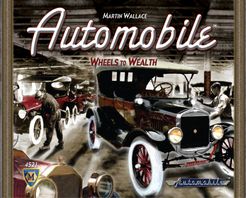
Automobile – Ten small decisions are greater than one big (Published 15 Jan 2018)This review has also been published at Boardgamegeek. IntroductionImagine a situation where you have to evaluate return on investment, free cash flow and market segmentation in the competitive and evolving car industry. A boring routine task at work? An even more boring assignment at business school? No, a surprisingly good time at a game of Automobile. The designer Martin Wallace has managed to collect several financial decisions, simplify and streamline them, and put them all together in a medium heavy game. One would almost think that Automobile was designed to teach future executives how to manage a manufacturing company. The basicsThe goal of Automobile is simply to earn the most money. To do so, you invest in production facilities, produce cars, invest in marketing activities and sell cars. This sounds like nine out of ten other euro games out there, where you build an engine, turn resources into victory points, and rinse and repeat until the runaway leader wins. However, every little link in this value chain has a special mechanic that turns the whole into something completely different. If the mechanic hadn’t been there, you wouldn’t have noticed that anything was missing, but once you’ve seen it in operation, you can’t possibly imagine the game without it. Similar to a well manufactured car, it’s not one big thing that stands out but the way the many small details work together. Let us review those seemingly small design decisions to see how they support the game and why they do it so well. The investment actionOne available action is to invest in a factory space. This could have been one big decision where you are free to set how much to pay for production, what to produce and how much to produce but not so in Automobile. Instead, the investment action has been broken down into several small and limited decisions, each of which only has a few discrete options, but where all those decisions together have a great impact on your strategy. 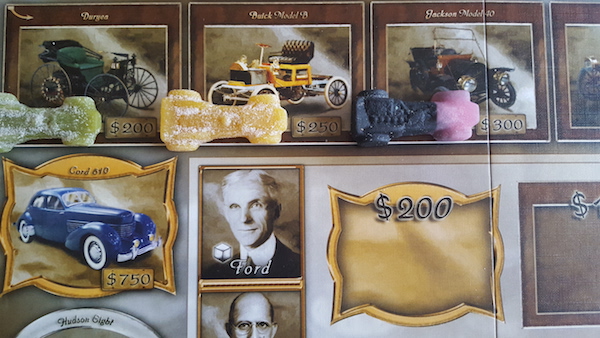
The factory spaces are neatly arranged in a clockwise pattern around the game board where each new space introduces a more modern (and more expensive) car model. This looks a bit like, although I shudder to mention the game in the same sentence as Automobile, how the streets in Monopoly are organized. Rest assured that there are no other similarities between those games! Each factory space has a fixed price and a fixed car model. So you have no choice but to pick the first available factory space and pay the fixed price? Not quite. To give you a few small decisions, Martin Wallace introduced two additional currencies besides money: R&D cubes (white) and Loss cubes (black). The pseudo currencies – and the action to get themThe R&D cubes allow you to jump empty factory spaces and pick more modern ones (that is, more modern than your competitors). The loss cubes are incurred if you are happy with picking the first empty factory space, even if that leaves you behind your competitors. You will not have to worry about acquiring and spending R&D cubes (two R&D cubes cost you one whole action) but your loss cubes will cost you money each round. 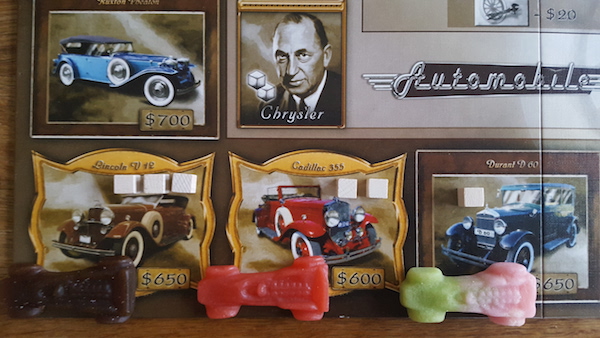
But wait, wouldn’t the game have been simpler with just one currency to immediately pay for R&D and losses rather than going via those pseudo currencies? One answer is that the cubes remove some fiddly cash transactions but more importantly, they serve as a limited currency that limit certain transactions and offer long term decisions. If you decide to jump factory spaces, you have to acquire white cubes first. Since white cubes are less abundant than money and the cost for jumping increases exponentially (one space costs one cube, two spaces cost three cubes and so on), you will rarely have the choice of jumping more than one or two spaces. If you want to keep a less modern factory one more round, you can’t take the entire loss this round but have to take into account future losses as well. A crazy design idea in theory but brilliant in practice. The production actionAnother available action is to produce cars. The number of cars you may produce must be within the boundaries of your production capacity, which in turn is determined by the number of factories you placed in the factory space during the investment action. (A factory space can have between one and three factories.) Take for example a factory space for middle-class cars with two factories. This may produce between four and seven cars – no more, no less. Again, we see an action that consists of small decisions with discrete options, some taken now and some taken in earlier actions. So how many should you produce? That depends on how many you will sell and that number is partially known and partially influencable. 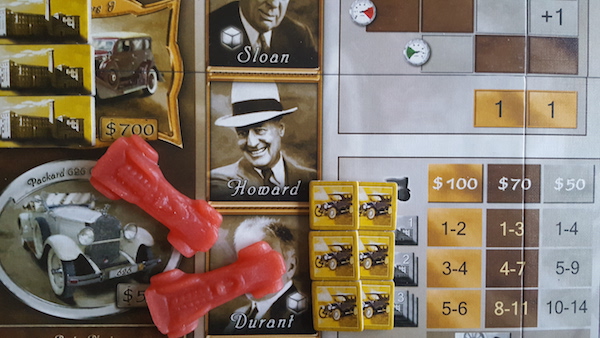
The market and the marketing actionAt the beginning of the round, the players draw demand tiles with a value between two and five. At the end of the round, the total value of all the players’ demand tiles determine the total demand for all players. This means that you have a limited knowledge about the demand but also that the demand cannot fluctuate too much. 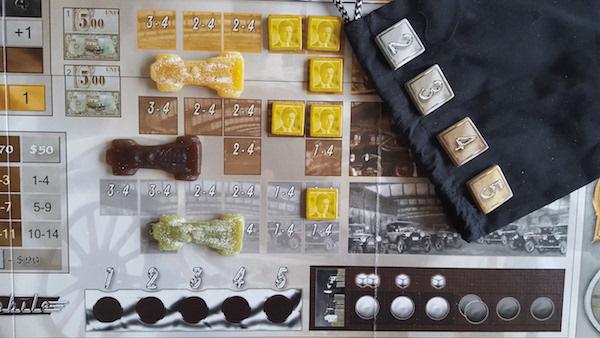
There is also an action available that lets you place one to three salesmen, each of which will let you sell one car in addition to the above demand. On the other hand, this means that you have less cars to cover the total demand so if you plan to sell through salesmen, also plan to increase your production, which you do in the production action, which you prepared in the investment action… The market segmentsOK, we’ve seen how the Automobile value chain requires many small decisions but does one round really differ from another? Oh yes, Automobile doesn’t simulate a mature market but an evolving one. We’ve already mentioned middle-class cars and there are actually two more market segments: premium-class cars and mass-market cars. Each segment differs in terms of investment cost, production cost and production capacity. More importantly, the demand for those cars fluctuate from round to round and consequently the players’ supply of those cars will shift as well. When is the right time to move to the mass-market segment? Do you have any competition in the premium-class segment? Is there still any demand for your old middle-class model? No matter how well your “engine” works in one round, it will be sadly obsolete the next round if you don’t pay attention to the evolving market. The dreaded loss cubes – and the action to get rid of themBut how can an engine become obsolete, you may ask? Can’t I just keep producing more cars and placing more salesmen to earn more money to produce and place even more? No, the dreaded loss cubes prevent you from this. We’ve already mentioned how less modern factory spaces accumulate loss cubes. So do producing cars that don’t get sold on the limited market or placing salesmen that can’t be allocated to the limited selling spaces. In essence, the loss cubes are a simple but thematic mechanic to punish you for what would be a bad decision in real life. Remember that loss cubes are kept through the rounds and cost you money each round. 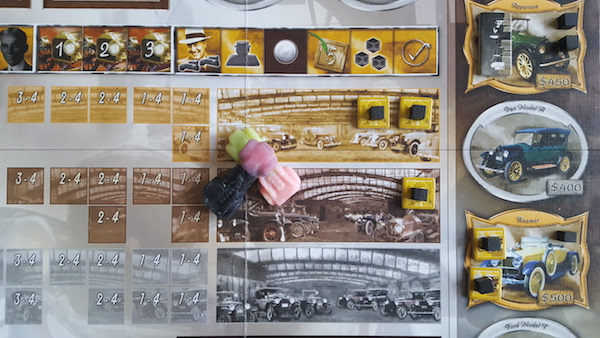
But don’t despair, there is an action that saves you. By closing a factory space, not only do you remove a source of loss cubes but you also get to discard half of your existing loss cubes. On the other hand, you only get half of your investment back so you want to make sure that you get a return on your investment before you trash it. The number of actionsAutomobiles wouldn’t be a euro game if you would have enough actions to do all this. But Automobile is only played through four rounds, each of which only gives you three actions. Add to this the fact that one of your action in most cases must be to produce cars and a second action often must be to invest in a new factory space and you will realize that your action space is… yes, you guessed right: limited. The final sales race and the executive decision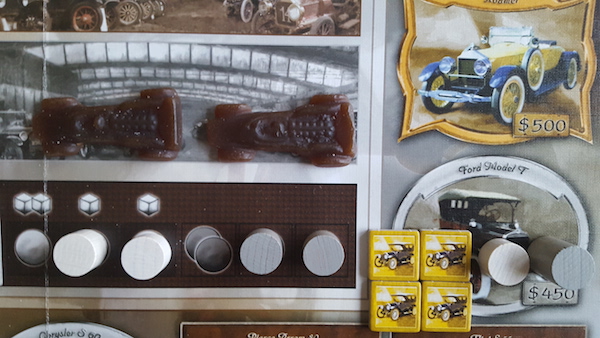
Ah, finally we get to sell the cars and get our well-deserved (and needed) money. The sales do not cost an action and thanks to the demand tiles and the salesmen, you have a pretty good idea about how many cars that will be sold. This should be a peaceful affair, right? Certainly not. 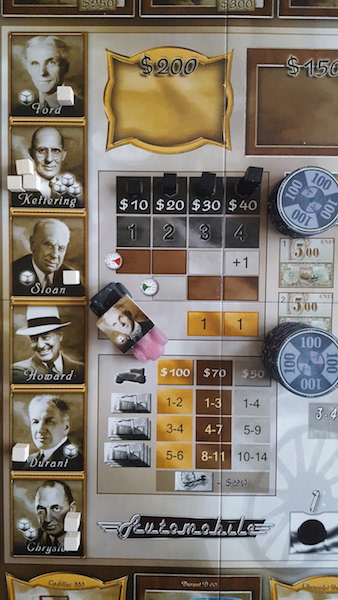
Cars are sold one at the time, starting from the most modern factory space of a specific segment and going counterclockwise as many laps as needed. However, Martin Wallace squeezed in another phase before that, the Executive Decision. This lets the players either pass or acquire advertisement discs or discount discs. The advertisement discs cost R&D cubes and the discount discs give you a lower price per car but they both let you sell more than one car at the time. Will the demand be high enough for all the cars to be sold? If not, should you pass, hoping that the other players won’t compete, or should you grab the discs yourself before it’s too late? This is possibly the best implementation of the prisoners’ dilemma I’ve seen in a game. If only one player competes, he or she will earn more than the others, but if all players compete, all will lose R&D cubes or sell cheaper to no avail since the total number of cars sold will remain the same. The charactersAs if there weren’t enough decisions already, you also get to choose one historical character each round to help you manage your corporation. The abilities of each character are seemingly limited (Ford lets you build one extra factory, Howard lets you sell two extra cars, Chrysler lets you discard loss cubes and so on) but they can be crucial to your strategy to give you that little edge you need at the right time and the right place. The loansSome reviewers say that a game is not a Martin Wallace game without a loan mechanic. Loans are indeed available in Automobile (1 or 2 fixed loans as you might expect) but at a high interest (10% per round +20% at the end of the game!). Does the return on your investment motivates such a draconic loan? It’s up to you to decide. The decision spacesLet us summarize what we have observed so far. Below is a list of the most important decisions. Each of them has a limited decision space but they can be combined into a huge number of strategies.

More importantly, each decision that a player takes will have a profound impact on the market as a whole and force all players to adapt their strategies accordingly. There is no take that in Automobile but the interaction is nevertheless fierce and ruthless. I’ve seen games where the players stick to their old factory spaces, manage their loss cubes and flood the market with cheaply produced models. But in my latest game, the rush for the more expensive models led to the final factory space being claimed already in the second to last round while we barely could afford to supply all the cars that the market demanded. My initial fears that Automobile would feel repetitive from game to game been disproved. But is it too much?If you agree with me in this review, Automobile appears to be a complex maze where you can only choose to go left or right but where the wrong direction will be devastating. But is it Automobile a punishing and unforgiving game? Not for an experienced gamer in my opinion. The limited decisions also limit the damage an unknowing player can inflict on himself or herself. The really bad decisions are often obvious, such as forgetting to produce cars (and get no money) or producing too many cars on an already saturated market (and get loss cubes for unsold cars). 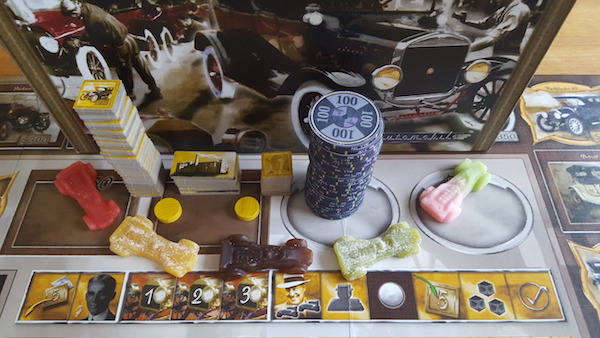
Instead, the challenge is to identify and take advantage of the many small opportunities that this maze may provide. Perhaps it is good to produce cars on this saturated market, if that denies the other players profit. Remember, the goal of the game is not to earn money but to make sure that no other player earns more than you. Most information in Automobile is open to all players and it’s the skilled player that will benefit most of it. Automobile does not punish weak players but it rewards strong players. A more valid argument against Automobile is that it can be too mathy. If you invest X now will you have enough money to produce Y cars for Z each in each of the market segments where you’re present? Is it better to close a factory now and accept a loss of investment X now or is it better to accept loss cubes that will cost you Y times Z for the remaining rounds? The math is not difficult, I would argue it’s on the same level like in Power Grid, but it is there and may not be for everybody. However, I strongly recommend the use of poker chips instead of paper money to speed up the cash transactions. The cash transactions are remarkably few for a financial game but poker chips are most welcome during the sales, when three markets with cars of up to five different player colors have to settled. 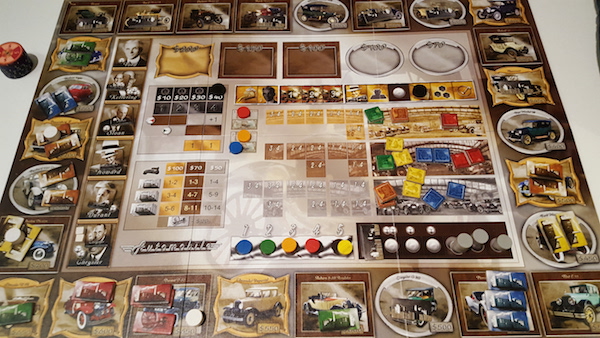
5 player end game - the aggressive R&D competition has opened up even the most advanced models SummaryMy first encounter with Martin Wallace was when I, fully trusting my geek buddies, decided to back Brass. Shortly afterwards, Onward to Venus became my first Martin Wallace game to play and I started to wonder whether I should cancel my pledge. But then I got an opportunity to acquire Automobile and a quick read-through of the rules convinced me to give Martin Wallace a third chance. I don’t regret it. Automobile is a game packed with interesting decisions that have been compressed, limited and spread over time to make them “gameable”. Every little player decision adds a piece to the history of the early car manufacturing and has to be taken into consideration by all players. This does not mean that Automobile is a purely tactical game where you have to optimize individual actions. On the contrary, the game rewards a good strategy that outlines the conditions for entering and exiting the different market segments to maximize your profit and minimize your losses. It’s up to you to use your limited actions in the way that best supports your strategy. Hence, Automobile is a highly interactive game with next to no downtime as the actions are short and each player has to assess the impact of each other player’s action. Martin Wallace has said that Automobile is the favorite of his designs and I completely agree! |
|