
 |
The Quest for the Perfect Game - Reviews to Extract the Essence of Games by Nicholas Hjelmberg | |









|
The Great Zimbabwe - What's so Great about Zimbabwe? (Published 14 May 2018)This review has also been published at Boardgamegeek. My introduction to Fine GamingThere are games and there are games. Some games are seen everywhere and played by everyone while others are surrounded by mystique and ritual. It's like comparing a mass market soft drink to a vintage wine - some are easily available and give an instant but quickly forgotten satisfaction while others provide a rare and unique experience. To the latter category belong games by Splotter Spellen. I was first introduced to Splotter Spellen when a collector solemnly produced a copy of Roads & Boats and carefully unwrapped it from its protective foil to present what superficially looked like a set of uninspiring components. With a playing time and a price tag triple to that I was used to, I remained lukewarm to his enthusiasm. The absence of Splotter Spellen games on all my game meetings seemed to further confirm my skepticism. But the more I learned about games, the more did games from Splotter Spellen stand out in the discussions about great games. Could such a game fill a gap in my already tight collection? Perhaps, there was one game that was highly praised by several influential geek buddies (cymric 9, chally 9, clearclaw 8, pincao 8) with a reasonable playing time (90-150 min) and weight (3.7). When I was offered to buy a used copy from the above mentioned collector (sleeved of course!), it was time to discover the world of Splotter Spellen! The Economy of The Great ZimbabweThe Great Zimbabwe is a good representant for the type of mechanics that I've come to understand characterize many games from Splotter Spellen: build a shared infrastructure and use it to make more profit than your competitors. In The Great Zimbabwe, the shared infrastructure consists of craftsmen, who turn resources into goods, which then are used to erect monuments. The higher the monument, the greater your score. Let us look closer at the different links in this economy. The AssetsThe resources are given at the setup (clay, wood, ivory and diamonds). The game board consists of a number of game mats with 6x6 squares, of which some contain resources. The craftsmen (potters, wood carvers, ivory carvers and diamond cutters) are placed by the players themselves. They must be placed within reach of resources (no more than 3 squares away). The monuments are also placed by the players themselves and they should be placed within reach of craftsmen (to enable additional levels). Each additional level requires 1 unique good but increases your score exponentially (1 for level 1, 3 for level 2, 7 for level 3 etc.). The higher you want your monument to be, the more craftsmen do you need in its vicinity. The reach to a craftsman (but not to a resource) may be upgraded by using a monument as a hub, thus enabling the creation of longer routes to get those precious goods. Connected sea squares work as one big "hub", making adjacent land squares particularly interesting for the placement of craftsmen and monuments. 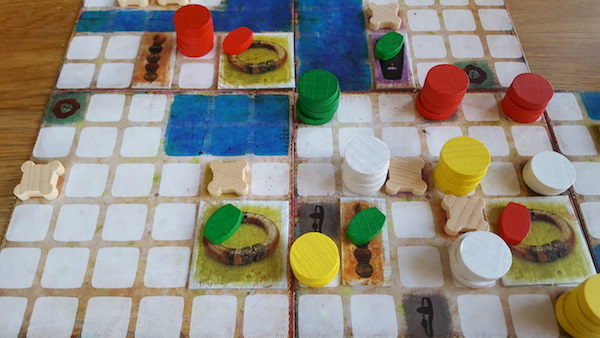
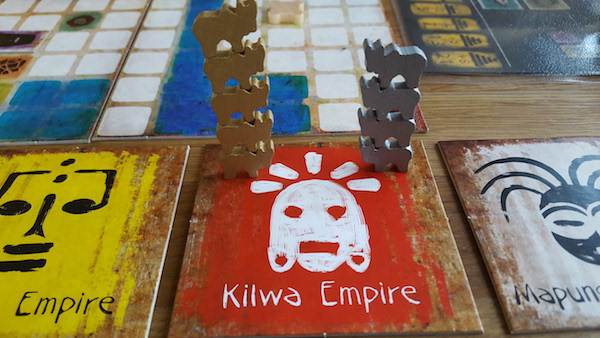
The LimitsNaturally, this economy does not have unlimited assets so let us continue by looking at the costs and the other limits of the zimbabwian economy. Thematically, all prices are paid in heads of cattle.
The Basic ChallengesThis simple economy sets the stage for an interesting interaction between the players. You must ensure that you have access to both cattle and craftsmen to upgrade your monuments. Perhaps you want to place a craftsman that only you can reach to secure goods? Perhaps you want to place a craftsman within reach for the other players to secure cattle? Or perhaps you will focus only on craftsmen or only on monuments? The designer could have stopped here and have a simple, almost solvable, puzzle. But no, he decided to throw just the right amount of spanners in the works to make the game more challenging. The Additional ChallengesThe Increased Victory RequirementsThe victory requirements are not fixed but can change during the game and be different for different players. One example (and more will follow) is the acquisition of a technology, which is a prerequisite for placing certain craftsmen. The technology is free but it increases the number of victory points you need to win. This adds some interesting challenges. First, you can choose between a "cheap" strategy (ignore the "engine" and keep the victory requirement low) or an "expensive" strategy (build an "engine" and accept that the victory requirement will be harder to reach). Remember that the bulk of your victory points will come from monuments and although higher monuments increase your score exponentially, so will their cost since they require more unique resources. Second, it's harder to tell who is in the lead. Is it the player who scores little every turn and is close to the low victory requirement or is it the player who scores a lot every turn but is far away from the high victory requirement? Or, in gamer language, who can you afford to help and who should you screw? 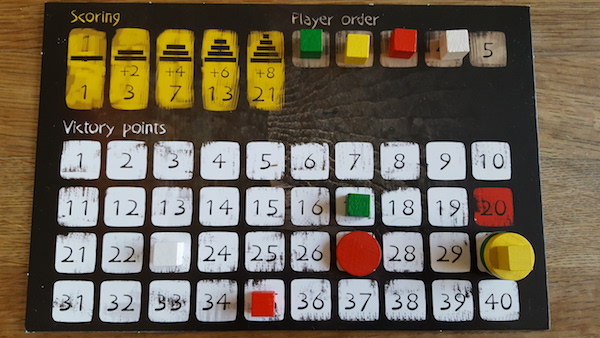
The PricesThe prices of the craftsmen's goods are not fixed but rather set by the players to a value between 1 and 3. This is supply and demand in its purest form. What will you earn the most from, low price and high volume or high price and low volume? At what price will your benefit from cattle be greater than your opponents' benefits from goods? And what happens if an opponent places a competing craftsman? To make your decision even more agonizing, once set prices can only be increased, never decreased. The Secondary CraftsmenDo you think that games like Power Grid and Santiago, where you can deny opponents resources, are evil? Then you haven't met the secondary craftsmen of The Great Zimbabwe. A secondary craftsman will use a resource AND a good from another ("primary") craftsman. To make a more valuable good? No, to make goods from the primary craftsman useless for monuments! A well placed secondary craftsman can make goods more expensive and/or rarer and completely cripple another player's economy. So much for product development! 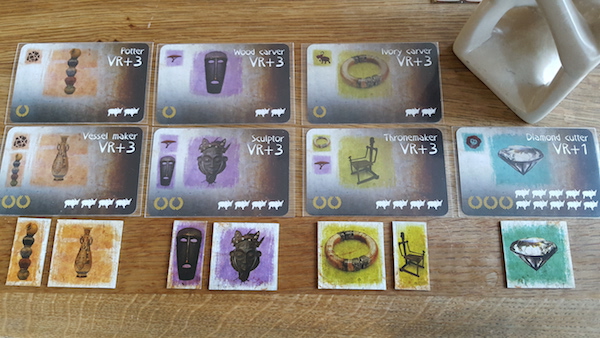
The BiddingGiven that the resources are limited each round, turn order is important so naturally there is a game around that as well. However, the bidding of The Great Zimbabwe is not only to reward the highest bidder but also to distribute cattle between the players. It accomplishes this by having the bids placed on certain spaces (1st cattle on 1st space and so on) and give back the cattle to the players afterwards (1st space to the highest bidder and so on). Do you really want to bid high, knowing that most of your bid will end up with other players afterwards? Did I say that The Great Zimbabwe was evil? The Specialists and the GodsI'm not a fan of cards in games. They often dictate your strategy randomly and lead to a gameplay where players look more at card tableaus than the board. But not so in The Great Zimbabwe. First, the cards are limited - only 5 specialists and 8 of 12 gods are used in a game and known to all players in advance. Thus, their potential influence on the game is transparent and predictable. Second, the cards are not random but rather chosen by the players themselves (at a cost of increased victory requirements). Thus, you can adapt your strategy to your choice of a specialist and/or a god and vice versa. Third, given the interlocked economy, the other players' choices will have a profound impact on the gameplay and something that you must take into account in your own strategy. 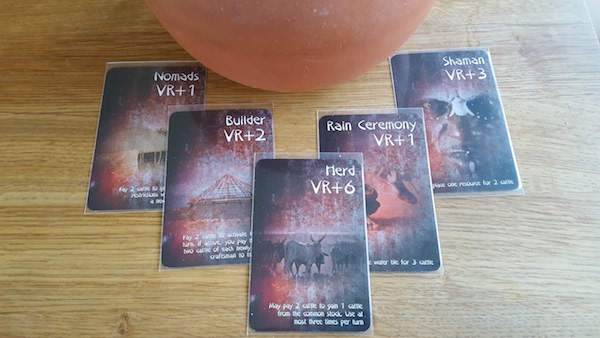
Let's look at some examples:
The result is that the presence or absence of a specialist or a god can drastically change the game from play to play. New players are spared the surprise of a god unknown to them while experienced players are rewarded by knowing how a god known to all players may impact the game. In my book, this is an example of cards done right in a game. 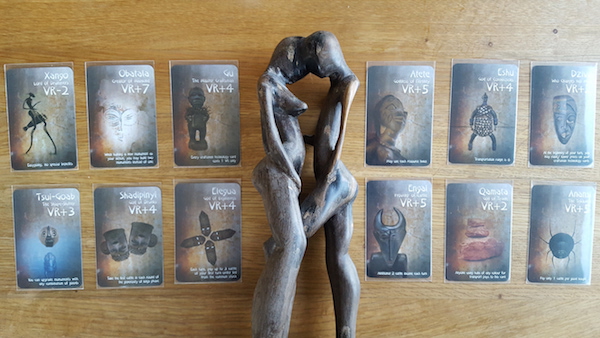
So what's on a Player's Mind?There is a lot to think of in a game of The Great Zimbabwe. First, we have the bidding. If I bid high, will I have enough cattle left to do what I want to do on the board? If I bid low, will there be enough left for me to do on the board after then other players have taken their turns? Second, we have the choice of a god and/or a specialist. Which powers are good in this particular game and are they worth the increased victory requirement? Perhaps I should wait one more round before I decide, but what they are snatched by another player before then? Third, we have the choice between craftsmen or monuments. If I choose craftsmen, should I help myself to cattle (from the other players using my craftsmen) or goods (by using my craftsman myself)? If I choose monuments, I increase my score in the short term but will I have enough cattle to upgrade them in the long term? Fourth, if I choose craftsmen, which should I choose and where should I place him? Is proximity to many resources or many craftsmen best? Is a low price or a high price best? Which other craftsmen and prices are there on the board? Fifth, if I choose monuments should I focus on few large monuments or many small monuments? Few large monuments increase my score quicker but are there enough resources? Many small monuments are cheaper but is there enough time? Sixth, there is a question about which craftsmen and resources I should use. If I use my own craftsmen, I will get the money back next round. But perhaps it's more important to use craftsmen that other players need to deny them goods? Seventh, there is another question about when is the right time and where is the right place for a secondary craftsman. To give myself more cattle or goods that only I can get or to block other players from using primary craftsmen? Or both? Eighth, if I'm falling behind, how can I best wreck the economy for everybody else to catch up? (This is one of many things that I'm still learning.) So many things to think about, yet so little time - a game typically only last 6-8 rounds! The ComponentsFinally some words about the art. I hinted earlier that Splotter Spellen has often been bashed for poor components. Although the components of The Great Zimbabwe may be a bit flimsy, they do the job and the symbolic icons and images, based on authentic African art, is simply beautiful. I would certainly not trade the components for plastic miniature cattles. Final WordsGames are so often described as having interlocked mechanics and subtle interaction that the words begin to lose their meaning but The Great Zimbabwe manages to revitalize them. This is not a game about taking an action that perhaps another player wanted to take. No, this is a game of perfect information where everything that happens does so because of the players' actions. You cannot directly attack other players but you can "subtly" destroy their very foundations. Yet, all those mechanics are so well tuned and balanced that the game itself resists all attempts break it. As a designer, I can't help wondering how many hours of testing that went into The Great Zimbabwe to reach this perfection. Jeroen Doumen and Joris Wiersinga have created a masterpiece and I bow my head humbly. 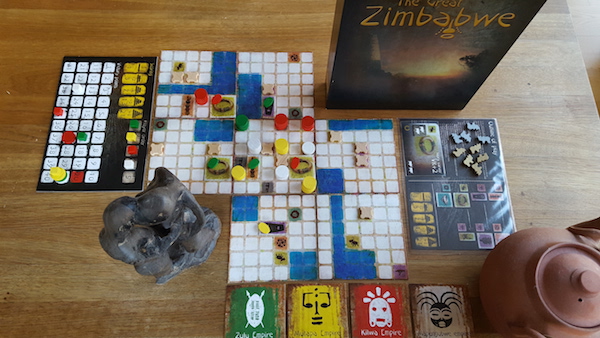
|
|