
 |
The Quest for the Perfect Game - Reviews to Extract the Essence of Games by Nicholas Hjelmberg | |


























|
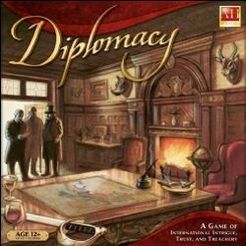
Diplomacy - The Art of Developing Trust to get what you Want and Destroying Trust when you got what you Want (Published 18 March 2019)This review has also been published at Boardgamegeek. IntroductionOne does not simply review Diplomacy. Diplomacy is so much more than a game, it's an institution. It revolutionzed boardgaming when it was released in 1959 and 60 years later its impact is still strong. Yet, Diplomacy was rejected by major publishers then and would perhaps have been rejected today, since many of its mechanics are shunned by modern boardgames. So why has Diplomacy become a classic that is likely to remain long after all the current top 100 games have crumbled to dust? This is the question that this review humbly seeks to understand. Let's start with the background. How it all beganDiplomacy was invented by Allan B. Calhamer in 1954 and self-published in 1959. According to Wikipedia, his inspiration originated from reading an article about the Congress of Vienna at the age of 13 and was reinforced by the book The Origins of the World War 8 years later. This is reflected in the game by the fact that although it looks like a game about the first World War, it's really about the diplomacy behind the scenes. Let's proceed by looking closer at how Diplomacy is played. 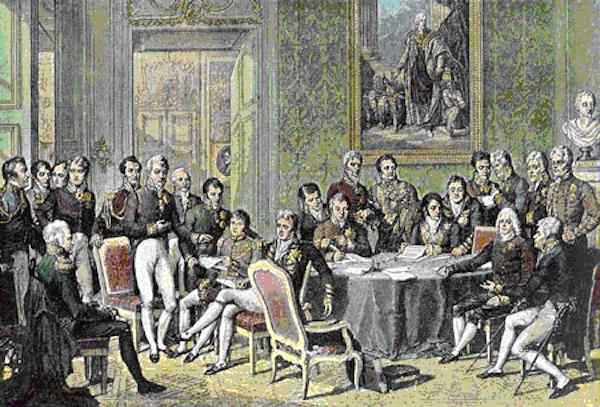
Early Diplomacy players at the Vienna Congress How the game is playedThe rules of Diplomacy are simple, almost banal. Diplomacy is played by up to 7 players on a simplified map depicting Europe in 1900. The map is territory-based with only two types of territories; 57 land provinces, 34 of which are so called supply centers, and 19 sea provinces. 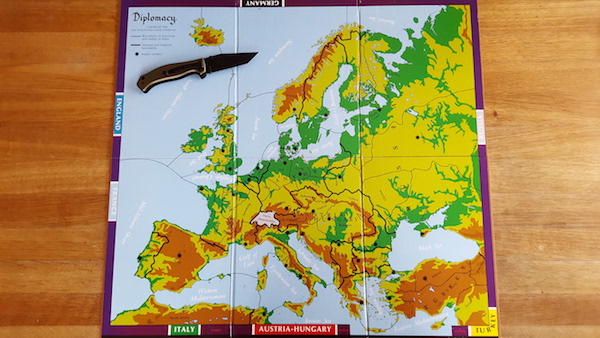
The peaceful Europe before the storm The number of unit types is also two; land units (armies) and sea units (fleets). A unit may only move one territory at the time, land units on land provinces and sea units on sea provinces and coastal provinces (land provinces adjacent to sea). There is also a convoy rule, which allows fleets to act as "bridges" for one land unit, which may then move across several sea provinces (but they must still end the move in a land province). Each unit has a combat value of 1. If an attacking unit has more total combat value than a defending unit, the latter must retreat. However, each province may only hold 1 unit so to increase the combat value beyond 1, adjacent units must give a support order rather than a move order. 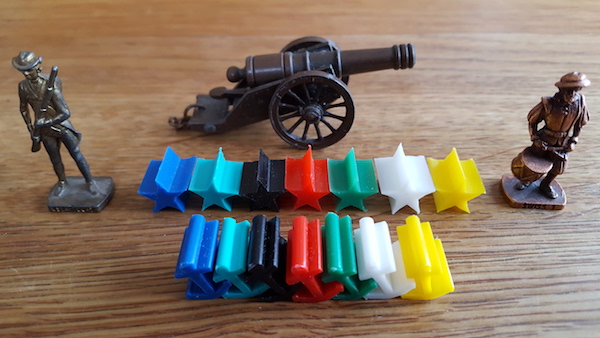
The colorful uniforms of the European powers (England blue, France teal, Germany black, Austria red, Italy green, Russia white, Turkey yellow) The three types of orders in the game (move, convoy or supply) are issued secretly and simultaneously, meaning that each player writes down orders for each unit, after which they are revealed and resolved at the same time. 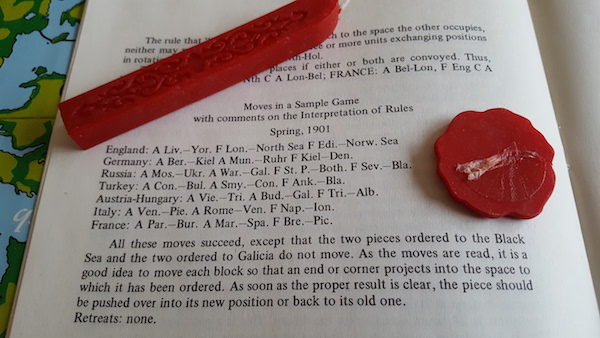
The cryptic orders of Diplomacy - A Liv-Yor means Army Liverpool to York etc. Each player starts with 3 units (or 4 units in the case of Russia). Every second round ("Fall"), each player's number of units are checked against the number of supply centers and units are added or discarded accordingly. A player wins by taking control of more than half of the supply centers. 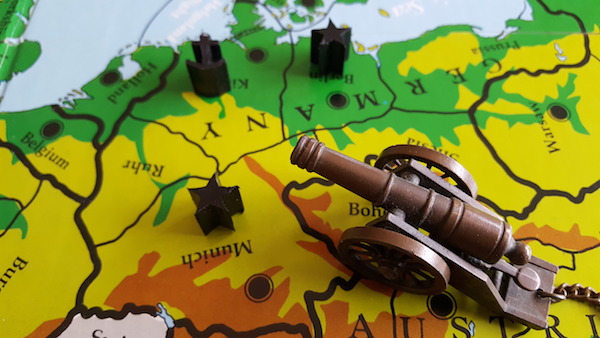
Germany mobilized for a game of Diplomacy with 2 armies and 1 fleet That's basically it. There are some special rules concering the disruption of support that won't be covered here. (Supporting units have their support cut if attacked but if the support targets the attacked unit, the support is not cut, but if the attacked unit forces the supporting unit to retreat, the support is cut and so on.) 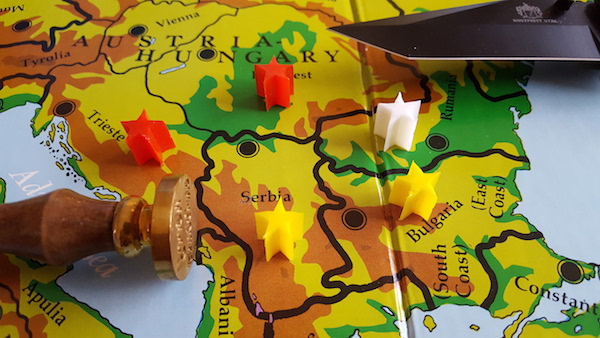
A Turkisk attack from Serbia to Budapest won't cut the Budapest army from supporting Trieste to Serbia BUT if Russia supports the Turkish attack, the Budapest army is forced to retreat and the support is cut Now one might wonder how military can win you a game of Diplomacy when you're outnumbered 1 to 6 at the start. The simple answer is you can't. You have to win with diplomacy in the metagame that Diplomacy really is. How the metagame is playedThe act of writing and resolving orders each round is a minor part of a game of Diplomacy. Instead, it's the talk between rounds that's important. Although the players issue move orders to their own units, they may support or convoy other players' units. Thus, to make military progress, you will need diplomatic skills. But say that you play England and want France's support for an attack against Germany, which resources do you have at your disposal? Money? Arms? Formal agreements? No, you have nothing but your word. There are no limits as to what you may promise but there are also no requirements to fulfil your promises. As a matter of fact, the key to winning Diplomacy is to know when to break a promise (or, using the Diplomacy expression, when to stab). Some typical agreements in Diplomacy include a demilitarized zone in a sensitive border province, an allocation of neutral territories into spheres of interest, and an alliance to bring down a third party and divide the spoils afterwards. Does it sound familiar? If so, you may agree that Diplomacy very well simulates world politics. It's probably no surprise that politicians like John F. Kennedy and Henry Kissinger are said to have been fans of Diplomacy. 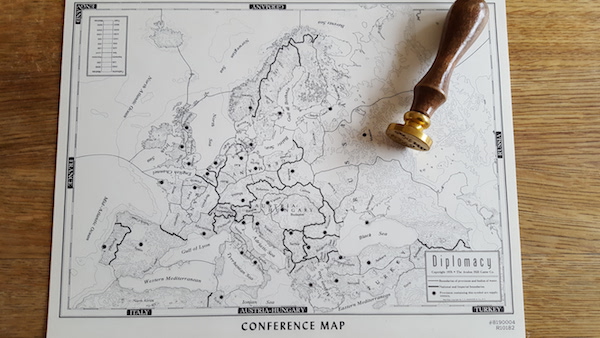
Where the real actions take place - the conference maps used at negotiations away from board Now that we know how Diplomacy is played, let's see how it's played well. The tactical gameAs we've seen, Diplomacy differs from the ordinary war game in many respects. The units are generic with no particular combat values or abilities, as is the terrain with no impact on combat. The combat resolution is deterministic with no randomness and the unit positions are known to everybody without any fog of war. In fact, the tactical Diplomacy has more in common with abstract games like Chess than war games. As a military commander, your mind isn't occupied with questions as which kind of units to put up against particular enemy units or how to best make use of a particular terrain. Instead, it's a pure mathematical affair where you assess which parts of the frontier that are critical and count how much strength you need to defend or break through there. The simultaneous combat resolution means that you'll also have to predict your opponent's actions in a rock-paper-scissors way. This game is not without its merits. There are many tactical tricks to learn, such as the "self-bouncing" to defend three areas with only two units, or the involuntarily support to enemy units to counter the said self-bouncing. However, once you've learnt them, there's not much depth left. Chess offers more pieces with more movement variety than Diplomacy and hence offers more depth to explore. The limits of the Diplomacy units make them rather inflexible and likely to get stuck along fixed frontiers with no prospects of breaking through. A two-player game of Diplomacy between two reasonably skilled players will most likely lead to a stalemate. Although this mirrors the First World War that the game is based upon, it makes the game itself dull. But if this is the case, perhaps the strategic options arising from the multi-player Diplomacy helps us to understand more of Diplomacy's appeal. 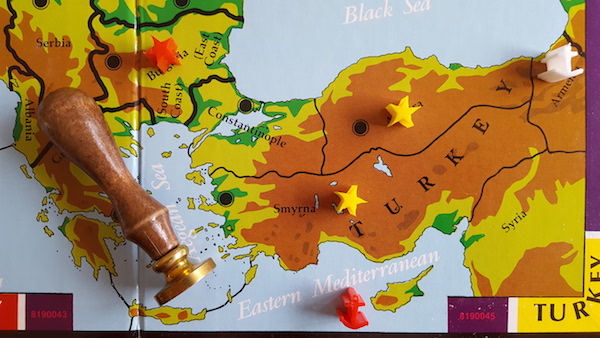
The two Turkish units may defend against the three enemy units by ordering both armies to Constantinople and "self-bounce" (unless Austria anticipates it and supports one of them) The strategic gameThe presence of other players, in combination with the secret negotiations and simultaneous order resolution, makes the strategic game more interesting than the tactical game. An opponent move may not be what it appears to be, a shift in alliances may turn the tide of the war, even a player with a single unit left may have a role to play if it occupies a vital position. A classic example is where an Italian unit crosses the Austrian border in the first round, only to proceed to the Balkans in the second round in the Key Lepanto Opening directed against Turkey. 
Italians on a temporary stop on their way to Turkey - or have they come to stay? The strategic game and the tactical game have a curious relation in Diplomacy. Usually, tactics is a mean to accomplish a strategic goal, but in Diplomacy, tactical goals may dictate strategies. Say that you play England and have an alliance with France. The Kaiser offers a strong resistance on the Western frontier while Russia and Turkey runs a juggernaut in the East. In a strategy > tactics game, you would solve the problem by trying different tactics to break through (and probably end up with Field Marshal Haig's testimony). But in a tactics > strategy game, you would perhaps come to the conclusion that the tactical opportunities against France are better and promptly change your strategic goal (and probably end up with Brutus' testimony but hey, all's fair in love and war). 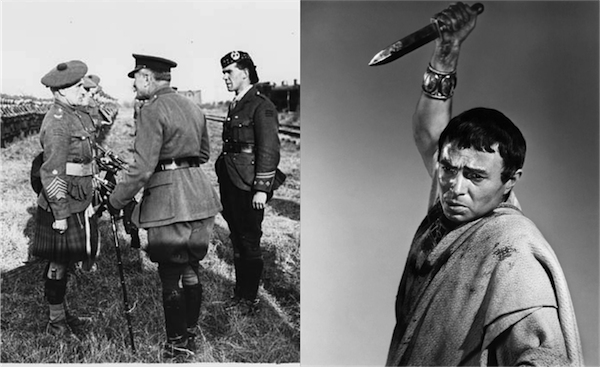
One dagger is stronger than a million men This sounds very well but can't you play the same game in a more complex war game, or even in the simple RISK, for that matter? Before answering this, we need to examine how to play the third sub-game well, the diplomatic game. The diplomatic gameIf you thought your tactical and strategic resources are limited, your diplomatic resources are next to nothing. As discussed above, you have only your word at your disposal. However, by knowing what to say when is the key to master the diplomatic game. Basically you play different roles during different stages of Diplomacy. In the early game you may play the deal-maker, aiming at finding mutually beneficial deals that helps both parties to expand. Are several players interested in the Balkans? Find a deal that satisfies all of them rather than fighting and benefitting only your neighbors. In the mid-game you may play the rhetorician, pointing out which players to sacrifice so that the other players can continue to expand. Are the Balkans big enough for all of you? Find the arguments to point out which player to kick out and make sure it's not you. In the late game, you may play the liar, stabbing your trusting ally when he or she least expects it and is hurt the most of it. This shows that the diplomatic game does offer some challenges in spite of its limited resources. But is this enough to make the diplomatic game more interesting than other negotiation games? Why not play Avalon instead for a pure negotiation game or The Republic of Rome for a more complex negotiation game? The surprising answer to this question is found when we combine those three seemingly shallow games. 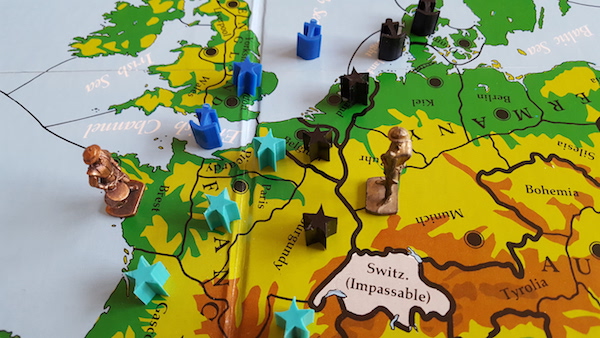
All Quiet on the Western Front How three shallow games make one deep gameOur ambition to break down Diplomacy into its three sub-games of tactics, strategy and diplomacy hasn't managed to reveal what differentiates it. Each sub-game is simple and offers little extra compared to games like Chess, ordinary war games and pure negotiation games. However, the fact that each sub-game is simple distills the diplomacy game experience to the one and only thing that really matters: TRUST. The tactical game prevents you from playing solitaire while the strategic game encourages you to cooperate. Since both those games are deterministic, you can predict the exact outcome of a certain set of moves. You won't be distracted by die probabilities and you can't blame bad luck. If you lose a battle, you can only blame the human factor. If you lose the war, you lose it because others were more trustworthy than you. Thus, the diplomatic game is not about conferring HOW to attack, it is about gaining and building trust so that the answer to the question of WHOM to attack will be another player. This is further strengthened by the simultaneous order resolution. You can't wait for your partner to reveal his or her intentions first, you have to reveal them at the same time. Do you trust your partner enough to turn your back? And if you didn't, how can you regain your partner's trust? The diplomatic game in the corridors may be full of lies and deceptions but the tactical and the strategic game on the map will always tell the truth. Or will it? The map serves as a focal point around which the diplomatic revolves. Not only do you have to win the diplomatic battles before the order resolution but also afterwards. How should a certain order be interpreted? Did Italy really stab Austria or are they preparing the previously mentioned Lepanto? Was the Kaiser lucky to find the only combination of orders that saved the Reich or is there a traitor in your alliance? You have to make sure that your interpretation becomes the accepted one. A military victory is worth nothing if it's accompanied by a loss of trust. Unless, of course, you follow the golden rule of Diplomacy to stab only when your victim can't retaliate. So is everything great?Certainly not! Diplomacy uses two of the most disliked mechanics in the gaming world: take that and player elimination. To single out players and eliminate them is not merely a side-effect of the game, it's the purpose of the game. Without those mechanics, the tension would be completely lost. Thus, the infamous label "Destroying Friendships since 1959" isn't just a joke, it's a most appropriate warning - Diplomacy is not for sensitive players and shouldn't be either. Other challenges include the by modern standards clunky order resolution. Experienced players will quickly asses the board state and move the units accordingly but beginners may be intimidated by the book-keeping and the downtime. Even longer is the downtime between order resolutions, 15 minutes according to the rules (30 minutes for the first round), which of course sums up to a very long game. Again, experienced players will want to talk to everybody every round and find this time too short, but beginners with bad positions may perceive this as prolonged agony. My advice here is to keep talking to everybody because your game isn't over until your last unit has been eliminated. 
Destroying friendships since 1959, courtesy of BGG user leroy43 A case studyWords alone cannot give justice to the experience of playing a game of Diplomacy but a case study may at least give a hint. This game was my first distance game of Diplomacy, with diplomacy by phone and orders issued through a game master. This was also a time when the dominant strategy in my gaming group was for the four border powers England, France, Russian and Turkey to divide the central powers Austria, Germany and Italy. Thus, the game master almost apologized when he revealed that poor Austria had fallen to my lot. 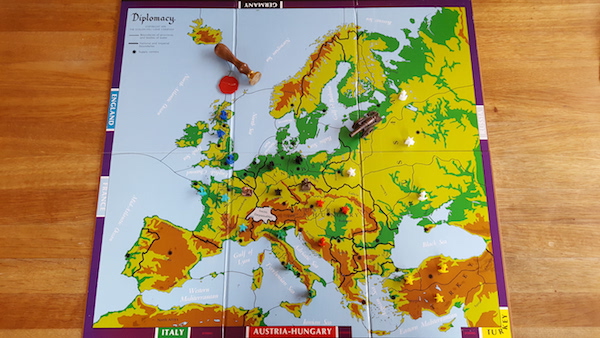
The beginning of a game - Let's all be friends Nevertheless, I did what I could and talked to everybody. With Germany, I signed an agreement to form the permanent alliance of the Grand German Empire, signed with a formal agreement and everything. (My group was also into role-playing games at this time.) With Italy, I signed another agreement to divide the Mediterranean Sea into a Western Italian and an Eastern Austrian sphere of interest. With England and France, I formed information agreements to share information about our respective military arenas. I also hinted rumours about Russian and Turkish plans against Black Sea and warned the two Eastern powers for each other. Of course I would assist one against another in case of a conflict. With that, I had hopefully secured my Northern and Western borders and issued orders for march against the Balkans while Russia and Turkey fought each other. Now followed a period of agony until the order deadline. The revelation was a surprising success. All the other moves went as planned and the Balkans fell into my hands while Russia and Turkey were still too entangled to make peace. As agreed with Germany, I focused on Turkey while the Kaiser (who was equally fortunate to see England and France fighting each other) focused on Russia. However, while Turkey turned out to be a stubborn enemy, Russia fell into pieces as through a premature Russian Revolution and Germany reached Moscow while I still struggled to cross the Bosporus. Naturally, I urged England and France that they should unite against Germany (a good ally is a weaker than you ally) but to no avail and when France slipped into the Mediterranean, I got nervous that Italy may reconsider our alliance. Thus, I preceded the events and marched into Italy, claiming that Italy hadn't fulfilled her obligations. Things went very well and Italy vanished from the map in no time. It was now time to promise England and France support against Germany (but not until I had rid myself of the dangerous Ottoman of course) and province by province I caught up with Germany. As Turkey finally fell and the Kaiser expected us to declare a shared victory, I promptly replied by crossing the border and claiming the victory myself. 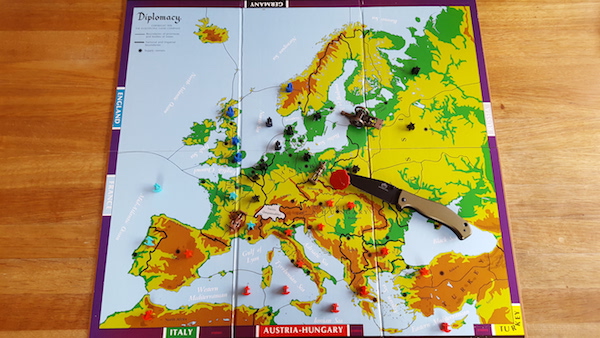
The end of a game - It's not you, it's me ConclusionThe secret behind Diplomacy's greatness is the balance between the war game in the game and the diplomacy game in the game. They both need each other to be interesting; the diplomacy game is interesting in the light of the war game but the war game is simple enough not to compete with the diplomacy game. The challenge of building, maintaining and (if necessary) regaining trust creates a game full of tension and uncertainty up to the moment of truth when the orders are resolved (but even then, players may offer different interpretations of the truth). Diplomacy is certainly not a game for everybody but it should be played by everybody at least once to experience the art of diplomacy at its worst. 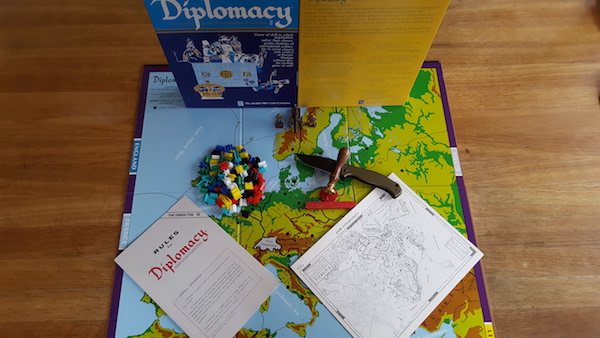
|
|