 |
Home | Game | Rules | Theme | Strategy | FAQ |  |





























|
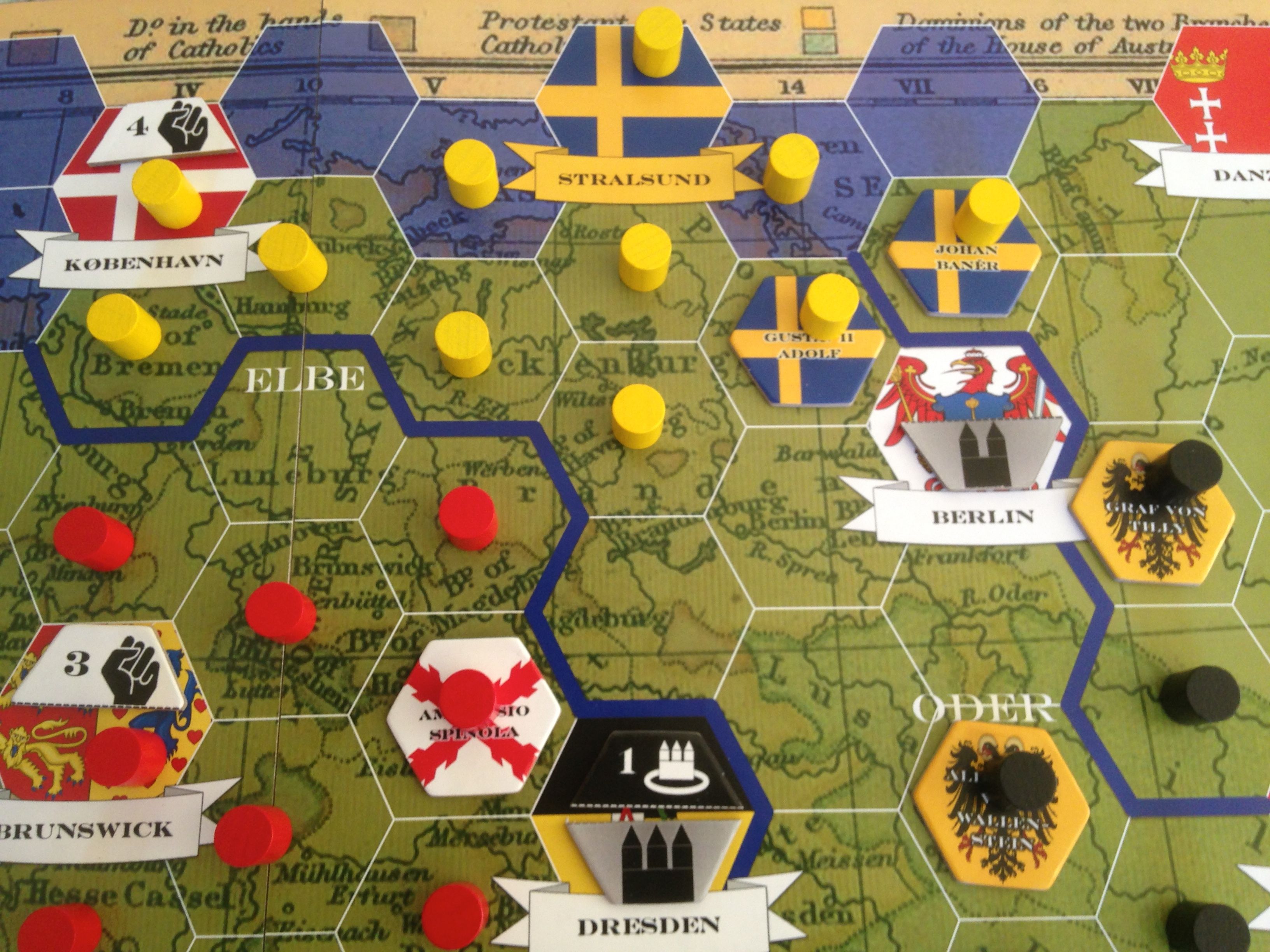
Bellum se ipsum alet - Conquest and Devastation© is the second game in the Nova Suecia series. The players take on the roles of commanders during the Thirty Years' War and have to fight not only each others on the battle field but also the devastation that follows the war. Bellum se ipsum alet is a tactical game but unlike many others in the genre, the resources are not unlimited. The players must continuously feed their armies by storming and occupying cities but the cities will continuously fight to free themselves and for each new occupant, there will be less to plunder. Add to this a battle system where the players need to balance between wasting soldiers to win the battle and saving them for next battle. Each player must thus find a way to make best use of the scarce and diminishing resources at hand and deliver the deliver the final blow at the right place at the right time.
"There is something philosophical about Bellum se ipsum alet. The presence of your influence tiles on the game board gives a clear visual indication of your power. However, soon holes will start appearing behind you, ever forcing you forward. Movements are slow but their impact vast as hexes and cities switch owners and every little movement will be closely monitored and evaluated by your opponents. Is it best to attack first or wait and move in when the others have weakened themselves? Or will it be too late? The player who understands this will also win the war." (Boardgamegeek) "Looks good, I'm hoping, a curious and compelling weuro (euro-wargame). Haven't played yet. Rules not hard, carefully written and professionally presented, but I think missing a couple sentences of explanation. I might be wrong though. Either way, I think I could figure it out. Took me extra effort to see that Siege and Resistance "levels" aren't so much levels as year indicators. In that respect I think symbols would be more clear than numbers. (Numbers implied to me a math process of some simple kind, an increasing or decreasing force, when really they are year signposts.) Once I understood it seems so easy now. I appreciate that the high-altitude weuro includes supply rules, almost a must for any wargame. The placing of influence reminds me of an abstract game, but with sieges, battles, cities as NPCs, and hovering black-cowled Death. How will it play? Don't know, hopeful! Curious about the player dynamics... If the players do too much damage to the cities, no one will win except the war. The designer I think is one to watch. Acquired Oct 2014." (Boardgamegeek)
Nicholas Hjelmberg, Stockholm, Sweden 

|
Order at The Game Crafter
Presentation (Video)
Summary (PDF)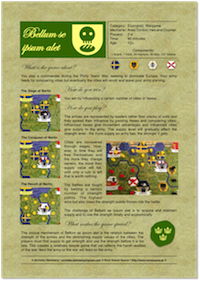
|
|||||||||||||||||